Equestrian Apparel Design and Manufacturing Guide
Equestrian Apparel Manufacturing begins with understanding how a rider moves, where garments experience pressure and friction, what the discipline requires, and how the finished clothing must perform both on and off the horse. Riding apparel may appear similar to conventional sportswear, but products such as breeches, show jackets, riding shirts and gloves have specific requirements related to saddle position, hip and knee movement, grip, boot interaction, competition presentation and extended wear.
Successful equestrian apparel is therefore not created by styling alone.
A technically strong product combines design, pattern engineering, appropriate fabrics, stretch and recovery, functional construction, disciplined branding and controlled sampling. The manufacturer then needs to reproduce those approved details consistently during bulk production.
For brands, retailers, wholesalers and riding businesses, understanding Equestrian Apparel Manufacturing before ordering can reduce avoidable sample revisions and help create a collection that is commercially consistent as well as suitable for riding.
BUSHI Sports® supports equestrian brands through custom equestrian gear manufacturing, including product development, material selection, samples, OEM, ODM, private labels and bulk production.
Table of Contents
- What Makes Equestrian Apparel Different?
- Start With the Rider and Discipline
- Build the Product Architecture
- Design for Riding Movement
- Select Technical Fabrics
- Develop Fit and Size Specifications
- Engineer Grip, Pockets and Functional Details
- Choose Stitching and Construction
- Prepare a Production Tech Pack
- Develop and Test Samples
- Branding and Private Label Development
- Quality Control and Bulk Manufacturing
- Competition and Market Requirements
- Equestrian Apparel Manufacturing Process
- Common Development Mistakes
- Frequently Asked Questions
What Makes Equestrian Apparel Manufacturing Different?
Equestrian Apparel Manufacturing combines elements of performance sportswear with the specific biomechanics and equipment interaction of riding.
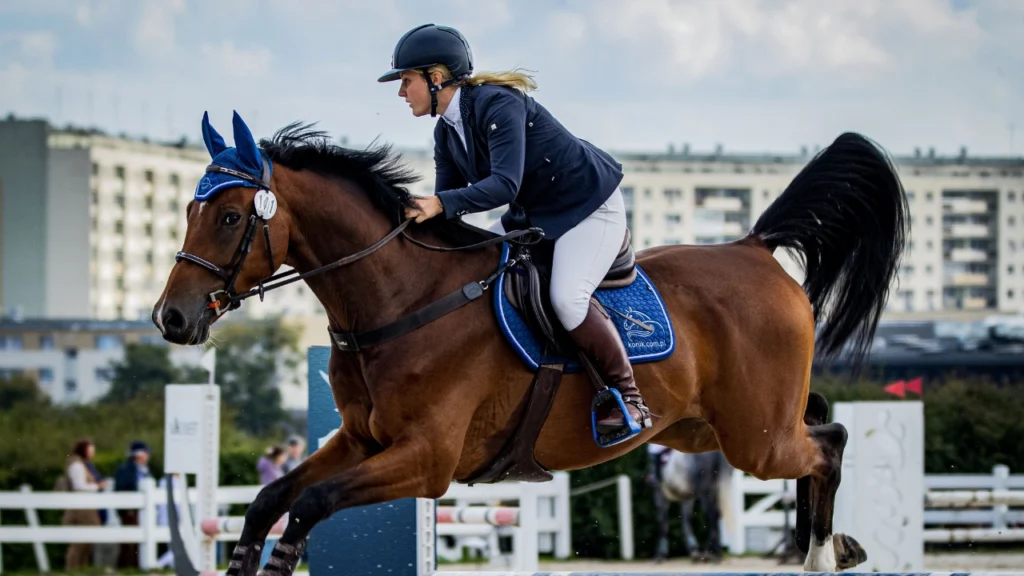
A rider spends considerable time in hip and knee flexion. Breeches remain in contact with the saddle and the inside of the rider’s leg. Tall riding boots can place additional pressure around the lower leg. Show jackets need to maintain a structured appearance while allowing the shoulders and arms to move naturally.
The product must also remain comfortable while the rider walks, bends, mounts, dismounts and performs stable work.
This creates several design priorities:
- Freedom through the hips and knees
- Controlled fabric stretch and recovery
- Low-bulk seams in contact areas
- Secure waistbands
- Suitable grip placement
- Abrasion resistance
- Breathability and moisture management
- Practical pockets
- Comfortable interaction with riding boots
- Professional appearance
- Reliable shape retention
The balance between these factors changes according to the product.
Breeches may place greater emphasis on stretch, opacity and saddle grip. A show jacket requires more structure. A summer riding shirt may prioritize lightweight moisture management. Riding gloves need rein control and hand mobility.
That is why professional Equestrian Apparel Manufacturing starts with product use rather than applying one fabric and construction formula across an entire collection.
Equestrian Apparel Manufacturing Starts With the Rider
Before creating technical sketches, identify the rider.
A dressage-focused brand may need different styling and fit priorities from a show-jumping collection. Recreational training garments have different requirements from competition apparel. Youth riders, riding schools and premium private-label customers can also require different size systems, materials and price points.
The product brief should establish:
| Development Question | Example Decision |
|---|---|
| Riding discipline | Dressage, jumping, eventing, schooling |
| Product use | Competition, training, lifestyle |
| Target customer | Women, men, youth, unisex |
| Climate | Warm, temperate, cold |
| Price position | Value, mid-market, premium |
| Fit direction | Compression, athletic, tailored, relaxed |
| Main feature | Grip, ventilation, structure, flexibility |
| Sales market | USA, UK, EU, international |
Competition apparel deserves additional research before design approval.
For example, the current May 2026 US Equestrian dressage attire guidance allows white, light or dark breeches or jodhpurs, while also defining rules for riding jackets, shirts, neckwear and permitted styling. Brands producing competition apparel should therefore check the rules that apply to the rider’s actual federation and discipline rather than treating fashion trends as competition requirements.
Building an Equestrian Apparel Collection
A complete collection should have a clear product hierarchy.
A useful rider-focused range may contain:
| Product | Main Development Priority |
|---|---|
| Riding Breeches | Stretch, recovery, grip, opacity, fit |
| Riding Tights | Mobility, softness, lightweight support |
| Show Jacket | Tailoring, shoulder movement, presentation |
| Show Shirt | Breathability, collar structure, comfort |
| Training Shirt | Moisture management, easy movement |
| Base Layer | Stretch, next-to-skin comfort |
| Riding Gloves | Rein grip, dexterity, palm durability |
| Full Chaps | Fit, durability, closure system |
| Half Chaps | Lower-leg fit, abrasion resistance |
Brands do not necessarily need to launch all of these products together.
For a new company, a controlled assortment of breeches, a technical riding shirt and gloves may provide a more manageable entry point than a large collection with multiple fabrics and complicated size ranges.
The BUSHI Sports® guide on starting a private label equestrian brand explains how brands can structure an initial range before expanding into additional categories.
Designing Equestrian Apparel Around Movement
Good Equestrian Apparel Manufacturing requires the designer to think about the garment in a riding position rather than only standing posture.
A pair of breeches can look perfectly fitted while the model stands upright but pull excessively across the hip when the knee is raised. A jacket can hang correctly during a fitting yet restrict the shoulder once the rider reaches forward.
Pattern development should therefore account for movement.
Important fitting areas include the rise, hip, thigh, knee, inseam, waistband, shoulder, armhole and sleeve.
For close-fitting garments, fabric elasticity becomes part of the fit equation.
ISO 20932-1 provides a standardized method for measuring elasticity and related properties of textile fabrics using strip tests. The standard remains current following its latest ISO review.
Brands do not necessarily need to perform laboratory testing on every early sample, but measurable stretch requirements are far more useful than vague descriptions such as “very stretchy fabric.”
BUSHI Sports® provides additional comparison in its two-way versus four-way stretch fabric guide.
Equestrian Apparel Manufacturing and Fabric Selection
Fabric is one of the most influential decisions in Equestrian Apparel Manufacturing because it affects fit, comfort, appearance and durability simultaneously.
Typical options include:
Nylon Elastane
Suitable constructions can provide a smooth hand, high mobility and close body fit.
Nylon-elastane is frequently considered for riding tights and fitted breeches where flexibility and premium hand feel are important.
Polyester Elastane
Polyester-elastane can provide useful stretch, dimensional stability, efficient drying and consistent color performance.
It can be particularly suitable for training apparel and scalable private-label collections.
Brands comparing these fibers can review the BUSHI Sports® polyester versus nylon guide.
Cotton Stretch Blends
Cotton-rich materials can provide a traditional hand feel but should be evaluated carefully for drying, shrinkage and recovery.
Performance Interlock
Interlock structures can provide a smooth, stable surface suitable for riding shirts, breeches and certain structured performance garments.
Mesh
Mesh can be used selectively where ventilation is required, including underarms, side panels or other lower-abrasion zones.
Soft Shell
Soft-shell constructions may be useful for cooler-weather riding garments where wind resistance, structure and stretch are required.
The correct fabric should be chosen for the actual garment rather than because it is described as “premium.”
Fabric Performance Should Be Measurable
Equestrian Apparel Manufacturing benefits from measurable fabric specifications.
A fabric specification may include:
- Fiber composition
- GSM
- Knit or woven construction
- Stretch percentage
- Recovery
- Abrasion requirement
- Pilling requirement
- Opacity
- Moisture management
- Shrinkage
- Colorfastness
- Surface finish
Abrasion is particularly relevant in equestrian clothing because breeches repeatedly contact the saddle and rider’s inner leg.
ISO 12947-2 specifies a Martindale method for determining fabric specimen breakdown and remains a current standard.
Moisture-management claims can also be assessed objectively. AATCC TM195 measures and classifies liquid moisture-management properties of textile fabrics.
For riding breeches specifically, the BUSHI Sports® Horse Riding Breeches Fabric Guide covers stretch, grip, GSM, abrasion and fit in greater depth.
Fit Is a Manufacturing Specification
Fit should not remain a subjective description such as “slim” or “comfortable.”
During Equestrian Apparel Manufacturing, the intended fit should be converted into measurements and tolerances.
For breeches, a specification may include:
- Waist
- High hip
- Low hip
- Front rise
- Back rise
- Thigh
- Knee
- Inseam
- Outseam
- Ankle opening
- Waistband height
- Pocket position
Show jackets require another measurement system involving chest, waist, shoulder, back length, sleeve, armhole and garment balance.
The base size is developed first. Once the fit is approved, the pattern is graded into the required size range.
Brands should inspect more than one size before bulk manufacturing. A medium sample can fit correctly while grading errors create problems in XS or XXL.
Grip Engineering in Riding Breeches
Grip is one of the most recognizable technical features of equestrian apparel.
Common configurations include knee grip and full-seat grip.
Knee grip concentrates silicone or another gripping material around the inside knee. Full-seat grip extends across a much larger saddle-contact area.
The design decision involves more than selecting one of the two.
Brands should determine:
- Grip location
- Pattern
- Dot or line size
- Spacing
- Silicone thickness
- Coverage
- Color
- Adhesion
- Stretch compatibility
Heavy silicone coverage can change how the underlying fabric stretches.
A visually attractive grip pattern may also feel different once the rider is seated.
For this reason, Equestrian Apparel Manufacturing should evaluate grip on the completed sample rather than approving it only as digital artwork.
Functional Pockets and Details
Pockets should be designed around riding.
A phone pocket needs sufficient depth and security without placing excessive bulk in an uncomfortable area. Zipper placement should not interfere with saddle contact or boot interaction.
Other useful design details can include:
- Secure side phone pockets
- Hidden waistband pockets
- Ventilation panels
- Flexible ankle panels
- High-rise waistbands
- Belt loops
- Covered zipper areas
- Reinforced wear zones
- Reflective elements on training products
Every additional feature should have a purpose.
Professional Equestrian Apparel Manufacturing avoids adding technical-looking elements that increase cost without improving function.
Equestrian Apparel Manufacturing and Stitch Construction
The seam needs to work with the fabric.
Highly elastic fabric paired with an unsuitable rigid stitch can restrict movement or contribute to thread breakage.
Seam placement also matters because riders spend long periods seated.
Bulky or poorly positioned seams can create pressure around the inner thigh, crotch or knee.
Depending on the product, construction may use overlock, coverstitch, flatlock and other techniques.
BUSHI Sports® explains these methods in its sportswear stitching types guide.
Important areas to inspect include:
| Garment Area | Main Concern |
|---|---|
| Crotch | Stretch and seam security |
| Inner leg | Friction and bulk |
| Waistband | Recovery and stability |
| Knee | Flexion |
| Reinforcement | |
| Show jacket shoulder | Range of movement |
| Sleeve | Riding position |
| Hem | Clean finish and durability |
Prepare a Complete Tech Pack
Equestrian Apparel Manufacturing becomes much more controlled when design information is documented before sampling.
A tech pack normally brings together the design, measurements, materials and manufacturing details.
It can contain:
- Technical sketches
- Front and back views
- Fabric specification
- Color references
- Measurement chart
- Tolerances
- Stitching
- Grip artwork
- Pocket dimensions
- Zipper specification
- Logo placement
- Main labels
- Size labels
- Care labels
- Hang tags
- Packaging
BUSHI Sports® explains these components in its sportswear tech pack guide.
The stronger the technical information, the less the manufacturer needs to interpret.
A physical reference sample can provide additional value when an existing garment represents the desired fit, material or construction.
Sampling in Equestrian Apparel Manufacturing
Sampling connects the design file with real product performance.
The first sample should answer questions that cannot be resolved on a screen.
Does the breech waistband remain stable?
Can the rider raise the knee comfortably?
Does the jacket shoulder move correctly?
Does the shirt remain comfortable beneath a jacket?
Is silicone grip too aggressive?
Are the pockets accessible while riding?
Does the ankle sit smoothly inside a tall boot?
A sample should be evaluated while worn, and riding trials are valuable where practical.
BUSHI Sports® provides a structured sportswear sample approval checklist covering measurements, materials, construction, branding and final approval.
The approved sample should become the physical reference for bulk Equestrian Apparel Manufacturing.
Sample Review Table
| Check | Breeches | Show Shirt | Show Jacket |
|---|---|---|---|
| Basic measurements | Yes | Yes | Yes |
| Riding movement | Yes | Yes | Yes |
| Stretch recovery | Yes | Yes | As applicable |
| Opacity | Critical | Review | Review |
| Moisture comfort | Important | Critical | Important |
| Grip | Critical | N/A | N/A |
| Pocket access | Important | Optional | Optional |
| Shoulder mobility | Secondary | Important | Critical |
| Boot interaction | Critical | N/A | N/A |
| Branding position | Yes | Yes | Yes |
| Wash behavior | Yes | Yes | Yes |
Branding Equestrian Apparel Professionally
Branding should support the garment rather than dominate it.
Equestrian apparel often benefits from controlled, precise brand placement.
Options can include:
- Silicone logos
- Premium heat transfer
- Embroidery
- Woven patches
- Rubber badges
- Woven labels
- Custom zipper pulls
- Branded buttons
- Printed inside labels
A show shirt may use a small chest or collar logo. Breeches can carry subtle branding at the hip, waistband or thigh. A show jacket may use discreet embroidery or hardware.
The branding technique should also suit the fabric.
A rigid decoration method should not be placed across a highly extensible area without testing.
BUSHI Sports® provides more detailed comparisons through its sublimation versus embroidery guide and silicone badges versus woven patches guide.
Private Label Equestrian Apparel Manufacturing
Private-label development allows the finished products to carry the buyer’s own brand identity.
That can include custom:
- Fabric
- Colors
- Patterns
- Fits
- Silicone grip
- Logos
- Woven labels
- Care labels
- Hang tags
- Packaging
Brands planning a wider range can use the BUSHI Sports® Private Label Equestrian Gear Manufacturing Guide as the main production pillar covering OEM, ODM, MOQ, materials, sampling and quality control.
MOQ also needs to be considered during design rather than afterward.
Custom fabrics, special colors, molded components and unique packaging may each have their own supplier minimums. The BUSHI Sports® Custom Equestrian Gear MOQ guide explains how product quantity, sizes, colors and material minimums interact.
Quality Control During Equestrian Apparel Manufacturing
Quality control should protect the approved product standard throughout manufacturing.
Incoming materials should be checked against the approved fabric and color.
During production, measurements and construction should be checked before large quantities progress too far.
Final inspection can review:
- Measurements
- Fabric shade
- Seam quality
- Grip positioning
- Logo dimensions
- Embroidery
- Heat transfers
- Zippers
- Pockets
- Labels
- Loose threads
- Surface defects
- Packing quantity
The goal is repeatability.
A strong first sample has little commercial value if bulk Equestrian Apparel Manufacturing does not reproduce it consistently.
BUSHI Sports® explains the broader process in its sportswear quality-control guide.
Competition Rules Should Influence Apparel Design
Competition clothing needs another layer of review.
Designers should confirm the current rules for the relevant discipline, federation and market before finalizing competition products.
For example, the 2026 USEF dressage attire booklet includes requirements and permitted options for jackets, breeches, jodhpurs, shirts, neckwear and other attire.
Competition requirements can change, and different organizations do not necessarily use identical rules.
Equestrian Apparel Manufacturing for competition therefore needs to separate two questions:
Is the garment technically suitable for riding?
Is it permitted in the competitions where the customer intends to use it?
Both matter.
Textile Labeling and Market Compliance
Private-label apparel also needs appropriate product information.
In the European Union, textile products marketed to consumers generally need labels or markings identifying fibre composition. EU guidance also addresses how fibre information should be presented and language requirements in markets where products are sold.
Brands can review the official EU textile labeling guidance when preparing products for that market.
BUSHI Sports® also provides a practical sportswear care labels guide.
Product requirements vary by market, so brands should confirm the rules that apply to their specific products and destinations.
Product Data Is Becoming More Important
Equestrian Apparel Manufacturing is also becoming more data-driven.
The European Commission currently identifies textile apparel as a priority product group under the ESPR Working Plan 2025–2030 for future ecodesign requirements and Digital Product Passport development. The exact textile-specific requirements will be defined through future delegated legislation.
This increases the value of organized manufacturing records.
Brands should maintain accurate information on:
- Material composition
- Supplier references
- Product identifiers
- Care information
- Manufacturing specifications
- Approved components
- Label information
- Production revisions
This documentation is useful for quality control and repeat orders even when no regulatory requirement applies.
Equestrian Apparel Manufacturing Process
| Stage | Main Activity |
|---|---|
| 1. Brand Brief | Define rider, discipline, market and price |
| 2. Design | Create technical concept and product features |
| 3. Tech Pack | Document measurements, materials and construction |
| 4. Material Sourcing | Select fabrics, trims and grip systems |
| 5. Pattern Development | Build base pattern around intended fit |
| 6. First Sample | Convert specification into physical garment |
| 7. Fit Testing | Evaluate movement and riding position |
| 8. Revision | Correct measurements, construction and details |
| 9. Size Development | Grade and review additional sizes |
| 10. Final Approval | Lock materials and specification |
| 11. Bulk Production | Cut, sew, finish and brand garments |
| 12. Quality Control | Verify bulk against approved standard |
| 13. Packaging | Apply labels, tags and packing requirements |
| 14. Shipping | Prepare international or domestic dispatch |
Professional Equestrian Apparel Manufacturing becomes easier to control when each stage has a clear approval point.
Common Equestrian Apparel Development Mistakes
Designing Only for Standing Fit
The garment needs to work in riding posture.
Choosing Fabric Only by Composition
Fiber percentage does not define stretch, recovery, opacity or durability.
Adding Too Much Grip
More silicone does not automatically create better riding performance.
Ignoring Size Grading
One approved medium sample does not guarantee that the full size range fits correctly.
Using Fashion Pockets Without Riding Tests
Pocket position should be evaluated while seated in the saddle.
Approving Branding Separately From Fabric
Logos and transfers need to stretch and wash with the garment.
Skipping Physical Samples
Digital artwork cannot demonstrate mobility, hand feel or saddle interaction.
Changing Materials After Approval
A replacement fabric can change fit and performance even when it looks similar.
Ignoring Competition Regulations
Competition products need to satisfy the applicable discipline and federation requirements.
Frequently Asked Questions About Equestrian Apparel Manufacturing
What is Equestrian Apparel Manufacturing?
Equestrian Apparel Manufacturing is the technical development and production of clothing designed for horse riders, including breeches, riding tights, show jackets, shirts, gloves, chaps and related apparel. It combines apparel design with riding-specific fit, fabrics and construction.
What fabrics are suitable for equestrian apparel?
Polyester-elastane, nylon-elastane, cotton stretch, interlock, technical mesh, soft shell and other performance materials may be appropriate depending on the product. Fabric should be selected according to stretch, recovery, durability, climate, fit and intended use.
Why is four-way stretch useful for riding breeches?
Riding creates movement in several directions through the hip, seat and knee. Four-way stretch can improve mobility, but recovery and garment fit remain equally important.
How are riding breeches different from ordinary leggings?
Riding breeches need to account for saddle contact, inner-leg friction, grip, boot interaction, riding posture, waistband stability and repeated knee flexion. Their design should therefore be developed specifically for equestrian use.
What should be included in an equestrian apparel tech pack?
Include technical drawings, fabric, colors, measurements, tolerances, stitching, trims, grip artwork, branding, labels, size information and packaging requirements.
Should equestrian clothing be sampled before bulk production?
Yes. Sampling allows the buyer to evaluate material, fit, movement, grip, measurements, branding and construction before those details are repeated in bulk.
How should show jackets be tested?
Show jackets should be evaluated for shoulder and arm movement, garment balance, sleeve position, closure, fabric recovery and appearance while the rider is in riding posture.
Can equestrian apparel be private labeled?
Yes. Private-label products can include custom fabrics, colors, designs, fits, logos, labels, hang tags and packaging according to the agreed manufacturing specification.
Does Equestrian Apparel Manufacturing require laboratory testing?
Testing requirements depend on the product and claims being made. Stretch, abrasion, moisture management, colorfastness, pilling and dimensional stability are examples of properties that may be tested where appropriate.
Can BUSHI Sports® manufacture custom equestrian apparel?
BUSHI Sports® supports equestrian brands, wholesalers, retailers and riding businesses with product development, fabric sourcing, sample development, custom branding, OEM, ODM, private labels, quality control, packaging and bulk Equestrian Apparel Manufacturing.
Conclusion
Equestrian Apparel Manufacturing requires a closer connection between design and function than ordinary fashion development.
The rider’s position affects pattern engineering.
Saddle contact affects material durability.
Knee and hip movement influence stretch requirements.
Competition use can influence styling.
Climate affects fabric selection.
Brand positioning affects trims, finish and packaging.
The best development process therefore begins with the rider and intended use, converts those requirements into measurable specifications, tests the garment physically and locks the approved details before bulk production.
For brands building a professional equestrian range, this approach creates a stronger foundation for riding breeches, show shirts, jackets, gloves and related apparel while improving consistency across future reorders.
BUSHI Sports® provides custom Equestrian Apparel Manufacturing as part of its broader private label equestrian gear production services for international B2B buyers.
To discuss your sample or custom order, contact BUSHI Sports® through the contact page, send details by WhatsApp, or email info@bushisports.com.
You can also view BUSHI Sports® on Google Maps or connect with BUSHI Sports® on LinkedIn.