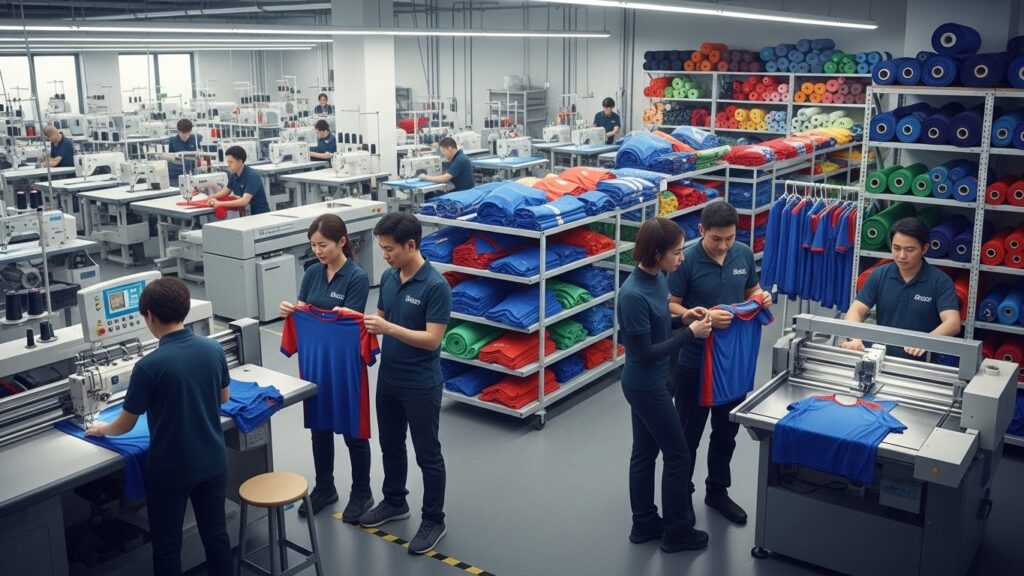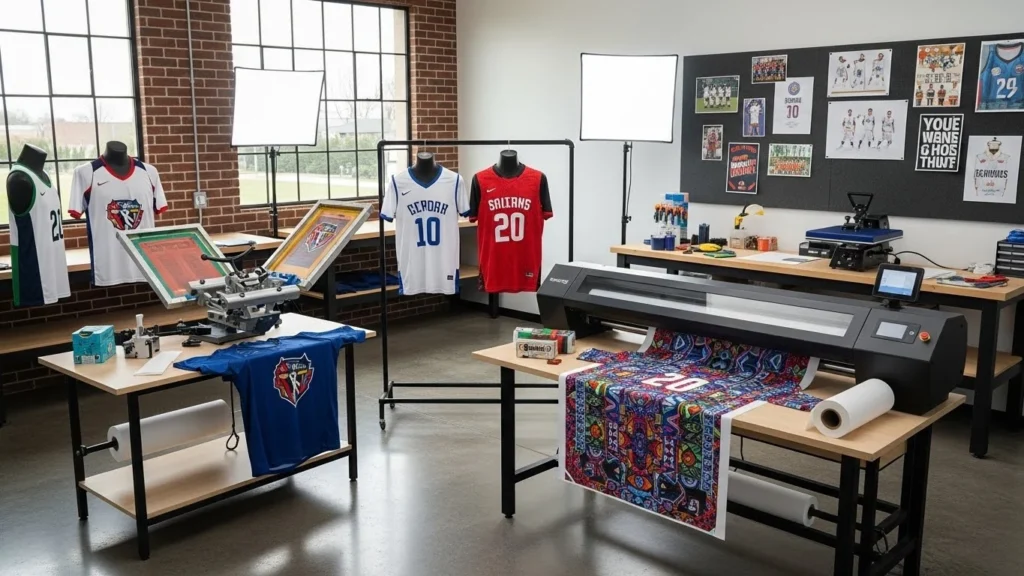
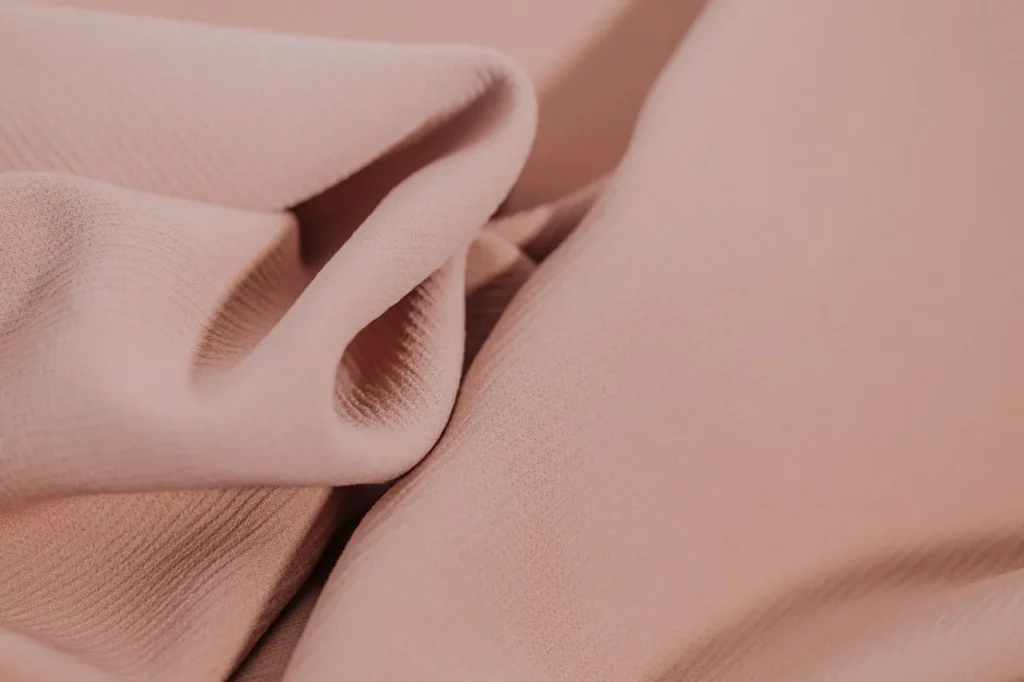
Two-way stretch vs four-way stretch fabric is a critical choice for leggings, sports bras, compression tops, running shorts, gym shirts, cycling apparel, and team training wear. The decision affects movement, recovery, opacity, pattern fit, seam performance, printing, production cost, and behaviour after repeated washing.
In commercial sourcing, two-way stretch usually means that a fabric stretches mainly in one direction, often across its width. Four-way stretch normally means that the material stretches across both width and length. These labels are useful, but they do not reveal extension percentage, recovery, fabric power, permanent growth, or opacity.
That is why two-way stretch vs four-way stretch fabric should be evaluated through measured performance rather than the label alone. Brands need to know how far the material stretches, how much force is required, how well it returns, and whether it changes after heat, sweat, and laundering.
BUSHI Sports® provides custom wholesale activewear manufacturing for brands, gyms, clubs, retailers, distributors, and private label buyers, including fabric selection, sampling, labels, packaging, and bulk production.
This guide explains seven buying decisions that help activewear brands select the correct stretch direction and avoid expensive fit or quality problems.
Quick Answer
For regular-fit T-shirts, polos, loose running tops, and selected tracksuit products, widthwise two-way stretch can be sufficient and economical.
For leggings, sports bras, compression tops, yoga wear, cycling shorts, and fitted training apparel, four-way stretch is usually the stronger starting point.
The practical two-way stretch vs four-way stretch fabric answer still depends on the exact product. A stable two-way knit can outperform a weak four-way material with poor recovery, low opacity, or excessive growth. For that reason, two-way stretch vs four-way stretch fabric should always be approved through physical samples and test data.
Two-Way Stretch vs Four-Way Stretch Fabric Comparison
| Requirement | Two-way stretch | Four-way stretch |
|---|---|---|
| Main extension | Usually one principal direction | Widthwise and lengthwise |
| Common fit | Regular, relaxed, or lightly fitted | Fitted, sculpted, compression, or high-mobility |
| Pattern flexibility | More direction-sensitive | Better multidirectional movement |
| Recovery requirement | Critical in the main stretch direction | Critical in both principal directions |
| Opacity risk | Easier to manage in the lower-stretch direction | Must be checked in both directions |
| Sewing complexity | Often simpler | Greater control of feed, seams, and orientation |
| Cost | Often lower | Frequently higher |
| Common products | T-shirts, jerseys, jackets, loose shorts | Leggings, sports bras, cycling shorts, compression wear |
What the Terms Actually Mean
Two-way and four-way are market terms rather than complete laboratory specifications. The movement may come from elastane, mechanical knit stretch, textured polyester or nylon yarn, fabric structure, or a combination of these elements.
Pattern orientation matters. A two-way fabric can perform well when its strongest direction runs around the body. If it is cut incorrectly, the garment may restrict movement or grow in the wrong zone.
ISO 20932-1:2018, together with its 2021 amendment, provides strip-test methods for elasticity and related properties. ISO 20932-2:2018 covers multiaxial deformation. ASTM D2594/D2594M-21 covers stretch and growth in relevant knitted fabrics.
These standards show why two-way stretch vs four-way stretch fabric should be expressed through test conditions and results rather than a supplier category alone.
Decision 1: Match Two-Way Stretch vs Four-Way Stretch Fabric to Movement
The first decision is how the athlete moves. A regular training T-shirt mainly needs room around the chest, shoulders, and arms. Widthwise stretch may be enough because the garment also contains positive ease.
A legging must extend around the hip and thigh while accommodating knee bending, sitting, squatting, and lengthwise movement. Four-way stretch is more suitable for that combination.
Two-way stretch vs four-way stretch fabric should be connected to shoulder rotation, torso twisting, hip flexion, squatting, lunging, cycling posture, running stride, and overhead reaching.
When Two-Way Stretch Works
Two-way stretch can suit regular-fit gym T-shirts, team training jerseys, polo shirts, light jackets, relaxed shorts, warm-up trousers, fanwear, and selected sports uniforms. Patterns can add movement through gussets, raglan sleeves, vents, articulated seams, or positive ease.
When Four-Way Stretch Is Better
Four-way stretch is usually preferred for workout leggings, sports bras, compression shirts, cycling shorts, yoga wear, wrestling singlets, fitted running shorts, and close-body base layers.
The fabric follows movement without pulling strongly in one direction or shifting the garment out of position.
Decision 2: Measure Recovery and Fabric Power
Stretch alone does not prove quality. A material can extend easily but fail to return to its original dimensions, creating bagging at the knees, elbows, seat, waistband, or underband.
The second two-way stretch vs four-way stretch fabric decision should review extension, recovery, fabric growth, force required to stretch, repeated-cycle performance, wash results, and behaviour after heat application.
Recovery and Growth
Recovery describes how closely the fabric returns to its initial dimensions after extension. Growth is the permanent change that remains. Poor recovery creates unstable fit even when the original stretch percentage appears impressive.
Fabric Power
Fabric power is the resistance felt while the material stretches. Two fabrics can both extend 80%, yet one may feel soft while the other provides firm compression.
Low-power stretch can suit comfort apparel. Higher controlled power may be required for sports bras, compression tights, and supportive waistbands. Excessive power can restrict movement or comfort.
Two-way stretch vs four-way stretch fabric tests should use the same load, direction, conditioning, extension, and recovery time. Results gathered under different methods should not be compared directly.
Decision 3: Build the Pattern Around Stretch Direction
A pattern cannot be separated from the fabric. The third two-way stretch vs four-way stretch fabric decision is how the pattern uses stretch, ease, seam placement, and grain direction.
A two-way material normally needs its strongest direction placed around the body, where circumference changes are greatest. A four-way fabric offers more freedom, but it can grow vertically when lengthwise recovery is weak.
The technical file should identify the fabric face, length and width directions, stretch percentage in both directions, approved cutting orientation, negative or positive ease, and whether panels may be rotated.
The BUSHI Sports® guide on 100% polyester vs polyester-spandex explains how elastane, mechanical stretch, and garment type influence fit.
Negative Ease and Grading
Compression and fitted garments use negative ease, meaning selected garment dimensions are smaller than the body. The material stretches during wear.
Negative ease must be developed from the approved fabric. A pattern made for a powerful four-way material may become loose in a softer blend or restrictive in a lower-stretch construction.
Stretch does not remove the need for accurate grading. Chest, waist, hip, rise, inseam, armhole, and body length must still change correctly across sizes. The sports uniform size guide explains why body and finished-garment measurements should remain separate.
Decision 4: Check Opacity, Support, and Comfort
The fourth two-way stretch vs four-way stretch fabric decision is performance at realistic extension. A fabric can look opaque on a table and become transparent over the hip, thigh, chest, or seat.
Test opacity unstretched, at widthwise and lengthwise extension, during a squat or bend, under bright light, over different undergarment colours, when damp, and after repeated washing.
Four-way stretch can improve mobility, but the knit may open in both directions. The product needs sufficient density, yarn coverage, colour depth, and recovery.
Support and Skin Comfort
A sports bra or compression short needs controlled resistance, not only maximum extension. A very soft four-way fabric may feel comfortable but provide insufficient support. A regular gym top may not need high-power fabric at all.
Review smoothness, seam bulk, cling, moisture accumulation, and surface change. Close-body products require extra care because small construction defects are more noticeable against the skin.
Two-way stretch vs four-way stretch fabric should also be tested with intended base layers, pads, liners, or sports bras.
Decision 5: Test Durability, Washing, and Heat
Stretch structures and elastane can be affected by repeated extension, washing, drying, pressing, chlorine, body oils, and high temperatures.
The fifth two-way stretch vs four-way stretch fabric decision should cover repeated recovery, dimensional change, pilling, abrasion, bursting strength, seam strength, colourfastness, perspiration exposure, and decoration trials.
ASTM D4966-22 covers Martindale abrasion testing. ISO 13938-2:2019 provides a pneumatic method for bursting strength.
Heat and Wash Performance
Four-way stretch materials often contain elastane. Excessive heat or pressure can change width, shine, recovery, and fit during sublimation, transfer application, ironing, or tumble drying.
Measure two-way stretch vs four-way stretch fabric samples before and after the intended decoration process. Then wash the complete garment because thread, elastic, seams, transfers, labels, and bonded parts can change the outcome.
The BUSHI Sports® sportswear sample approval checklist provides a complete PP-sample review before bulk cutting.
Decision 6: Compare Printing and Manufacturing Risk
The sixth two-way stretch vs four-way stretch fabric decision concerns cutting, sewing, printing, and inspection. Greater stretch can improve movement but make production more demanding.
Cutting and Sewing
Stretch fabric should be relaxed according to the approved process. Excess lay tension can cause panels to shrink after cutting.
Control relaxation time, lay tension, grain direction, slippage, cutting distortion, needle type, stitch density, differential feed, presser-foot pressure, and seam extensibility.
Four-way stretch garments may require ballpoint or stretch needles, flexible thread, overlock, coverstitch, or flatlock construction. A seam that cannot extend with the material can break even when the fabric itself is strong.
Printing and Branding
Polyester-spandex materials may support sublimation, but temperature, time, pressure, colour, and recovery must be approved. Heat transfers need compatible adhesives and enough flexibility.
Two-way stretch vs four-way stretch fabric also affects logo placement. A large rigid transfer across a highly elastic zone can restrict movement, crack, or lift.
BUSHI Sports® explains scalable artwork preparation in why vector artwork is important for sportswear printing.
Decision 7: Compare Cost, MOQ, and Product Value
The final two-way stretch vs four-way stretch fabric decision is commercial. Four-way stretch can cost more because of elastane, complex knitting, controlled finishing, testing, slower cutting, demanding sewing, and higher rejection risk when recovery varies.
Two-way stretch may reduce cost for products that do not need multidirectional elasticity and can provide stronger dimensional stability for regular-fit tops and jackets.
Cost depends on fibre and elastane percentage, yarn quality, GSM, knit structure, dyeing or sublimation, finishes, custom colour, testing, quantity, and packaging.
MOQ and Value
Stock two-way polyester may support lower minimums for training tops or jerseys. Custom-dyed four-way blends may require higher minimums per colour.
Do not save fabric cost by choosing two-way stretch for a product that needs four-way movement. Fit complaints, seam failures, and returns can cost more than the original material difference.
The correct two-way stretch vs four-way stretch fabric choice balances customer value with manufacturing practicality.
Which Stretch Should Each Product Use?
The following two-way stretch vs four-way stretch fabric recommendations provide a practical starting point for common activewear categories.
| Activewear product | Recommended starting point | Reason |
| Regular gym T-shirt | Two-way or mechanical stretch | Comfort without unnecessary compression |
| Running top | Two-way or light four-way | Depends on fit and body mapping |
| Team training jersey | Two-way stretch | Stable printing and athletic ease |
| Workout legging | Four-way stretch | Hip, knee, and multidirectional movement |
| Sports bra | Four-way stretch | Support, fit, and recovery |
| Compression shirt | Four-way stretch | Negative ease and body movement |
| Cycling shorts | Four-way stretch | Pedalling, compression, and recovery |
| Yoga apparel | Four-way stretch | Deep multidirectional movement |
| Tracksuit jacket | Two-way stretch | Structure and comfort |
| Fitted running shorts | Four-way stretch | Stride and hip mobility |
| Relaxed shorts | Two-way stretch | Widthwise comfort and lower cost |
Practical Verdict
Two-way stretch is usually the practical choice for regular-fit tops, jerseys, jackets, relaxed shorts, and products where structure, printing, and cost are priorities.
Four-way stretch is normally better for leggings, sports bras, compression apparel, cycling shorts, yoga wear, and fitted products requiring movement in several directions.
The strongest two-way stretch vs four-way stretch fabric choice is confirmed through actual stretch, recovery, opacity, wash, fit, and production testing.
Two-Way Stretch vs Four-Way Stretch Fabric Testing Checklist
| Property | Test direction | Why it matters |
| Widthwise extension | ISO 20932-1 or approved method | Confirms circumferential movement |
| Lengthwise extension | ISO 20932-1 or approved method | Confirms vertical movement |
| Multiaxial elasticity | ISO 20932-2 | Evaluates surface deformation |
| Stretch and growth | ASTM D2594 for relevant knits | Identifies extension and permanent growth |
| Abrasion | ASTM D4966 | Checks surface durability |
| Bursting strength | ISO 13938-2 | Evaluates multidirectional strength |
| Dimensional change | Approved wash procedure | Checks shrinkage and growth |
| Opacity | Stretched wear and light test | Prevents transparency complaints |
| Heat stability | Decoration trial | Protects width and recovery |
| Finished-garment trial | Movement, wash, and fit test | Confirms real performance |
Questions to Ask a Manufacturer
Use these two-way stretch vs four-way stretch fabric questions before approving a quotation:
- Which directions stretch, and by how much?
- Which method and load produced the results?
- What is the recovery after extension?
- How much permanent growth remains?
- What is the elastane percentage?
- Does the fabric become transparent?
- Can it tolerate the selected sublimation or transfer process?
- How does it perform after repeated washing?
- What cutting direction is required?
- Is the PP sample made from the final bulk fabric?
- What MOQ applies by colour?
- Can the yarn, GSM, or stretch specification change without written approval?
Common Buying Mistakes
Most two-way stretch vs four-way stretch fabric mistakes begin when a commercial label replaces measured performance.
Treating Four-Way as Automatic Quality
Four-way describes direction. It does not prove recovery, opacity, strength, comfort, or durability.
Comparing Different Test Methods
Stretch values measured under different loads or procedures are not directly comparable.
Ignoring Lengthwise Growth
A material may stretch vertically but fail to recover, creating longer knees, sleeves, or body panels.
Approving Only a Swatch
A swatch cannot reveal complete fit, seam behaviour, opacity during movement, or logo restriction.
Ignoring Heat
Sublimation and transfer application can change elastic materials when time, temperature, or pressure is unsuitable.
Why Work With BUSHI Sports®?
BUSHI Sports® supports activewear brands, gyms, clubs, retailers, distributors, and private label buyers with stretch-fabric comparison, leggings, sports bras, compression wear, running apparel, tracksuits, patterns, size sets, sublimation, branding, samples, labels, packaging, quality inspection, and international bulk production.
A complete two-way stretch vs four-way stretch fabric brief should identify the product, fit, movement, GSM, elastane, stretch directions, recovery, opacity, colours, branding, quantity, testing, price target, and delivery date.
Frequently Asked Questions
These two-way stretch vs four-way stretch fabric questions address the most common activewear sourcing decisions.
What is the main difference in two-way stretch vs four-way stretch fabric?
Two-way stretch usually extends mainly in one principal direction, while four-way stretch provides meaningful extension in both width and length. Exact results depend on the material and test method.
Is four-way stretch always better for activewear?
No. It is usually better for close-fitting products requiring multidirectional movement. Two-way stretch can be more appropriate for regular-fit tops, jackets, jerseys, and relaxed shorts.
Can 100% polyester have four-way stretch?
Some engineered knitted constructions provide multidirectional mechanical stretch without elastane, although polyester-spandex blends are common where strong recovery is required.
Which stretch is better for leggings?
Four-way stretch is usually preferred because leggings must extend around the body and through hip, knee, and lengthwise movement.
Which stretch is better for sports jerseys?
Two-way or mechanical stretch can be sufficient because many jerseys contain positive ease. Fitted match products may use four-way fabric or mapped stretch panels.
How should stretch be tested?
Measure widthwise and lengthwise extension, recovery, growth, and fabric power using a documented method. ISO 20932 and ASTM D2594 are relevant examples for suitable fabric categories.
Does four-way stretch cost more?
It frequently costs more because of elastane, fabric complexity, finishing, testing, and production controls. The exact difference depends on the fabric and order.
What should be approved before bulk production?
Approve the fabric code, GSM, composition, stretch in both directions, recovery, opacity, colour, printing, measurements, seams, wash results, labels, packaging, and PP sample.
Conclusion
Two-way stretch vs four-way stretch fabric should be selected through product movement, fit, recovery, opacity, durability, processing, and price rather than the label alone.
Two-way stretch is often sufficient for regular gym tops, team jerseys, tracksuit jackets, relaxed shorts, and products with positive ease. Four-way stretch is usually more suitable for leggings, sports bras, compression wear, cycling shorts, yoga apparel, and fitted garments that move in several directions.
Brands should test extension, recovery, permanent growth, power, opacity, abrasion, wash stability, heat response, seams, and finished-garment fit. Approved results should be locked into the technical file before bulk production.
BUSHI Sports® supports two-way stretch vs four-way stretch fabric development through material comparison, patterns, samples, fit testing, sublimation, branding, labels, packaging, quality control, and international manufacturing.
To discuss a custom activewear project, email info@bushisports.com, message BUSHI Sports® on WhatsApp at +92 348 4018 578, or submit requirements through the contact page.