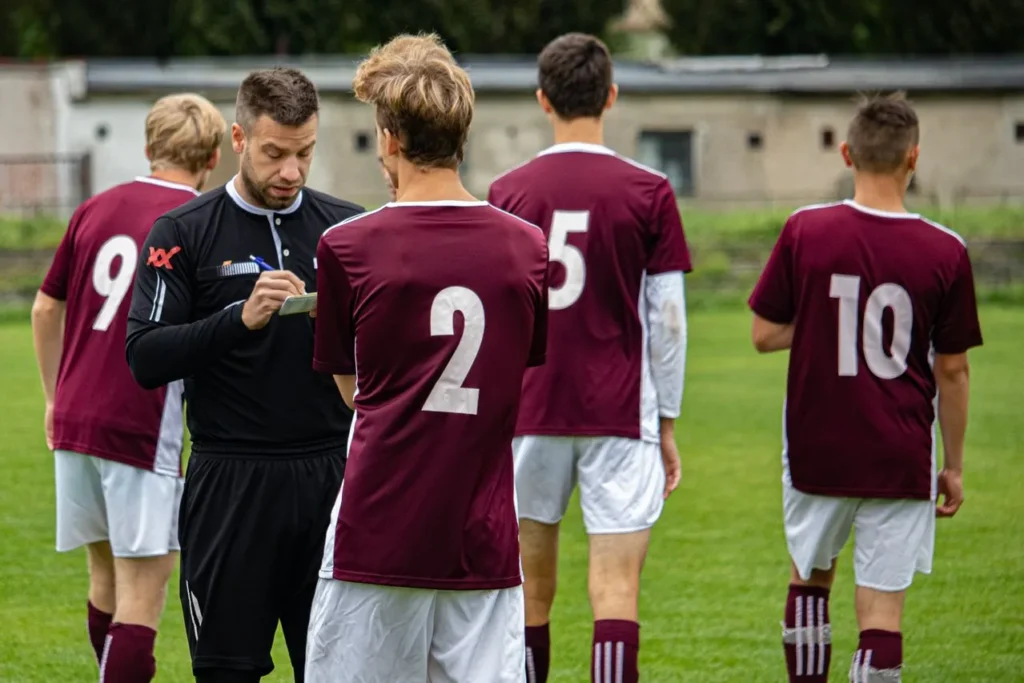
A reliable sports uniform size guide helps clubs, academies, schools, universities, retailers, and private label brands avoid expensive errors before a custom order enters production. A strong design cannot compensate for a jersey that restricts the shoulders, shorts that slip at the waist, sleeves that cover the hands, or uniforms that fit inconsistently across the team.
Custom sizing errors are costly because garments may already contain permanent player names, numbers, sponsor marks, sublimated graphics, custom collars, and team colours. Once produced, a wrongly sized item may require a remake, additional freight, and a delayed delivery.
The most common mistake is confusing body measurements with finished-garment measurements. A player’s chest circumference is not the same as a jersey measured flat. The difference between the body and the garment is controlled through ease, fabric stretch, layering, and the intended fit.
ISO 8559-1:2017 defines anthropometric measurements used for clothing, ISO 8559-2:2025 identifies primary and secondary size dimensions, and ISO 8559-3:2018 explains how body-measurement tables and intervals can be developed. These standards provide a measurement framework rather than one universal chart for every team.
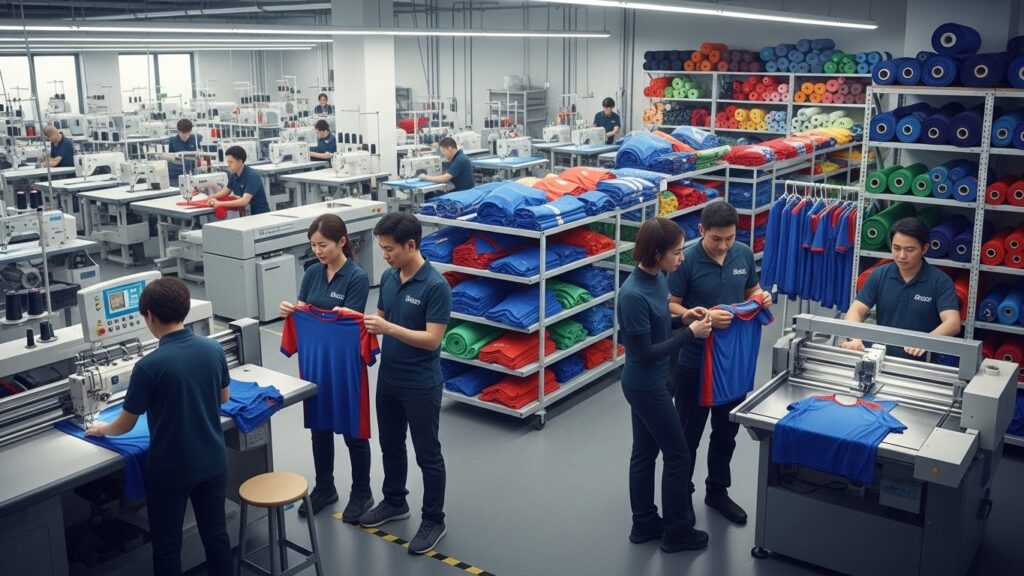
BUSHI Sports® manufactures custom sports uniforms for brands, clubs, teams, academies, schools, universities, retailers, wholesalers, and distributors. This sports uniform size guide explains nine practical controls for accurate measuring, sample approval, team-order management, and bulk inspection.
“The safest size decision is based on verified body measurements, an approved garment chart, and the intended fit—not on a player’s usual T-shirt size.”
Quick Sports Uniform Sizing Workflow
| Stage | What the team should do | Main risk prevented |
|---|---|---|
| Define product and fit | Confirm sport, garment, fabric, layering, and fit direction | Using one fit rule for every uniform |
| Prepare measurement setup | Use one trained measurer, one tape, and one method | Inconsistent data |
| Measure players | Record required body dimensions in centimetres | Guessing from age, height, or casual size |
| Compare with chart | Use the manufacturer’s exact body or garment chart | Mixing charts from different suppliers |
| Consider ease | Review movement, equipment, and fabric stretch | Selecting a size that fits standing but fails in play |
| Conduct try-on | Use samples or a size set | Ordering without physical verification |
| Record selection | Obtain player or team approval | Disputes after production |
| Build order matrix | Match name, number, size, product, and quantity | Data-entry and personalization errors |
| Inspect production | Compare bulk garments with approved measurements | Size drift during manufacturing |
Control 1: Use the Sports Uniform Size Guide to Define the Product
The first rule in a sports uniform size guide is to identify the exact garment before choosing measurements. Teams often measure every athlete and ask for “a medium” without confirming whether the product is a match jersey, replica jersey, compression top, warm-up jacket, goalkeeper shirt, padded uniform, or casual fanwear.
The sports uniform size guide must therefore be linked to one approved product specification.
A size label is meaningful only within one product specification. Medium in a slim-fit match jersey may be smaller than medium in a relaxed supporter shirt. Medium in one manufacturer’s chart may not match medium in another manufacturer’s chart. The same brand may also use different blocks for men, women, youth, goalkeepers, and compression garments.
Before measurement begins, confirm:
- Sport and playing position
- Jersey, shorts, pants, jacket, compression layer, or complete set
- Men’s, women’s, youth, or unisex pattern
- Match, team, training, replica, or fanwear tier
- Fabric stretch and recovery
- Regular, slim, relaxed, oversized, or compression fit
- Base layers or protective equipment worn underneath
- Tucked or untucked use
- Current competition requirements
- Intended season and climate
The BUSHI Sports® comparison of match jerseys, replica jerseys, and fanwear explains why visually similar products may use different fabrics, patterns, and fit allowances.
Sport-Specific Fit Differences
| Sport or product | Key sizing concern |
| Soccer and field hockey | Shoulder movement, body length, and athletic ease |
| Basketball and netball | Chest, armhole depth, shoulder width, and torso length |
| Baseball and cricket | Layering room, shoulder mobility, waist, hip, rise, and inseam |
| Rugby and wrestling | Secure fit, stretch, torso length, and negative ease |
| American football and ice hockey | Sizing over protective equipment |
| Goalkeeper uniforms | Extra sleeve or body allowance for padding and base layers |
The BUSHI Sports® guide to match jerseys, replica jerseys, and fanwear explains why visually similar products can use different patterns and fit allowances. Define the exact product before applying any sports uniform size guide.
Control 2: Separate Body and Garment Data in the Sports Uniform Size Guide
The second control in this sports uniform size guide is to separate body measurements from garment measurements.
The sports uniform size guide should label every column as body data or finished-garment data.
Body measurements are taken around or along the player. Finished-garment measurements are taken on the completed uniform when it is laid flat or positioned according to an agreed procedure. Both are useful, but they are not interchangeable.
A player may bring a favourite shirt and ask the manufacturer to copy its size. That garment may have stretched, shrunk, been measured incorrectly, or use a different fabric and pattern. It can be used as a comfort reference, but the team should still collect body measurements.
Body Measurement Examples
- Chest or bust circumference
- Natural waist circumference
- Hip or seat circumference
- Stature or full height
- Inseam
- Outseam
- Shoulder breadth
- Sleeve length
- Neck circumference
- Thigh circumference
- Torso or trunk length
Finished-Garment Measurement Examples
- Half chest measured flat
- Body length from high shoulder point
- Shoulder width
- Sleeve length
- Half waist
- Half hip
- Front rise
- Back rise
- Inseam
- Leg opening
If a jersey has a half-chest measurement of 54 centimetres, its approximate full circumference is 108 centimetres before accounting for fabric thickness and measurement method. That does not mean it is intended only for a player with a 108-centimetre chest. The difference between the player’s body and the garment is part of the intended ease.
Never Mix Measurement Bases
One of the most costly mistakes occurs when a team sends body chest measurements but the supplier interprets them as finished-garment measurements—or the reverse. Every chart should be labelled clearly:
- Body measurements
- Finished-garment measurements
- Centimetres or inches
- Garment condition during measurement
- Tolerance
- Fit type
The order form should use the same measurement basis as the approved chart.
Control 3: Standardize the Sports Uniform Size Guide Measurement Setup
The sports uniform size guide becomes reliable only when the measurement process is repeatable.
Accurate measurements require a consistent process. A sports uniform size guide will not work if one coach pulls the tape tightly, another leaves several centimetres of slack, and players measure themselves over hoodies.
Measurement Equipment
Prepare:
- Flexible non-stretch measuring tape
- Height scale or flat wall and reliable measuring device
- Full-length mirror where practical
- Data sheet or digital form
- Sample garments or size set
- Pen or tablet
- Light fitted clothing for players
Use centimetres for manufacturing records where possible. Centimetres reduce the need to convert fractions and are widely used in international production.
Player Preparation
The player should:
- Wear light, close-fitting clothing
- Remove bulky jackets and hoodies
- Remove items from pockets
- Stand naturally
- Avoid holding the breath or expanding the chest
- Keep feet positioned consistently
- Wear normal underlayers or protective equipment when the product requires them
The measuring tape should lie flat and level. It should touch the body without compressing soft tissue. The measurer should repeat any dimension that appears unusual.
Use One Trained Measurer
Where possible, one trained person should measure the whole team. This reduces variation in tape position and tension.
If several measurers are required, demonstrate each measurement first and provide written diagrams. Conduct a short repeatability check by having two measurers assess the same players and compare results.
Measure Twice
A practical rule is to take every critical measurement twice. If the results differ materially, take a third measurement and investigate.
Common causes of variation include:
- Tape held at an angle
- Player changing posture
- Incorrect waist position
- Measurement over thick clothing
- Confusion between inside and outside leg
- Tape pulled too tightly
- Measurement entered in the wrong unit
Control 4: Record Upper-Body Data in the Sports Uniform Size Guide
The sports uniform size guide should use the same anatomical landmarks for every player.
The upper-body section of a sports uniform size guide covers jerseys, jackets, polos, compression tops, and one-piece garments. Use the supplier’s named landmarks because sleeve and shoulder methods can differ.
| Measurement | Correct method | Main use |
| Height | Without shoes, floor to top of head | Proportion and length check |
| Chest/bust | Around the fullest area, level under the arms | Main jersey size selection |
| Natural waist | Around the natural waistline | Torso shaping |
| Hip/seat | Around the fullest hip and seat | Long tops, women’s fit, singlets |
| Shoulder breadth | Between defined outer shoulder points | Shoulder and sleeve fit |
| Sleeve length | Shoulder point or centre-back neck to wrist, as specified | Long sleeves and jackets |
| Neck | Around the base of the neck | Collar opening |
| Torso length | Defined shoulder-to-hem or trunk route | Singlets, skinsuits, long jerseys |
Keep the tape flat without compressing the player. Height alone is never enough because players with the same stature can have very different chest, shoulder, waist, and torso proportions. For raglan sleeves, centre-back neck to wrist may be more useful than a conventional shoulder-to-wrist measurement.
Control 5: Record Lower-Body Data in the Sports Uniform Size Guide
The sports uniform size guide should record top and bottom selections independently.
A sports uniform size guide for shorts, pants, leggings, bib products, and compression bottoms must include more than a casual waist size.
| Measurement | Correct method | Main use |
| Wearing waist | Around the intended waistband position | Shorts and pants size |
| Hip/seat | Around the fullest seat | Mobility and seat fit |
| Inseam | Crotch point to intended hem along the inside leg | Leg length |
| Outseam | Waistband position to intended hem | Overall length |
| Thigh | Around the fullest upper thigh | Fitted shorts and compression products |
| Calf/ankle | Around the required lower-leg points | Leggings and tapered pants |
Rise is usually controlled as a finished-garment measurement. It determines where the waistband sits and how the product fits through the crotch and seat. Record jersey and bottom sizes separately because many athletes do not fit one size across the complete set.
Control 6: Add Garment Ease to the Sports Uniform Size Guide
The sports uniform size guide must connect each body dimension with the intended garment ease.
The most technical part of a sports uniform size guide is ease. Ease is the difference between body dimensions and garment dimensions, adjusted for fabric stretch, product type, and fit intention.
Positive Ease
Positive ease means the garment is larger than the body at a measurement point. It supports comfort, airflow, layering, and movement.
Examples may include:
- Regular team jersey
- Basketball top
- Cricket shirt
- Warm-up jacket
- Supporter jersey
Negative Ease
Negative ease means the garment is smaller than the body and relies on stretch to fit.
Examples include:
- Compression shirt
- Wrestling singlet
- Cycling bib
- Compression tights
- Sports bra
Negative ease must be calculated with the actual fabric’s stretch and recovery. Copying a compression pattern into a fabric with lower stretch can create restriction and seam failure.
Zero or Minimal Ease
Some athletic products use body dimensions that are close to garment dimensions in selected zones. Even then, the complete fit depends on stretch, seam placement, and three-dimensional pattern shaping.
Do Not Add Random Centimetres
Teams sometimes choose one size larger “to be safe.” This can create:
- Dropped shoulders
- Oversized armholes
- Excess fabric during contact sport
- Unstable shorts
- Poor number placement
- Unprofessional presentation
The correct approach is to compare the player’s measurements with the approved chart and then confirm through a sample.
Check the Largest Critical Dimension
A player may have a medium chest but a large waist or hip. Select the size based on the dimension that would otherwise restrict the garment, then evaluate whether pattern alteration is necessary.
For standard team orders, the closest larger size may be practical. For professional or premium programmes, custom grading or special-length options may be justified.
Control 7: Adjust the Sports Uniform Size Guide for Different Players
The sports uniform size guide should identify which pattern block applies before a size is approved.
One chart cannot serve every population equally well. A sports uniform size guide should identify when separate patterns or additional checks are needed.
Women’s Fit
Women’s uniforms may require different relationships between:
- Bust
- Waist
- Hip
- Shoulder width
- Sleeve position
- Body length
- Rise
A smaller men’s jersey is not automatically a suitable women’s fit. The choice between women’s, unisex, and men’s patterns should be communicated clearly before measurement.
Youth Fit and Growth
Children and adolescents change in height, weight, and proportion over time. CDC growth charts illustrate the distribution of selected body measurements across childhood and adolescence; age alone is therefore not a reliable uniform size.
For youth orders:
- Measure every player rather than ordering by age
- Record the measurement date
- Conduct the try-on close to the order date
- Avoid excessive oversizing for future growth
- Consider the length of the season
- Recheck players near a size boundary
- Use adjustable waist systems where appropriate
Growth allowance should not make a garment unsafe. Oversized shorts can fall, long sleeves can cover the hands, and loose jerseys can be grabbed or interfere with movement.
Tall and Short Options
Some teams need regular, tall, and short lengths within the same chest or waist size. This is common where players have similar circumferences but different stature or limb proportions.
Possible solutions include:
- Regular and long jersey lengths
- Separate inseam options
- Adjustable hems
- Custom goalkeeper length
- Position-specific patterns
Muscular Athletes
Athletes with developed shoulders, thighs, or calves may not fit a standard size based on waist or height alone. Critical circumferences should guide the decision.
Players Wearing Protective Equipment
Measure or fit the jersey over the actual equipment whenever possible. Do not estimate pad allowance without a sample.
Control 8: Validate the Sports Uniform Size Guide With a Size Set
The sports uniform size guide should be confirmed by physical try-on whenever the order size justifies sampling.
A physical size set is the strongest protection against bulk sizing errors. A sports uniform size guide should support sample fitting rather than replace it.
A size set is a selection—or complete range—of sample garments produced in the intended pattern and fabric. Players try on the sample closest to their body measurements and confirm comfort during movement.
What to Test
Players should perform sport-relevant actions:
- Raise both arms
- Reach forward and overhead
- Rotate the torso
- Bend and squat
- Sprint or jog
- Jump
- Assume playing stance
- Wear protective equipment
- Sit or cycle where relevant
Check:
- Shoulder mobility
- Chest restriction
- Armhole exposure
- Jersey length
- Waist stability
- Hip and thigh room
- Rise comfort
- Inseam
- Sleeve length
- Collar opening
- Fabric transparency under stretch
Fit Approval Form
Each player or team representative should record:
- Player name
- Player number
- Product
- Body measurements
- Sample size tried
- Selected final size
- Fit preference
- Special length or alteration
- Approval signature or digital confirmation
- Date
This record reduces disputes after production.
Do Not Use Samples From Another Fabric Blindly
A size medium in a rigid fabric may fit differently from the same pattern in a four-way stretch fabric. Sample fit should use the intended or sufficiently equivalent fabric.
The BUSHI Sports® guide on sportswear for extreme heat explains how fabric weight, stretch, mesh, and construction can change garment behaviour.
Control 9: Connect the Sports Uniform Size Guide to Bulk Control
The sports uniform size guide must continue into the name-number-size matrix and final inspection.
The final control in this sports uniform size guide is data and production management. Many expensive errors are not caused by measuring. They happen when names, numbers, sizes, and products are copied incorrectly into the manufacturing order.
Team Order Matrix
Use one controlled spreadsheet with columns such as:
| Player ID | Player name | Display name | Number | Jersey size | Short size | Length option | Goalkeeper/outfield | Quantity | Approval |
| 01 | Example Player | EXAMPLE | 10 | M | L | Regular | Outfield | 1 set | Approved |
Important rules:
- Use one row per player and product combination
- Separate jersey and short sizes
- Confirm spelling and capitalization
- Store numbers as text where leading zero matters
- Lock the final approved version
- Add a revision number and date
- Highlight late changes
- Require written approval
Check Duplicate and Missing Numbers
Before production, verify:
- No unintended duplicate player numbers
- No missing names
- No blank size cells
- Correct goalkeeper colours
- Correct product quantities
- Correct women’s, men’s, youth, or unisex block
- Correct sleeve length and short length
Bulk Size Quality Control
The manufacturer should compare finished garments against the approved measurement chart. Inspection should include critical points such as chest, length, waist, hip, inseam, sleeve, and opening dimensions.
Every specification should include tolerances. Garment manufacturing cannot hold every measurement to an impossible zero tolerance, but variation must remain controlled and suitable for the product.
BUSHI Sports® explains wider inspection practices in how quality control works in sportswear manufacturing.
Sports Uniform Size Guide Measurement Form
Use one controlled form with the following fields:
| Player details | Body and order details |
| Full and printed name | Height, chest/bust, waist, hip/seat |
| Player number and position | Shoulder, sleeve, torso length |
| Men’s, women’s, youth, or unisex block | Inseam, outseam, thigh |
| Sample size tried | Jersey size and bottom size selected |
| Length or equipment requirement | Approval name and date |
Keep personal measurement data secure and limit access to staff and supplier personnel who need it for order processing.
Sports Uniform Size Guide Approval Process
- Define the product, fit, fabric, player group, and size range.
- Approve the body-measurement and finished-garment methods.
- Measure players consistently and select preliminary sizes.
- Produce or supply a prototype and physical size set.
- Conduct sport-specific movement and equipment trials.
- Approve the measurement chart, tolerances, and size matrix.
- Confirm every name, number, jersey size, and bottom size.
- Approve the final pre-production sample.
- Inspect bulk garments against the approved chart.
- Pack by player, team, or size according to the distribution plan.
Sports Uniform Size Guide Quality-Control Table
| Inspection area | What to check | Common failure |
| Pattern block | Correct men’s, women’s, youth, or position fit | Wrong pattern used |
| Fabric | Approved stretch, weight, and recovery | Fit changes because of substitution |
| Chest/bust | Finished dimension and tolerance | Restriction or excessive looseness |
| Body length | Front and back reference points | Jersey rides up or appears oversized |
| Waist and hip | Circumference and elastic recovery | Rolling, pressure, or slipping |
| Sleeve | Length, opening, and symmetry | Restricted arm movement |
| Rise and inseam | Correct points and lengths | Crotch discomfort or wrong leg length |
| Size label | Matches actual pattern and order | Mislabelled garments |
| Name and number | Correct player data and placement | Personalized remake required |
| Pairing | Correct jersey and short sizes | Mixed player sets |
| Carton assortment | Correct quantity and distribution | Delivery shortages or sorting delays |
Costly Mistakes the Sports Uniform Size Guide Prevents
| Mistake | Why it causes problems |
| Ordering by age or casual size | Age and retail labels do not describe the player’s body accurately |
| Mixing inches and centimetres | Conversion errors can affect an entire order |
| Measuring over bulky clothing | Uncontrolled allowance pushes players into larger sizes |
| Pulling the tape tightly | The recorded body measurement becomes too small |
| Confusing half chest with full chest | Flat garment width is mistaken for body circumference |
| Using one size for the set | Players often need different jersey and short sizes |
| Ignoring fabric stretch | The same pattern behaves differently in rigid and stretch fabrics |
| Skipping a size set | Charts cannot show every body shape or fit preference |
| Oversizing for growth | Excess fabric can affect movement, appearance, and safety |
| Accepting late verbal changes | Names, numbers, and sizes can be entered incorrectly |
How to Evaluate a Manufacturer’s Sports Uniform Size Guide
Ask the manufacturer:
- Is the chart based on body or garment measurements?
- Which ISO or internal definitions guide measurement points?
- Are men’s, women’s, youth, and unisex blocks separate?
- Is the fit regular, slim, relaxed, or compression?
- What fabric stretch is assumed?
- Can a physical size set be supplied?
- Can jersey and short sizes be mixed?
- Are tall or short options available?
- What are the measurement tolerances?
- How are bulk garments checked?
- Can personalized orders be packed by player?
- What happens when the fabric changes?
A reliable supplier should explain the chart and fit rather than asking only for small, medium, and large quantities.
Why Work With BUSHI Sports®?
BUSHI Sports® supports sports brands, clubs, academies, schools, universities, retailers, wholesalers, distributors, and private label buyers through custom sportswear development and bulk manufacturing.
Sizing support can include:
- Product-specific measurement charts
- Men’s, women’s, youth, and unisex patterns
- Match, team, training, and fanwear fits
- Jersey and short size separation
- Goalkeeper and position-specific adjustments
- Size-set samples
- Fit and movement review
- Custom names and numbers
- Pre-production samples
- Bulk measurement inspection
- Player-based packing
- International order coordination
Buyers developing soccer kits can review the custom wholesale soccer uniform manufacturer page and the published guides on 2026 soccer jersey design trends and cultural soccer kit design.
Start Your Custom Teamwear Order
Brands, clubs, academies, schools, universities, retailers, distributors, and private label buyers can contact BUSHI Sports® for measurement charts, size-set development, fabrics, samples, names, numbers, private labels, packaging, bulk production, and delivery.
- Email: info@bushisports.com
- WhatsApp: +92 348 4018 578
- Project inquiry: Contact BUSHI Sports®
Include the sport, garment types, player group, preferred fit, size range, quantities, artwork, personalization list, target price, and delivery date. Request the exact sports uniform size guide for the selected product before collecting final player measurements.
Frequently Asked Questions About the Sports Uniform Size Guide
What is a sports uniform size guide?
A sports uniform size guide explains which body measurements to collect, how they relate to a manufacturer’s chart, and how to choose sizes for a specific uniform, fabric, and fit.
Should players order their normal clothing size?
Not without checking the supplier’s chart. Casual clothing and performance uniforms can use different blocks, stretch, ease, and grading.
What is the difference between body and garment measurements?
Body measurements are taken on the player. Finished-garment measurements are taken on the uniform and already include the intended fit relationship.
What is garment ease?
Ease is the difference between body and garment dimensions. Positive ease adds room, while negative ease allows a stretch garment to fit closely.
Can jersey and short sizes be different?
Yes. Record tops and bottoms separately because chest and waist proportions do not always fall within one size.
How should youth players be sized?
Measure every player, use a youth-specific chart, conduct a try-on, and consider how much time will pass before delivery. Do not choose sizes by age alone.
Should goalkeepers simply order one size larger?
No. Test a goalkeeper pattern over the intended base layers or padding instead of applying an automatic size increase.
Is a physical size set necessary?
It is strongly recommended for bulk personalized orders because it allows players to test the actual pattern and fit before production.
What if a player falls between two sizes?
Review the largest critical dimension, fabric stretch, intended ease, and sample fit. Select the option that preserves movement and coverage.
What should be sent to the manufacturer?
Send the product list, measurements, selected sizes, names, numbers, pattern category, fit approvals, artwork, quantities, and delivery requirements.
Conclusion
A sports uniform size guide protects teams and manufacturers from avoidable remakes. Begin by defining the sport, garment, fabric, fit, pattern category, layering, and equipment requirements. Then collect standardized body measurements rather than guessing from age or casual clothing labels.
Body measurements and finished-garment measurements must remain clearly separated. The manufacturer converts player dimensions into an intended fit through positive, minimal, or negative ease. Upper-body measurements control jerseys and jackets, while waist, hip, thigh, rise, and leg measurements control bottoms. Women’s, youth, goalkeeper, tall, short, compression, and equipment-compatible products may require separate patterns.
For a significant personalized order, use a physical size set and movement trial. Record each player’s selected jersey and bottom sizes, approve names and numbers in writing, and lock the final revision before production. Bulk uniforms should be inspected against the approved chart and tolerances.
BUSHI Sports® supports custom teamwear sizing through measurement guidance, patterns, size sets, samples, personalization, quality control, player-based packing, and international production coordination.
To request the relevant sports uniform size guide, email info@bushisports.com, message BUSHI Sports® on WhatsApp at +92 348 4018 578, or submit the project through the contact page.