Polyester vs nylon for activewear is not a simple comparison between a cheap fibre and a premium fibre. Both materials can produce lightweight, stretchable, durable performance clothing, but they behave differently when exposed to sweat, abrasion, heat, printing, repeated washing, and bulk manufacturing.
Polyester is widely used for running shirts, team training tops, tracksuits, shorts, and sublimated sportswear. It generally absorbs little moisture, dries quickly, retains colour well, and is available through a broad global supply base.
Nylon, also called polyamide, is commonly selected for leggings, sports bras, fitted gym wear, compression apparel, and premium performance products. It can provide a smooth hand feel, strong abrasion resistance, and excellent flexibility when blended with elastane.
These differences do not mean that every polyester garment dries faster than every nylon garment or that every nylon fabric is softer and stronger. Yarn shape, filament size, knit structure, GSM, elastane content, finishing, brushing, and garment construction can significantly change the final result.
A lightweight engineered polyester mesh may manage heat better than a dense nylon jersey. A high-quality nylon-elastane interlock may provide better recovery and surface durability than a weak polyester blend. Polyester vs nylon for activewear should therefore be evaluated through the exact polyester blend. Polyester vs nylon for activewear should therefore be evaluated through the exact finished fabric rather than fibre content alone.
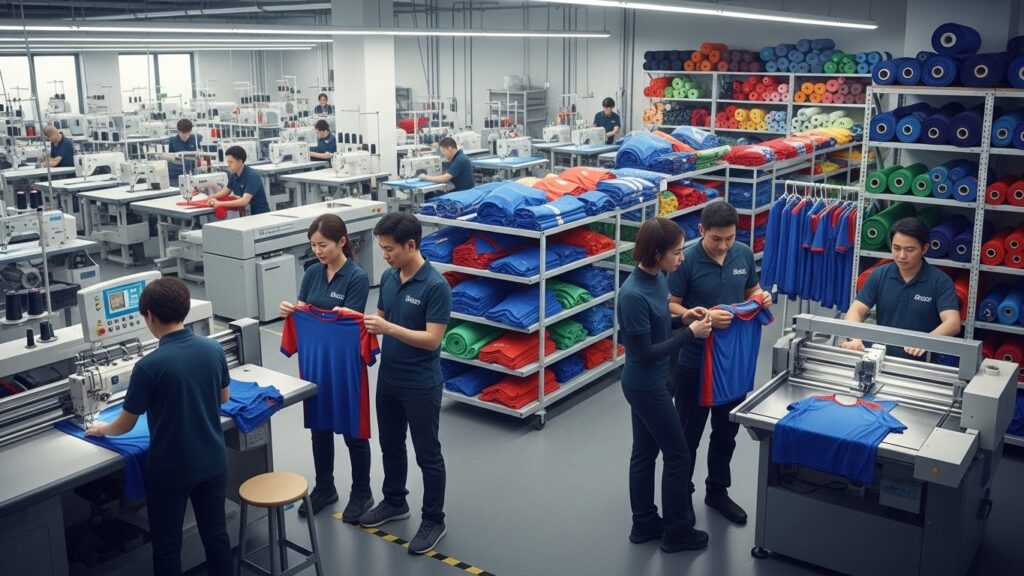
BUSHI Sports® provides custom wholesale activewear manufacturing for sports brands, gyms, retailers, clubs, distributors, and private label buyers. Projects can include leggings, sports bras, gym shirts, compression tops, shorts, tracksuits, running apparel, custom labels, packaging, samples, and bulk production.
This guide compares polyester vs nylon for activewear through seven practical buying and manufacturing decisions.
“The correct activewear fibre is the one that meets the product’s moisture, fit, abrasion, colour, cost, and care requirements after testing—not the one with the strongest marketing description.”
Quick Polyester vs Nylon for Activewear Comparison
| Requirement | Polyester | Nylon |
|---|---|---|
| Moisture absorption | Generally lower | Generally higher |
| Drying direction | Often faster under comparable construction | May retain more moisture |
| Hand feel | Can range from crisp to soft | Commonly smooth and soft |
| Abrasion resistance | Good when correctly engineered | Often selected for high-abrasion fitted garments |
| Sublimation | Highly suitable with compatible polyester fabrics | Less straightforward than polyester |
| Colour depth | Strong, especially through disperse dyeing and sublimation | Can produce rich colours with suitable dye systems |
| Stretch | Usually blended with elastane for fitted apparel | Commonly blended with elastane for smooth stretch |
| UV and weather stability | Often suitable for outdoor apparel | Performance depends on yarn, dyes, and finishing |
| Cost | Usually more economical and widely available | Frequently priced above comparable polyester |
| Common uses | Jerseys, running tops, shorts, tracksuits | Leggings, sports bras, compression apparel |
| Main risk | Odour retention, pilling, or low-quality hand feel | Moisture retention, cost, heat sensitivity during processing |
This table provides general manufacturing direction. The exact fabric must still be tested.
Decision 1: Define the Product Before Comparing Polyester vs Nylon for Activewear
The first polyester vs nylon for activewear decision is the garment itself. A sports bra, running shirt, compression top, workout legging, tracksuit, and team training jersey do not need the same material.
A running top may prioritize low weight, rapid drying, ventilation, and affordable replacement. A legging may need opacity, recovery, abrasion resistance, softness, and shape retention. A sports bra requires support, stretch stability, moisture management, and comfortable skin contact.
Before requesting samples, define:
- Product type
- Sport or activity
- Indoor or outdoor use
- Climate and humidity
- Loose, regular, fitted, or compression fit
- Required stretch direction
- Opacity requirement
- Abrasion zones
- Printing or branding method
- Washing frequency
- Target retail price
- Order quantity
- Environmental claims
Polyester vs nylon for activewear should also be compared within the same fabric category. Comparing a 120 GSM polyester mesh with a 250 GSM nylon-elastane interlock does not reveal which fibre is universally better. It mainly shows the effects of two very different fabric structures and weights.
The published BUSHI Sports® guide on polyester mesh vs interlock fabric explains why knit structure can influence airflow, stability, opacity, and printing as much as fibre type.
Decision 2: Compare Moisture and Drying Performance
Moisture behaviour is one of the main differences in polyester vs nylon for activewear. Polyester is relatively hydrophobic and normally absorbs less moisture into the fibre. Nylon absorbs more moisture, although it still absorbs much less than many natural fibres.
Lower absorption can help polyester release moisture and dry quickly when the fabric structure, finish, airflow, and climate support evaporation. This is one reason polyester is widely used for running tops, soccer jerseys, training shirts, and hot-weather sportswear.
Nylon’s higher moisture absorption can contribute to a smoother or less clammy initial feel in some constructions, but it may also hold more moisture and take longer to return to its dry weight. In a dense nylon-elastane garment, the fabric may feel heavier after a demanding session.
However, fibre absorption is only one part of moisture performance.
The finished fabric also depends on:
- Yarn cross-section
- Filament fineness
- Knit density
- Surface treatment
- Capillary channels
- Fabric thickness
- Garment fit
- Air permeability
- Elastane content
- Washing history
AATCC TM195 evaluates liquid moisture management, including wetting, spreading, and transport between fabric surfaces. ISO 11092:2026 measures thermal and water-vapour resistance under controlled conditions.
Which Is Better for Hot Weather?
Polyester is often the practical starting point for hot-weather running shirts, training tops, and team jerseys because it can be lightweight, quick-drying, and compatible with open mesh structures.
Nylon can still perform well in heat when developed as a lightweight knit with controlled moisture transport. Dense nylon leggings or sports bras, however, should not be compared directly with a loose polyester T-shirt.
Brands developing warm-climate products can review sportswear manufacturing for extreme heat for guidance on airflow, body mapping, opacity, and responsible cooling claims.
Decision 3: Compare Durability and Abrasion Resistance
Durability is a major reason buyers consider nylon. Nylon fibres are frequently selected for garments exposed to rubbing, stretching, floor exercises, equipment, and repeated close-body use.
Applications may include:
- Workout leggings
- Cycling shorts
- Sports bras
- Compression tights
- Climbing apparel
- Fitted training shorts
- Reinforced activewear panels
Polyester also provides good durability and can perform strongly in jerseys, tracksuits, shorts, and outer layers. A high-quality polyester fabric may easily outperform a loosely knitted or poorly finished nylon fabric.
Polyester vs nylon for activewear durability should be evaluated through fabric testing rather than assumptions.
ASTM D4966-22 measures abrasion resistance using the Martindale method. ASTM also publishes methods for pilling, breaking strength, stretch, and related fabric properties.
Inspect candidate fabrics for:
- Surface abrasion
- Pilling
- Snagging
- Fibre breakage
- Colour change
- Loss of stretch
- Seam exposure
- Thinning in high-friction zones
Abrasion Is Not the Same as Pilling
A fabric may resist complete wear-through but still develop unattractive pills. Another may remain visually smooth while gradually losing thickness.
For leggings and fitted gym wear, test the inner thigh, seat, knees, waistband, and contact areas. For running tops and jackets, evaluate backpack, underarm, shoulder, and side-body zones.
The fabric should also be tested after washing because heat, detergent, flexing, and drying can change the surface.
Decision 4: Compare Softness, Stretch, and Fit
Nylon is often chosen for premium fitted activewear because it can produce a smooth, soft, and flexible fabric. Nylon-elastane blends are common in leggings, sports bras, yoga apparel, and compression products.
Polyester can also be made extremely soft through microfilament yarns, texturing, peaching, brushing, and finishing. The difference is that these treatments may affect pilling, fibre shedding, drying, and long-term appearance.
Polyester vs nylon for activewear fit depends heavily on the elastane percentage and fabric construction.
Review:
- Two-way or four-way stretch
- Lengthwise stretch
- Widthwise stretch
- Recovery after extension
- Growth during wear
- Compression level
- Fabric modulus
- Opacity under stretch
- Seam compatibility
A fabric that stretches easily but does not recover can become loose at the knees, seat, waist, or elbows. A fabric with excessive resistance may feel restrictive even when the garment measurements appear correct.
Compression Products
Compression apparel needs controlled negative ease. The pattern is smaller than the body and relies on fabric extension to fit. The correct amount depends on fabric power, stretch, recovery, panel shape, and seam construction.
A nylon-elastane fabric may suit premium leggings because of its smooth stretch and hand feel. A polyester-elastane fabric may be preferred when fast drying, sublimation, or price is more important.
The BUSHI Sports® sports uniform size guide explains how body measurements, finished-garment dimensions, and ease should remain separate during development.
Decision 5: Compare Colour, Printing, and Branding
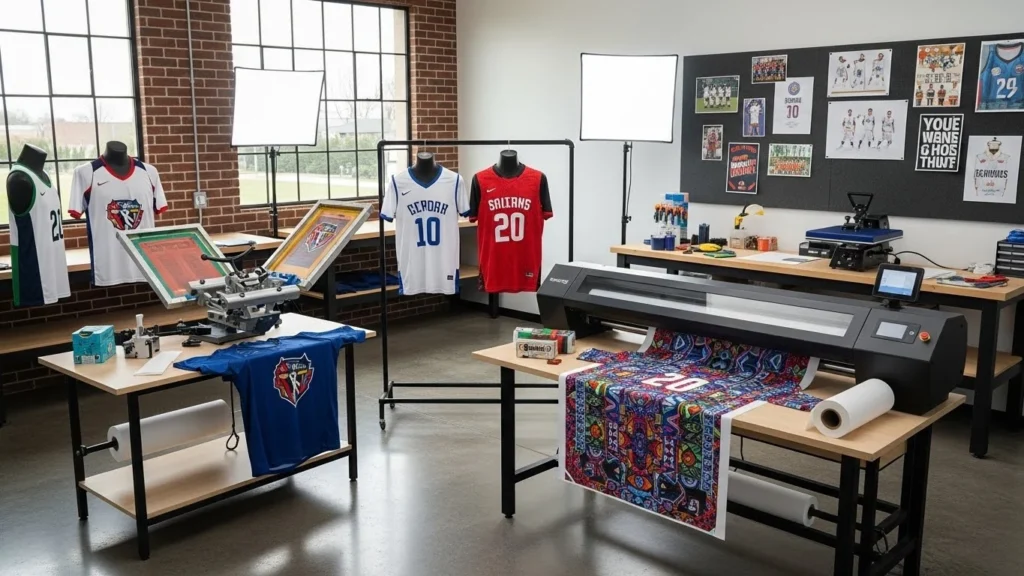
Printing is one of polyester’s strongest commercial advantages. Polyester fabrics can be dyed with disperse dyes and are widely compatible with sublimation printing.
Sublimation allows graphics to become part of the polyester material rather than forming a heavy surface layer. This makes polyester useful for:
- All-over printed gym shirts
- Running tops
- Team training products
- Tracksuits
- Branded shorts
- Custom jerseys
- Promotional activewear
Nylon normally uses different dye systems and requires more careful control during heat application. Standard polyester sublimation processes should not automatically be applied to nylon because high temperature, colour behaviour, fabric movement, and finish compatibility can differ.
Nylon is commonly suitable for:
- Solid-dyed premium leggings
- Sports bras
- Compression products
- Cut-and-sew colour blocking
- Heat-transfer logos developed for the material
- Silicone or TPU branding
Colourfastness and Migration
Both materials should be tested for:
- Colourfastness to washing
- Colourfastness to perspiration
- Dry and wet rubbing
- Heat exposure
- Transfer adhesion
- Colour migration
- Shade consistency between production lots
Dark polyester can sometimes create dye-migration problems beneath light heat transfers if the fabric, dyeing, transfer, and pressing conditions are incompatible. Nylon can also react poorly to excessive heat.
Artwork should be approved on the exact fabric and colour. BUSHI Sports® explains file preparation in why vector artwork is important for sportswear printing.
Decision 6: Compare Environmental and Care Considerations
Both polyester and nylon are synthetic polymers. Neither should be marketed as environmentally harmless simply because it is durable, recycled, lightweight, or long-lasting.
Polyester has a larger recycled-material supply chain, particularly through recycled PET sources. Recycled nylon is also available, including materials sourced from industrial waste and selected post-consumer streams, but availability, certification, colour, MOQ, and price can differ.
Recycled content does not automatically prove:
- Lower microfiber shedding
- Greater durability
- Lower total environmental impact
- Recyclability of the complete garment
- Biodegradability
- Lower energy use
The exact material should be tested and documented.
The BUSHI Sports® guide on microfiber shedding in polyester sportswear explains why yarn, knit structure, brushing, abrasion, cutting, washing, and surface damage influence fibre release.
Odour and Care
Polyester is sometimes associated with odour retention after repeated high-sweat use. Nylon can also retain odour depending on the fabric, finishing, skin oils, bacteria, washing, and drying conditions.
Anti-odour or antimicrobial treatments should be tested rather than treated as automatic fibre properties.
Care labels should reflect the complete garment, including:
- Main fabric
- Elastane
- Transfers
- Elastic
- Mesh
- Padding
- Zippers
- Bonding
- Printed labels
Hot washing and drying can damage stretch fibres even when the main polyester or nylon fibre remains stable.
Decision 7: Compare Cost, MOQ, and Production Risk
Cost is often the deciding factor in polyester vs nylon for activewear. Polyester is generally more widely available and often more economical, especially for high-volume jerseys, training shirts, tracksuits, and sublimated products.
Nylon frequently carries a higher fabric cost, particularly in high-quality fine-gauge blends with substantial elastane content. It may still be commercially justified for premium leggings, sports bras, compression apparel, and products where hand feel or abrasion performance supports a higher retail price.
The final quotation depends on:
- Yarn quality and denier
- Fabric GSM
- Knit structure
- Elastane percentage
- Dyeing or sublimation
- Surface finishing
- Moisture or odour treatment
- Recycled content
- Testing requirements
- Order quantity
- Colours
- Packaging
MOQ Differences
Polyester offers broad stock-fabric availability in many markets. A buyer may be able to launch a smaller order by using an existing polyester fabric and sublimated colours.
Custom-dyed nylon-elastane fabrics may require higher minimums per colour because the supplier must dye a specific fabric lot. Neon, pale, dark, or difficult shades can create additional development work.
Bulk Production Risks
Whether polyester or nylon is selected, the buyer should lock:
- Fabric supplier and code
- Fibre composition
- GSM
- Elastane content
- Stretch and recovery
- Colour
- Surface finish
- Test results
- Care instructions
- Approved pre-production sample
The sportswear sample approval checklist explains how to approve these details before bulk cutting.
Which Material Is Better for Each Activewear Product?
| Product | Practical starting point | Reason |
| Running T-shirt | Polyester | Low weight, quick drying, ventilation, and printing |
| Team training top | Polyester | Sublimation, colour consistency, and cost |
| Gym T-shirt | Polyester or blend | Depends on hand feel, drying, and retail tier |
| Performance leggings | Nylon-elastane or polyester-elastane | Nylon for softness; polyester for drying and cost |
| Sports bra | Nylon-elastane | Smooth hand, stretch, and close-body comfort |
| Compression top | Either fibre with controlled elastane | Depends on moisture, fit, print, and price |
| Cycling jersey | Polyester-dominant | Moisture release, printing, and ventilation |
| Cycling shorts | Nylon-elastane or polyester-elastane | Depends on abrasion, compression, and drying |
| Tracksuit | Polyester | Durability, shape stability, colour, and cost |
| Yoga wear | Nylon-elastane | Soft hand and smooth stretch |
| Sublimated activewear | Polyester | Most practical fibre for sublimation |
The Practical Verdict
Polyester is usually the stronger commercial option for quick-drying tops, printed sportswear, team training products, tracksuits, outdoor jerseys, and price-sensitive bulk orders.
Nylon is often the stronger premium option for leggings, sports bras, yoga apparel, compression bottoms, and fitted garments requiring a smooth hand and strong abrasion performance.
The best decision may also be a product range using both fibres. A brand can use polyester for tops and tracksuits while selecting nylon-elastane for premium leggings and sports bras.
Polyester vs Nylon for Activewear Testing Checklist
| Property | Test direction | Why it matters |
| Liquid moisture management | AATCC TM195 | Compares wetting, spreading, and transport |
| Thermal and vapour resistance | ISO 11092:2026 | Evaluates heat and water-vapour behaviour |
| Air permeability | ASTM D737 | Supports ventilation comparison |
| Abrasion | ASTM D4966 | Evaluates resistance to rubbing |
| Pilling | ASTM D4970 or suitable equivalent | Checks surface appearance |
| Stretch and recovery | Buyer-approved recognized method | Protects fit and compression |
| Dimensional change | Approved laundering and measurement method | Checks shrinkage and growth |
| Colourfastness | Washing, perspiration, and rubbing tests | Protects colour and branding |
| Opacity | Dry, wet, and stretched inspection | Prevents transparency complaints |
| Finished-garment trial | Wear, wash, fit, and movement review | Confirms actual product performance |
Questions to Ask an Activewear Manufacturer
- What exact polyester and nylon fabrics are available?
- What are their GSM, yarn type, and elastane percentages?
- How do stretch and recovery compare?
- Which option performs better after repeated washing?
- Is the nylon suitable for the intended heat-transfer process?
- Can the polyester be sublimated?
- Are recycled-content certificates available?
- What testing reports can be supplied?
- What MOQ applies to each colour?
- Can fabrics change without written approval?
- Can a size set and PP sample be produced?
Why Work With BUSHI Sports®?
BUSHI Sports® supports activewear brands, gyms, retailers, clubs, wholesalers, distributors, and private label buyers with:
- Polyester and nylon fabric comparison
- Leggings and compression apparel
- Sports bras
- Gym T-shirts and tank tops
- Running shirts and shorts
- Tracksuits
- Sublimation
- Patterns and size sets
- Sample development
- Private labels
- Testing coordination
- Packaging
- Bulk quality inspection
- International order coordination
A clear polyester vs nylon for activewear brief should include the product, fit, climate, fabric weight, stretch, colours, branding, quantity, testing, price target, and delivery date.
Frequently Asked Questions
What is the main difference in polyester vs nylon for activewear?
Polyester normally absorbs less moisture, dries quickly, and works well with sublimation. Nylon commonly provides a smoother hand and is often selected for fitted garments requiring strong abrasion resistance.
Is nylon more durable than polyester?
Nylon is often associated with strong abrasion performance, but fabric durability depends on yarn, knit construction, GSM, finishing, elastane, and testing. A high-quality polyester can outperform a poorly engineered nylon fabric.
Which material is better for leggings?
Nylon-elastane is popular for premium leggings because of its smooth hand and stretch. Polyester-elastane can provide rapid drying, strong printing options, and a lower price.
Which material is better for running shirts?
Polyester is commonly the practical choice because it can be lightweight, quick-drying, ventilated, and suitable for sublimated branding.
Does nylon absorb more sweat?
Nylon generally absorbs more moisture into the fibre than polyester. Actual sweat management still depends on fabric construction, finishes, airflow, and fit.
Can nylon be sublimated?
Standard polyester sublimation should not automatically be used on nylon. Specialized nylon-compatible processes may be possible, but the exact fabric, ink, heat, colour, and finish must be tested.
Is polyester cheaper than nylon?
Polyester is generally more economical and widely available. Final prices depend on yarn, GSM, elastane, colour, finish, testing, quantity, and supplier.
Can polyester and nylon be used in one collection?
Yes. Brands often use polyester for tops, jerseys, and tracksuits while using nylon-elastane for leggings, sports bras, and fitted premium products.
Conclusion
Polyester vs nylon for activewear should be decided through the intended garment, not through fibre reputation alone.
Polyester is commonly preferred for quick-drying tops, sublimated products, team training wear, tracksuits, and large commercial orders. Nylon is often preferred for premium leggings, sports bras, yoga wear, and compression garments requiring a smooth hand and abrasion resistance.
Fabric structure, elastane, GSM, finishing, moisture performance, stretch recovery, opacity, dyeing, printing, and washing can change the outcome. Brands should compare exact fabrics through laboratory tests, physical samples, wear trials, and wash testing before bulk approval.
BUSHI Sports® supports polyester vs nylon for activewear development through material comparison, patterns, samples, sublimation, size sets, private labels, packaging, testing coordination, quality inspection, and international bulk manufacturing.
To discuss a custom activewear project, email info@bushisports.com, message BUSHI Sports® on WhatsApp at +92 348 4018 578, or submit your requirements through the contact page.