Polyester mesh vs interlock fabric is a major material decision in custom jersey development. Both can use polyester and support sublimation, but they create different airflow, coverage, print surfaces, durability, fit, and production costs.
Mesh is generally selected when ventilation and low bulk are priorities. Interlock is generally selected when the buyer needs a smooth surface, stronger opacity, dimensional stability, and consistent printing. However, polyester mesh vs interlock fabric cannot be approved from these labels alone. Yarn, stitch structure, GSM, thickness, finishing, stretch, and garment design can change the result.
The correct choice depends on the sport, climate, jersey tier, graphics, washing frequency, price, and expected lifespan. Many performance jerseys use interlock in stable graphic zones and mesh where extra ventilation is valuable.
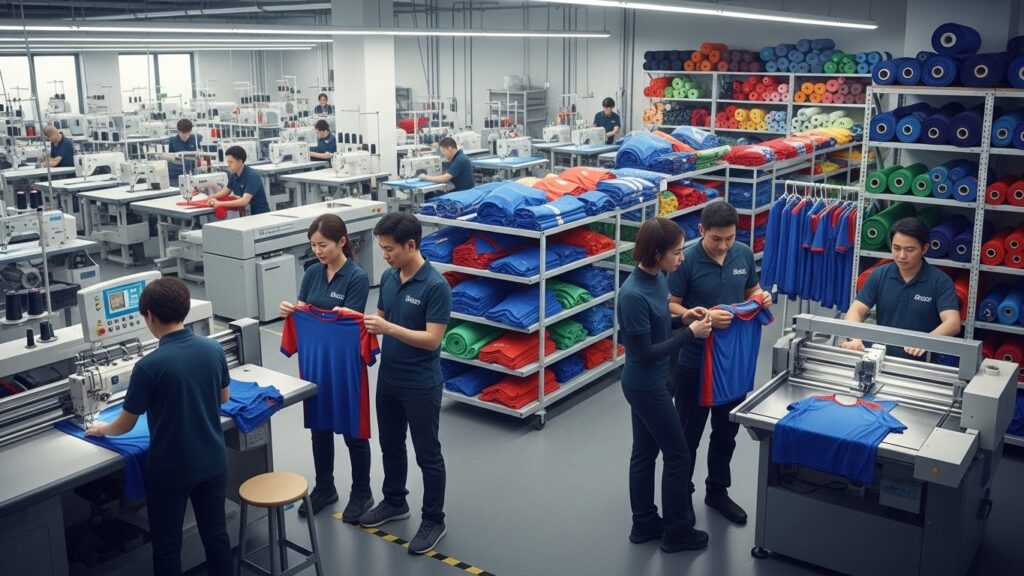
BUSHI Sports® provides custom wholesale soccer uniform manufacturing for brands, clubs, academies, schools, retailers, and distributors. Projects can include fabric selection, sublimation, patterns, size sets, personalization, labels, packaging, sampling, and bulk production.
This guide compares polyester mesh vs interlock fabric through seven practical manufacturing decisions so buyers can choose a construction that works during play and remains repeatable in bulk.
“The best jersey fabric is not the lightest, smoothest, or most open option. It is the fabric that balances performance, appearance, durability, and cost for the intended user.”
Quick Polyester Mesh vs Interlock Fabric Comparison
| Requirement | Polyester mesh | Polyester interlock |
|---|---|---|
| Airflow | Usually higher because of a more open structure | Usually lower because of a compact double-knit structure |
| Opacity | Can be lower, especially in pale colours or under stretch | Usually stronger and more consistent |
| Print surface | Texture or holes can interrupt very fine artwork | Smooth and suitable for detailed sublimation |
| Dimensional stability | Depends strongly on hole pattern, stitch length, and finish | Commonly stable when correctly knitted and finished |
| Snag resistance | Open structures may catch more easily | Compact surfaces are often easier to protect |
| Hand feel | Light and ventilated, but quality varies | Smooth, balanced, and more substantial |
| Best use | Ventilation panels, hot-weather jerseys, training products | Main jersey body, replica tiers, detailed graphics, school uniforms |
| Main risk | Transparency, snagging, weak logo support, seam distortion | Heat retention, higher weight, slower air exchange |
These are general directions, not universal rules. Buyers should approve the exact fabric rather than a category name.
Decision 1: Define the Product in Polyester Mesh vs Interlock Fabric
The first polyester mesh vs interlock fabric decision is the product brief. A match jersey, academy uniform, replica shirt, training top, and supporter jersey have different priorities. Define the sport, climate, product tier, washing frequency, fit, opacity, artwork, branding method, target price, and reorder needs before choosing fabric.
A lightweight match jersey may justify open ventilation zones. A school uniform may need stronger opacity and repeat-wash durability. A replica may prioritize a smooth hand, stable graphics, and a fit that suits more body types.
The published BUSHI Sports® guide on match jerseys, replica jerseys, and fanwear explains why visually similar shirts should not automatically use the same fabric or pattern.
Mesh Is a Broad Category
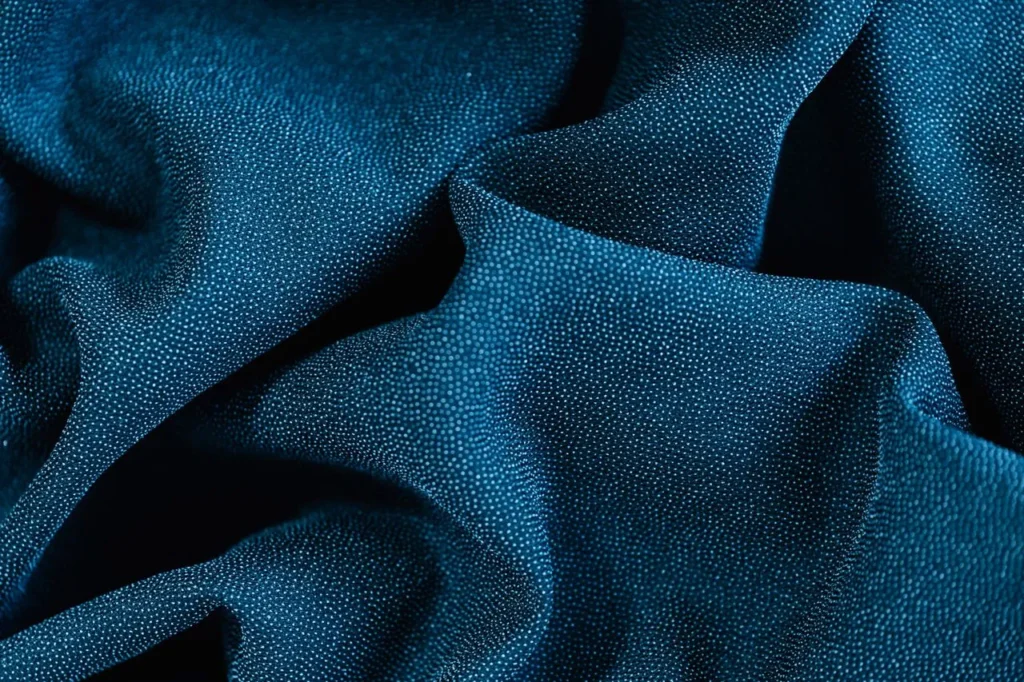
Mesh may refer to bird-eye, micro-mesh, eyelet, pinhole, warp-knit, or interlock-mesh constructions. Interlock is a double-knit structure, but its yarn, stitch length, elastane, finish, and weight also vary. Polyester mesh vs interlock fabric must therefore be compared through exact swatches and specifications, not supplier names alone.
Decision 2: Compare Airflow in Polyester Mesh vs Interlock Fabric
Airflow is the clearest advantage commonly associated with mesh. The openings in polyester mesh can allow more air to pass through the garment, which may improve ventilation during running, football, basketball, cycling, or indoor training.
Interlock has a more compact structure. This usually gives it a smoother surface and stronger coverage, but it can restrict air exchange compared with an open mesh of similar fibre content.
A 2025 study of selected knitted sportswear structures found much higher air permeability in its interlock-mesh sample than in compact interlock, while compact interlock provided better dimensional stability. This shows why polyester mesh vs interlock fabric should be compared across several properties. ASTM D737-18(2023) measures fabric air permeability; reports should identify the exact specimen, pressure, unit, and condition.
Mesh is often useful across the back, underarms, sides, sleeves, and other ventilation zones. Interlock is often safer on sponsor panels, number zones, pale colours, shoulders, collars, hems, school uniforms, and replica jerseys requiring stable repeat washing.
Brands developing products for hot climates can connect this decision with the BUSHI Sports® guide to sportswear for extreme heat.
Air Permeability Is Not Complete Cooling Proof
High airflow does not prove complete cooling. Temperature, humidity, fit, evaporation, and layering also matter. ISO 11092:2026 measures thermal and water-vapour resistance, while finished-jersey wear trials remain necessary.
Decision 3: Compare Moisture in Polyester Mesh vs Interlock Fabric
Fabric structure and finish determine how sweat wets, spreads, transfers, and dries, so polyester mesh vs interlock fabric cannot be judged through fibre content alone.
An open mesh may expose more surface area to moving air and can dry rapidly when the climate supports evaporation. However, a poorly engineered mesh may allow sweat to remain in concentrated areas or feel rough against the skin.
Interlock provides greater contact area and can be engineered to spread liquid effectively across the fabric. In the 2025 knitted-structure study, both interlock and interlock mesh showed useful moisture-management behaviour, and the mesh version performed strongly under the selected construction parameters.
AATCC TM195 measures and classifies liquid-moisture-management properties in knitted, woven, and nonwoven fabrics. A useful test programme can also include vertical wicking, horizontal wicking, drying time, and drying rate.
When comparing polyester mesh vs interlock fabric, review wetting time, spreading, one-way transport, drying time, wet weight, cling, and performance after repeated washing.
Test the Finished Jersey
A moisture finish should be checked after laundering. Dense transfers, crests, double layers, seam tape, and undershirts can also alter moisture movement, so test the decorated jersey with its intended base layer.
Decision 4: Compare Durability in Polyester Mesh vs Interlock Fabric
The next polyester mesh vs interlock fabric decision concerns strength and long-term appearance. Mesh creates ventilation by opening the structure, but those openings can increase the risk of snagging, local stretching, transparency, or seam distortion when the construction is too loose.
Interlock is commonly valued for dimensional stability, smoothness, balanced stretch, and a substantial hand. These characteristics can make it easier to maintain jersey measurements, graphic placement, and shape through repeated washing.
Bursting Strength
Sports jerseys experience multidirectional stress rather than only straight-line pulling. ISO 13938-2:2019 provides a pneumatic method for determining bursting strength and bursting distension of fabrics.
The correct limit depends on the product tier and expected use.
Opacity
Opacity should be checked dry, wet, stretched, in direct light, across colours, and after repeated washing.
Interlock usually provides a safer base for white, yellow, or pastel jerseys. Mesh may need a smaller hole pattern, additional density, strategic placement, or a different colour to maintain coverage.
Dimensional Change
ISO 5077:2007 specifies a method for determining dimensional change after suitable washing and drying procedures. Compare body length, chest, sleeve, and panel alignment before and after testing.
The article on sports uniform sizing explains why even a small fabric or shrinkage change can alter the intended fit across a team order.
Snagging and Surface Damage
Open mesh can catch on hook-and-loop closures, rough benches, equipment, jewellery, or other garments. Compact interlock can also snag, but its smoother surface may be easier to protect. The exact risk depends on filament quality, loop stability, finish, and use.
Decision 5: Compare Printing in Polyester Mesh vs Interlock Fabric
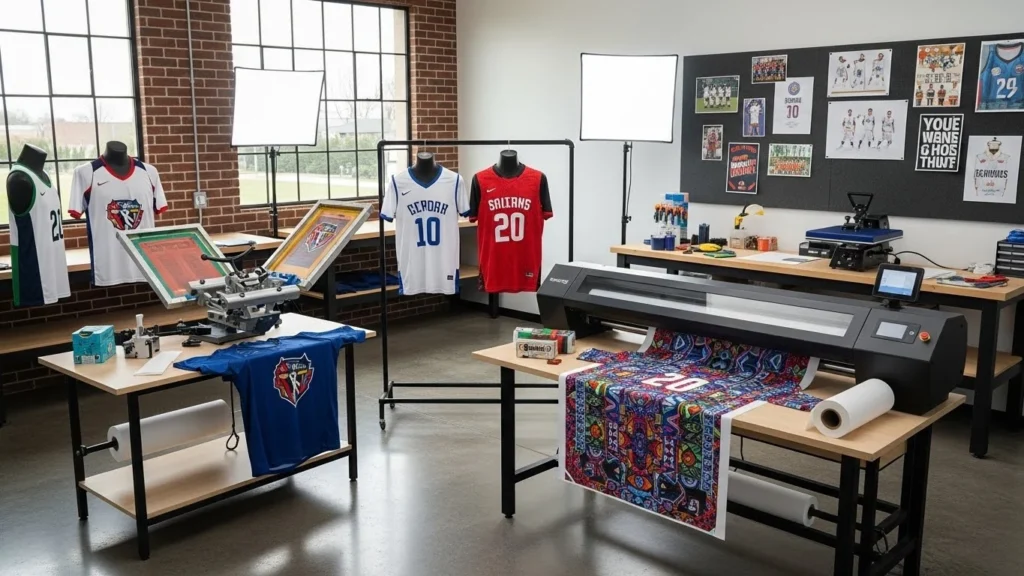
For custom sports jerseys, artwork performance can decide the polyester mesh vs interlock fabric outcome. Interlock normally offers a smooth, continuous surface that supports fine patterns, sponsor text, gradients, numbers, and photographic sublimation.
Mesh can also be sublimated, but visible openings and surface texture may interrupt small text or thin lines. Artwork may appear lighter because less printed fibre is visible within a given area. The difference can become especially noticeable when mesh and interlock panels meet in one colourway.
Before approval, compare physical strike-offs for colour strength, fine details, gradients, sponsor readability, number edges, panel alignment, shade matching, and appearance under stretch.
Branding Applications
Heat transfers, silicone crests, embroidery, and patches need a stable base. A very open mesh may not provide enough continuous surface for small adhesive details. It may also distort around dense applications.
Interlock generally provides stronger support for:
- Heat-applied sponsors
- Woven crests
- Silicone or TPU badges
- Embroidery in suitable designs
- Large player numbers
Mesh branding can still work when the application, backing, placement, and heat settings are engineered for the fabric.
BUSHI Sports® explains artwork preparation in why vector artwork matters for sportswear printing and how to prepare print-ready files.
Decision 6: Compare Fit in Polyester Mesh vs Interlock Fabric
Polyester mesh vs interlock fabric affects pattern measurements and sewing behaviour. A mesh panel may extend, recover, or grow differently from the interlock body. Joining two fabrics without checking compatibility can create rippled seams, twisted panels, mismatched lengths, or uneven hems.
The development team should compare lengthwise and widthwise stretch, recovery, growth, shrinkage, thickness, curling, needle response, differential feed, and seam strength.
Pattern Allowance
A jersey pattern approved in interlock should not automatically be cut in mesh without a fit trial. The mesh may require adjusted ease, seam length, or panel shape. This is especially important in slim match jerseys and women’s or youth blocks.
Seam Selection
Possible constructions include overlock, coverstitch, flatlock, and bonded seams. Control the needle, thread, stitch density, differential feed, seam allowance, panel alignment, and heat exposure. Stretch and wash the sample before approval. The BUSHI Sports® sportswear sample approval checklist provides a complete PP-sample inspection process.
Decision 7: Compare Cost in Polyester Mesh vs Interlock Fabric
The final polyester mesh vs interlock fabric decision is commercial. Interlock can simplify sourcing because one stable main fabric may cover the complete jersey. A hybrid jersey using multiple meshes can increase performance but also increases material codes, cutting operations, sewing time, colour matching, inspection points, and minimum order considerations.
Cost is influenced by yarn quality, GSM, finishing, custom mesh structure, number of materials, moisture treatments, sublimation behaviour, seams, testing, quantity, and colour range.
Bulk Colour Consistency
Mesh and interlock reflect light differently. Two panels printed from the same digital colour may not look identical. The buyer should approve a physical panel combination rather than isolated swatches.
Fabric Substitution
A supplier should not replace one mesh or interlock with a visually similar alternative without written approval. The change may affect airflow, fit, opacity, printing, strength, and price.
Buyers concerned about synthetic-fibre release can also review microfiber shedding in polyester sportswear. The exact finished fabrics should be tested because construction and finishing influence shedding behaviour.
Which Fabric Is Better for Each Jersey Type?
| Jersey application | Recommended direction | Reason |
| Elite hot-weather match jersey | Hybrid: stable interlock plus mapped mesh | Balances graphics, coverage, and ventilation |
| Standard club match jersey | Lightweight interlock or controlled micro-mesh | Depends on climate, durability, and design |
| Academy or school uniform | Interlock-dominant construction | Opacity, stability, repeat washing, and easy reorders |
| Basketball or indoor training jersey | Mesh or mesh-dominant construction | Airflow and low bulk can be prioritized |
| Retail replica jersey | Interlock | Smooth feel, print quality, regular fit, and durability |
| Goalkeeper jersey | Interlock body with selected mesh zones | Supports graphics and coverage while allowing ventilation |
| Fanwear shirt | Interlock or product-specific knit | Comfort, appearance, and retail presentation |
Polyester Mesh vs Interlock Fabric: The Practical Verdict
For most team programmes, interlock is the safer main-body fabric for opacity, stable sizing, detailed sublimation, and repeated washing. Mesh is often better for ventilation zones and hot or high-intensity conditions.
The strongest polyester mesh vs interlock fabric solution is frequently not an either-or choice. A hybrid jersey can place interlock on the chest, shoulders, and number zones while using mesh on the back, underarms, or side body. The two fabrics must still be compatible in stretch, shrinkage, colour, seam behaviour, and care.
Polyester Mesh vs Interlock Fabric Testing Checklist
| Property | Useful method or check | Why it matters |
| Air permeability | ASTM D737 | Compares airflow through the fabric |
| Thermal and vapour resistance | ISO 11092:2026 | Compares heat and water-vapour behaviour |
| Liquid moisture management | AATCC TM195 | Evaluates wetting, spreading, and transfer |
| Bursting strength | ISO 13938-2 | Assesses multidirectional fabric strength |
| Dimensional change | ISO 5077 with approved laundering procedure | Checks shrinkage and growth |
| Opacity | Dry, wet, stretched, and direct-light review | Prevents exposure complaints |
| Sublimation | Physical strike-off and wash test | Confirms colour and artwork quality |
| Stretch and recovery | Buyer-approved laboratory method | Protects fit and panel compatibility |
| Snagging and pilling | Relevant buyer or recognized test | Supports durability decisions |
| Finished-jersey trial | Fit, movement, wash, and wear review | Confirms the complete product system |
Polyester Mesh vs Interlock Fabric Supplier Questions
- Which exact mesh and interlock structures are available?
- What are the yarn type, GSM, thickness, and stretch values?
- Can airflow, moisture, strength, and wash results be supplied?
- Are pale colours opaque under stretch?
- Can both materials be sublimated to a matching shade?
- Which fabric supports the selected crest and sponsor method?
- Will the final fabric be used for the size set and PP sample?
- What tolerances and MOQ apply?
- Can materials change without written approval?
Why Work With BUSHI Sports®?
BUSHI Sports® supports brands, clubs, academies, schools, retailers, and distributors with mesh and interlock comparison, custom jerseys, sublimation, patterns, size sets, PP samples, personalization, labels, packaging, quality inspection, and bulk-order coordination.
A clear polyester mesh vs interlock fabric brief should state the sport, climate, product tier, fit, colour, artwork, sizes, quantity, tests, price target, and delivery date.
Frequently Asked Questions
What is the main difference in polyester mesh vs interlock fabric?
Mesh uses a more open construction that usually provides greater airflow. Interlock is a compact double-knit construction that usually provides a smoother print surface, stronger opacity, and greater dimensional stability.
Is mesh always cooler than interlock?
Mesh commonly allows more air to pass through, but perceived cooling also depends on humidity, fit, sweat evaporation, garment panels, and layering. The exact fabrics should be tested under the same conditions.
Is interlock suitable for professional match jerseys?
Yes. Lightweight engineered interlock can be used for match jerseys, especially when the product requires detailed graphics, stable fit, and opacity. Mesh panels can be added for targeted ventilation.
Which fabric is better for sublimation?
Interlock usually provides the smoother and more continuous sublimation surface. Mesh can also be sublimated, but holes and texture may reduce fine-detail clarity or change apparent colour strength.
Which fabric is more durable?
A compact interlock often provides stronger stability and snag resistance, but durability depends on yarn quality, GSM, stitch construction, finishing, and testing. A high-quality mesh can outperform a weak interlock.
Can mesh and interlock be used in one jersey?
Yes. Hybrid construction is common and can balance ventilation with coverage and print quality. The two materials must be tested for stretch, shrinkage, colour matching, seam compatibility, and washing.
Which fabric is better for youth team uniforms?
Interlock is often the safer main-body option because it supports opacity, stable sizing, and repeat washing. Controlled mesh panels can be added when the climate or sport requires extra ventilation.
What should be approved before bulk production?
Approve the exact fabric codes, GSM, stretch, colour, artwork, measurements, seam construction, test results, labels, packaging, and pre-production sample before bulk cutting.
Conclusion
Polyester mesh vs interlock fabric is not simply breathable versus durable. Performance depends on yarn, stitch design, density, weight, finish, stretch, printing, and garment architecture.
Mesh is usually stronger for ventilation zones and low-bulk hot-weather products. Interlock is usually safer for opacity, smooth sublimation, stable sizing, branding support, and repeated washing. A controlled hybrid often provides the best balance, provided sampling confirms compatible colour, stretch, shrinkage, seams, and care.
BUSHI Sports® supports polyester mesh vs interlock fabric selection through material comparison, patterns, sublimation, size sets, PP samples, labels, quality control, packaging, and international bulk manufacturing.
To discuss a custom jersey project, email info@bushisports.com, message BUSHI Sports® on WhatsApp at +92 348 4018 578, or submit your requirements through the contact page.