Sportswear stitching is easy to overlook, yet it has a direct effect on comfort, stretch, durability, and appearance. A premium performance fabric cannot prevent popped seams, rough internal edges, wavy hems, or loose waistbands when the wrong stitch is used.
The types of stitching used in sportswear manufacturing vary because every product behaves differently. A team jersey needs flexible panel seams and clean hems. Compression tights need low-bulk construction that stretches with the body. A tracksuit may require stable lockstitching, while a sports glove needs precise reinforcement around small curved panels.
This guide explains 12 important sportswear stitch types, where they are used, how they differ, and what should be checked before bulk production.
What Is Sportswear Stitching?
Sportswear stitching refers to the industrial sewing methods used to join, finish, reinforce, shape, or decorate athletic garments and performance accessories. It includes visible sewing around hems and panels as well as hidden construction inside waistbands, necklines, gloves, pockets, cuffs, and side seams.
A stitch and a seam are not exactly the same. A stitch is the thread formation created by the sewing machine. A seam is the complete construction that joins two or more layers of material.
The ISO 4915 standard classifies and illustrates machine- and hand-sewn stitch types. Common industrial references include 301 for lockstitch, 401 for chainstitch, 504 for three-thread overedge, 514 for four-thread overedge, and 516 for a five-thread safety stitch. These codes make sportswear stitching instructions more precise.
Why Sportswear Stitching Matters
Athletic garments are exposed to bending, twisting, stretching, impact, sweat, abrasion, and repeated washing. The seam must respond to those conditions without breaking or restricting movement.
A four-way stretch polyester-spandex fabric may extend easily, but a rigid stitch can limit that extension. Force then concentrates around the needle holes and may break the thread or damage the fabric.
Comfort is equally important. Bulky seam allowances may rub the skin during running, cycling, or gym training. This is why compression apparel, base layers, sports bras, and workout leggings often use flatter seams in high-contact areas.
Good sportswear stitching should provide:
- Suitable stretch and recovery
- Strength in high-stress areas
- Low bulk and comfort
- Clean, repeatable bulk-production quality
- Compatibility with the selected fabric and thread
“Performance fabric reaches its full value only when the stitching can stretch, recover, and endure with it.” — BUSHI Sports®
Comparison of Sportswear Stitch Types
| Stitching type | Common reference | Main purpose | Typical application |
|---|---|---|---|
| Single-needle lockstitch | 301 | Controlled joining | Pockets, labels, zippers and jackets |
| Double-needle lockstitch | Two 301 rows | Reinforcement and styling | Tracksuits and panel seams |
| Chainstitch | 401 | Flexible joining | Knit panels and waistbands |
| Three-thread overlock | 504 | Edge finishing | Mesh, linings and light panels |
| Four-thread overlock | 514 | Stretch-fabric assembly | Jerseys, T-shirts and leggings |
| Five-thread safety stitch | 516 | Strong joining and edge control | Shorts, pants and jackets |
| Coverstitch | Often 406 | Hemming and binding | Sleeve, bottom and leg hems |
| Flatlock or flatseam | Often 606 or 607 | Low-profile joining | Compression wear and base layers |
| Zigzag stitch | 304 | Flexible attachment | Elastic, appliqué and glove parts |
| Bartack | Programmed cycle | Local reinforcement | Pockets, tabs and stress points |
| Multi-needle elastic stitch | Varies | Elastic attachment | Waistbands and sports bras |
| Binding and topstitching | Varies | Edge control and decoration | Necklines, armholes and cuffs |
1. Single-Needle Lockstitch
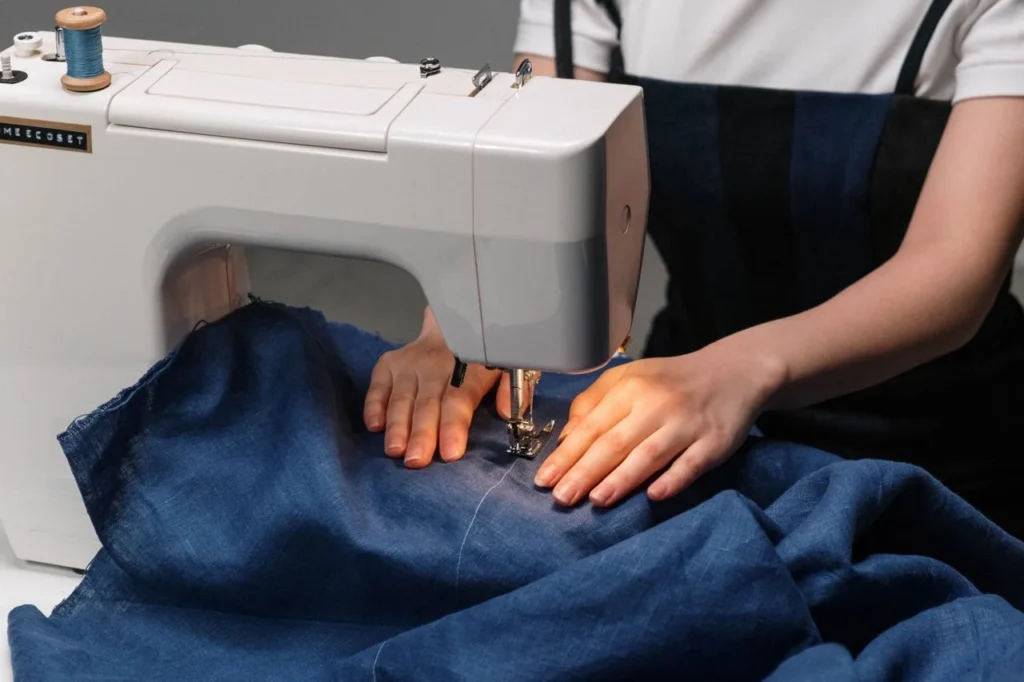
Single-needle lockstitch is one of the most widely used forms of sportswear stitching. A needle thread interlocks with a bobbin thread inside the material, creating a neat and controlled line.
It is commonly used for labels, pockets, zippers, plackets, woven panels, patches, hook-and-loop tape, and visible topstitching.
Its main limitation is stretch. A standard lockstitch can break when placed across a highly elastic area. The manufacturer must select the right thread, tension, stitch length, and seam direction, then test the construction on the final fabric.
2. Double-Needle Lockstitch
Double-needle lockstitch produces two parallel lines during one operation. It is used on tracksuit panels, athletic trousers, pockets, jackets, waistbands, and decorative style lines.
However, two rows do not automatically make a seam twice as strong. Fabric structure, needle size, thread, stitch density, and seam allowance still determine performance.
Needles placed too close together may perforate lightweight fabric. A reliable custom apparel manufacturer should therefore test double-needle sportswear stitching on the approved material rather than copying settings from another garment.
3. Chainstitch
Chainstitch is formed when the needle thread interloops with a looper thread beneath the fabric. Its chain-like underside contains additional thread, giving the seam useful flexibility.
This sportswear stitching method may be used for knit panels, side seams, shoulder seams, waistbands, tapes, elastic, and decorative multi-needle rows. It works well where controlled movement is required.
The seam ends must be secured because a damaged or loose chain can unravel. Factories may overlap, backtack, enclose, or pull the thread tail into another seam.
4. Three-Thread Overlock
Three-thread overlock uses one needle thread and two looper threads. The loopers wrap the cut edge while the machine normally trims excess material.
It is suitable for lightweight mesh, linings, pocket bags, jersey edges, and low-stress internal areas.
However, three-thread overlock should not replace a stronger joining stitch in high-tension areas simply to reduce cost. Tight leggings, underarms, and heavily loaded side seams normally require greater security. Edge finishing and structural joining are different functions, even when the visible stitches look similar.
5. Four-Thread Overlock
Four-thread overlock is one of the most common sportswear stitching methods used in activewear manufacturing. It normally contains two needle threads and two looper threads, joining stretch panels while covering the raw edges.
It is widely used for sports jerseys, training T-shirts, workout leggings, sports bras, compression tops, and stretch shorts.
Differential feed is important. Lightweight polyester, mesh, rib, and elastane blends may stretch while passing beneath the presser foot, creating wavy seams. Brands working with a custom activewear manufacturer should test the seam at the garment’s expected extension.
6. Five-Thread Safety Stitch
Five-thread safety stitching combines a chainstitch joining line with an overedge finish. It creates a secure seam while controlling the cut edge.
This sportswear stitching method is commonly used for woven training shorts, tracksuit pants, warm-up jackets, pocket bags, casual athletic trousers, and stable uniform panels.
The added structure improves security but can create unnecessary bulk in close-fitting apparel. A woven short and a compression tight therefore require different solutions.
The BUSHI Sports® guide to sublimation versus cut-and-sew manufacturing explains how panel design and seam complexity affect performance and production.
7. Coverstitch
Coverstitch creates the parallel rows commonly seen on T-shirt, sleeve, and legging hems. A looper thread covers the reverse side, keeping the edge flexible and controlled.
It is used for bottom hems, sleeve hems, necklines, bindings, elastic edges, sports bra openings, tank tops, and decorative seams. The formation stretches with knitted fabric more effectively than a rigid straight hem.
Good coverstitching should remain flat, even, and flexible. Poor settings may create tunneling, skipped stitches, loose underside coverage, exposed raw edges, or wavy hems.
8. Flatlock and Flatseam Stitching
Flatlock or flatseam construction creates a low-profile seam with less internal bulk. The fabric edges may be butted or slightly overlapped depending on the machine and specification.
This sportswear stitching technique is common in compression shirts, tights, cycling apparel, running tops, sports bras, thermal layers, yoga clothing, and triathlon garments. It is particularly useful where the seam touches the skin.
Not every seam described as flatlock is a true 606 or 607 flatseam. Some garments use an opened overlock seam with coverstitching. Buyers should include a seam drawing or approved sample instead of relying on the name alone.
As a useful production reference, JUKI lists a four-needle 607 flatseamer with a maximum speed of 4,200 stitches per minute, showing how specialized and high-speed this operation can be.
9. Zigzag Stitch
Zigzag stitching moves from side to side rather than forming one straight line. This geometry allows it to open when the material stretches.
It may be used for elastic, appliqué, hook-and-loop components, straps, flexible reinforcement, and selected sports glove parts.
The width, tension, and density must match the component. Very dense stitching can damage lightweight elastic or make it stiff. A loose zigzag may fail to hold the material securely.
10. Bartack Reinforcement
A bartack is a concentrated group of stitches placed at a high-stress point. It is commonly found at pocket openings, zipper ends, drawcord points, side slits, glove tabs, webbing ends, and strap attachments.
More stitches are not always better. An excessively dense bartack can cut delicate fabric by placing too many needle holes in one small area.
The technical specification should show the exact location, length, width, thread color, and any backing material required.
11. Multi-Needle Elastic Stitching
Elastic attachment is essential in workout leggings, sports bras, compression shorts, and waistbands. The elastic must stretch comfortably, recover quickly, and remain evenly distributed.
Multi-needle sportswear stitching uses several parallel rows to attach or cover elastic.
Uneven feeding can make the waistband twist, ripple, feel too tight, or vary between garments. A custom workout leggings manufacturer must control the elastic extension ratio, needle spacing, fabric feed, stitch density, and finished measurement.
12. Binding and Decorative Topstitching
Bindings finish raw edges around necklines, armholes, glove openings, pockets, and straps. They may be applied with lockstitch, chainstitch, coverstitch, or another specialized formation.
This form of sportswear stitching protects the edge while contributing to the design.
The binding should remain even, fully capture the raw edge, and recover after stretching. Decorative topstitching must not restrict movement, create a rough internal surface, or perforate lightweight performance fabric unnecessarily.
Flatlock vs Overlock vs Coverstitch
| Feature | Overlock | Coverstitch | Flatlock or flatseam |
| Main function | Join panels and cover raw edges | Hem, bind, or cover an allowance | Create a low-profile joining seam |
| Edge trimming | Usually yes | Usually no | Depends on construction |
| Common position | Side seams, shoulders and sleeves | Bottom, sleeve and leg hems | Inseams, underarms and body panels |
| Stretch | Good when adjusted correctly | Good | Very good when correctly engineered |
| Internal bulk | Moderate | Low at the edge | Low across the seam |
| Common products | Jerseys and activewear | T-shirts, leggings and sports bras | Compression wear and base layers |
A fitted training top can be assembled with four-thread overlock, hemmed with coverstitch, and use flat seams in areas that touch the skin. Effective sportswear stitching is a coordinated system rather than one machine choice.
Best Sportswear Stitching by Product
| Product | Recommended starting construction | Areas to test |
| Team jersey | Four-thread overlock, coverstitch and binding | Underarms, neckline, hems and graphic alignment |
| Workout leggings | Flatlock or flexible overlock, coverstitch and elastic stitching | Crotch, inseam, waistband and leg openings |
| Sports bra | Overlock, coverstitch, binding and elastic attachment | Underband, straps and side seams |
| Compression shirt | Flatseam, coverstitch and flexible binding | Underarms, shoulders and torso panels |
| Running shorts | Overlock or safety stitch, bartacks and elastic stitching | Crotch, pockets, side slits and waistband |
| Tracksuit | Lockstitch, safety stitch, topstitch and bartacks | Zippers, pockets, cuffs and waistband |
| Sports gloves | Lockstitch, zigzag, binding and reinforcement | Fingers, palm, thumb and closure |
A sports uniform manufacturer may use flexible stitching for team jerseys but switch to lockstitch and safety stitch for woven shorts.
A custom sports gloves manufacturer must manage tighter curves, padding, grip materials, and concentrated flexing.
Thread, Needle, and Stitch Density
Sportswear stitching cannot be selected separately from the thread and needle. Polyester sewing thread is common because it offers useful strength, colorfastness, and production consistency. Textured polyester may be used in loopers where softness, coverage, and extension are important.
The needle must carry the thread without damaging the material. Knitted fabrics commonly require a ballpoint or stretch-appropriate needle that moves between loops.
Stitch density is usually measured in stitches per inch. Higher density may improve security up to a point, but excessive needle penetrations can weaken fabric, reduce extension, increase puckering, and generate heat.
The correct combination depends on:
- Fabric construction and GSM
- Fiber composition
- Elastane percentage
- Stretch direction
- Thread type and size
- Needle point and diameter
- Seam width
- Required durability
- Garment fit and end use
Common Sportswear Stitching Defects
Samples should be inspected while relaxed, stretched, and washed. Common defects include:
- Skipped or broken stitches
- Open or gaping seams
- Uneven stitch density
- Wavy hems and stretched panels
- Seam puckering
- Coverstitch tunneling
- Needle holes and damaged knit loops
- Raw edges escaping from overlock coverage
- Loose chain ends
- Incorrect bartack placement
- Uneven seam allowance
- Visible restitching or repairs
Wavy seams often appear when stretch material is pulled during sewing. Seam popping usually indicates that the construction cannot extend enough.
The BUSHI Sports® sportswear sample approval checklist covers stitch type, density, thread quality, seam allowance, overlock coverage, flatlock appearance, bartacks, hems, waistbands, and workmanship defects.
How to Test Sportswear Stitching
A seam that looks clean while lying flat may still fail during movement. Testing should reflect the intended use.
Stretch the seam in the direction it will be loaded and check for thread cracking, gapping, broken stitches, or fabric damage.
Allow the garment to recover after stretching. The seam should return without permanent waviness or distortion. Wash the sample according to its intended care instructions and inspect it again for puckering, shrinkage, twisting, thread damage, and elastic relaxation.
High-stress zones such as crotches, inner thighs, underarms, shoulders, waistbands, pocket openings, glove palms, and finger joints need additional trials.
For formal woven-fabric evaluation, ASTM D1683/D1683M describes a method for testing sewn-seam failure strength.
How to Add Sportswear Stitching to a Tech Pack
A technical pack should never say only “use durable stitching.” That instruction cannot be measured.
For every sewing operation, specify:
- Garment location
- Seam drawing
- Stitch type or reference
- Number of needles and threads
- Stitch density
- Seam width and allowance
- Thread type, size, and color
- Reinforcement or bartack position
- Required stretch and appearance
- Wash and performance tests
A sportswear stitching specification may look like this:
Garment area: Legging inseam
Stitch construction: Four-needle flatseam
Thread: Soft polyester thread suitable for stretch apparel
Performance requirement: Must extend with the approved fabric without cracking or gapping
Appearance requirement: Even coverage with no exposed edge, skipped stitches, or irregular seam width
Testing: Stretch, movement, recovery, and wash approval before bulk production
Sportswear Stitching at BUSHI Sports®
BUSHI Sports® is a Sialkot-based custom sportswear manufacturer supporting OEM, ODM, private-label, wholesale, and bulk manufacturing for sports brands, teams, clubs, academies, retailers, distributors, and gyms.
Sportswear stitching is selected according to fabric composition, stretch direction, fit, seam position, branding, stress level, and target use.
A training shirt may need four-thread overlock and coverstitched hems. Compression apparel may need flat seams and controlled elastic. Woven shorts may combine safety stitch, lockstitch, and bartacks. Gloves require precise curved seams and localized reinforcement.
The company’s sportswear manufacturing services include product development, materials, sampling, customization, branding, production, quality inspection, packaging, and international delivery.
Frequently Asked Questions
What is the best sportswear stitching for stretch fabric?
Four-thread overlock, coverstitch, chainstitch, flatlock, and selected zigzag formations are commonly used. The best option depends on whether the operation joins panels, forms a hem, attaches elastic, or reduces seam bulk.
What stitching is used for sports jerseys?
Sports jerseys often use four-thread overlock for panel assembly, coverstitch for sleeve and bottom hems, and binding or another flexible method around the neckline.
Is flatlock better than overlock?
Flatlock is usually better for low-bulk, close-to-skin seams. Overlock is more efficient for general knitted-garment assembly.
Why do sportswear seams become wavy?
Waviness often occurs when stretch fabric is pulled during sewing. Incorrect differential feed, presser-foot pressure, tension, density, or operator handling may contribute.
What does SPI mean?
SPI means stitches per inch. It describes stitch density.
Can one garment use several stitch types?
Yes. One garment may use overlock for assembly, coverstitch for hems, lockstitch for pockets, flatlock at skin-contact areas, and bartacks at stress points.
Conclusion
Sportswear stitching determines whether performance apparel can stretch, recover, remain comfortable, and survive repeated use. The correct choice depends on fabric structure, seam location, thread, needle, density, tension, fit, and end use.
Lockstitch provides control. Chainstitch adds flexibility. Overlock joins and covers knitted edges. Safety stitch supports stable construction. Coverstitch creates flexible hems. Flatlock reduces bulk. Zigzag, bartacks, multi-needle stitching, and binding solve specialized attachment and reinforcement needs.
Brands should approve sportswear stitching through a physical sample, movement trial, wash test, and documented technical specification before bulk production.
BUSHI Sports® provides custom sportswear manufacturing, private-label sportswear, custom teamwear, activewear, sports uniforms, gloves, casual wear, outerwear, and equestrian gear for international B2B buyers.
Discuss a project through the BUSHI Sports® contact page, send requirements by WhatsApp, or email info@bushisports.com.