Equestrian Show Shirts: Fabric, Fit and Competition Requirements
Equestrian Show Shirts combine competition presentation with the comfort and mobility required for riding. Unlike a conventional formal shirt, a riding show shirt needs to remain comfortable while the rider holds a fixed upper-body position, moves through the shoulders and arms, wears a competition jacket, manages perspiration and spends extended periods at the showground.
For equestrian brands, developing Equestrian Show Shirts therefore requires more than selecting a white fabric and adding a stand collar. Fabric stretch, moisture management, opacity, collar construction, sleeve fit, placket design, seam position, branding and competition requirements all affect the final product.
A shirt that looks professional while standing can become restrictive once the rider takes the reins. A fabric that feels lightweight can become too transparent in white. A collar that photographs well may feel uncomfortable underneath a jacket. These details need to be resolved during product development rather than after bulk production.
This guide explains how Equestrian Show Shirts should be developed for competition-focused collections, from fabric selection and fit to collars, ventilation, branding, samples and private label manufacturing.
BUSHI Sports® supports custom equestrian show shirt manufacturing for equestrian brands, wholesalers, retailers and riding businesses requiring custom designs, fabrics, colors, labels, OEM, ODM and private label production.
Table of Contents
- What Makes an Equestrian Show Shirt Different?
- Fabric Selection for Competition Riding
- Stretch and Mobility
- Moisture Management and Breathability
- Opacity and Fabric Weight
- Competition Fit and Pattern Design
- Collar and Placket Construction
- Sleeve and Shoulder Design
- Ventilation Panels and Technical Features
- Competition Requirements
- Branding and Logo Placement
- Designing Men’s, Women’s and Youth Styles
- Technical Specifications and Tech Packs
- Sampling and Fit Testing
- Private Label Manufacturing
- Frequently Asked Questions
What Makes Equestrian Show Shirts Different?
Equestrian Show Shirts occupy an unusual position between formal competition apparel and technical sportswear. The garment normally needs to look clean and refined while still supporting the movement, heat management and comfort expected from performance clothing.
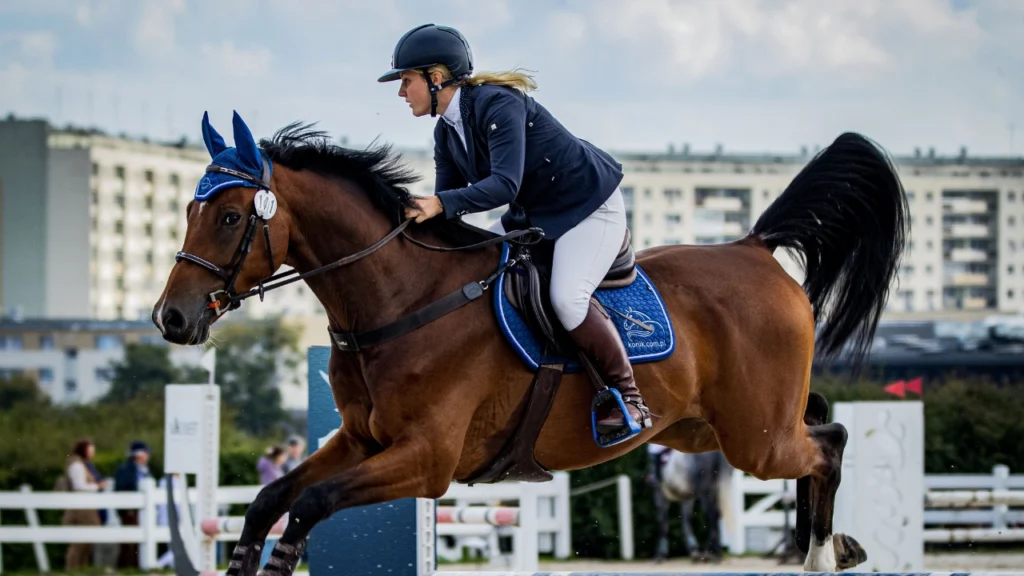
The rider’s posture creates specific demands. Arms remain forward while holding the reins, shoulders move as the horse moves, and the torso repeatedly adjusts during transitions and jumping. The shirt may also sit beneath a structured show jacket, which changes how fabric bulk, sleeve construction and collar height feel during competition.
These requirements mean that conventional fashion-shirt construction cannot simply be copied into Equestrian Show Shirts without considering riding movement. The pattern, fabric and finishing need to work together.
A good competition shirt should maintain a professional silhouette without feeling restrictive. It should remain stable when tucked into breeches, provide enough length through the body, allow shoulder movement and avoid excess fabric that bunches beneath a jacket.
| Design Area | Main Requirement | Common Problem |
|---|---|---|
| Fabric | Lightweight performance with coverage | Excess transparency |
| Stretch | Shoulder and torso mobility | Restriction during riding |
| Collar | Professional competition appearance | Excess pressure or stiffness |
| Placket | Secure closure and clean finish | Bulk beneath jacket |
| Sleeves | Mobility and close fit | Pulling across shoulders |
| Body Length | Remains tucked securely | Shirt pulling out |
| Ventilation | Heat management | Poor visual integration |
| Seams | Low bulk and durable | Irritation under jacket |
| Branding | Refined and competition appropriate | Oversized decoration |
The most successful Equestrian Show Shirts balance these features rather than maximizing any one characteristic.
Fabric Selection for Equestrian Show Shirts
Fabric is one of the most important development decisions because it influences fit, temperature regulation, opacity, appearance and laundering at the same time.
Technical polyester and polyester-elastane constructions are common directions for performance riding shirts because they can provide lightweight comfort, dimensional stability and useful drying performance. Nylon-elastane can also be considered when a brand wants a particularly smooth hand feel and flexible close fit.
Some collections use mixed structures, combining a more refined main body fabric with breathable mesh or perforated technical fabric in selected areas.
The decision should be based on how the finished Equestrian Show Shirts are intended to perform rather than on fiber composition alone.
Two fabrics with similar composition percentages can differ substantially in surface appearance, stretch, recovery, weight, opacity and moisture behavior.
BUSHI Sports® compares two major performance-fabric families in its polyester versus nylon guide. Brands developing a full equestrian collection can use those principles alongside product-specific sample testing.
Equestrian Show Shirts Need Controlled Stretch
Stretch helps a show shirt follow the rider’s upper body without excessive pulling. The requirement is different from compression wear because the goal is generally freedom of movement and shape recovery rather than strong body compression.
Useful stretch becomes particularly important across the shoulders, upper back, chest and sleeves.
When the rider reaches forward toward the reins, the shoulder blades move and the back width effectively increases. A shirt designed only around standing posture may feel tight across this area even when the chest measurement appears correct.
For this reason, Equestrian Show Shirts made from technical stretch fabrics can provide a useful balance between a streamlined competition fit and riding mobility.
Fabric recovery also matters. Material that extends easily but does not recover can gradually create a loose appearance around the elbows, cuffs or torso.
BUSHI Sports® explains the difference between stretch directions in its two-way versus four-way stretch fabric guide.
Moisture Management and Riding Comfort
Competition days can involve far more time in the garment than the duration of the actual class. Riders may warm up, wait between rounds, walk courses, prepare horses and remain outside in changing temperatures.
Equestrian Show Shirts should therefore manage moisture and heat more effectively than an ordinary formal shirt.
A fabric may be described commercially as moisture-wicking, but brands developing technical products should understand what that claim is intended to mean. Liquid transport, absorption, drying speed and water-vapor transmission are related but different textile properties.
AATCC TM195 is an established method for measuring and evaluating liquid moisture-management properties of textile fabrics. AATCC TM195 moisture-management method
For brands, the practical objective is to select material that moves perspiration away from areas where it accumulates, dries efficiently and remains comfortable underneath a show jacket.
Mesh or more open structures can also be incorporated strategically around areas such as the underarm, upper back or side body where additional ventilation is useful.
Breathability Does Not Mean Maximum Mesh
Adding a large amount of visible mesh may improve airflow but can conflict with the refined visual requirements of competition clothing.
The design challenge is to create ventilation without making Equestrian Show Shirts look like gym tops.
Technical jacquard structures, micro-perforated fabrics, discreet mesh panels and engineered zones can provide airflow while maintaining a competition-appropriate appearance.
Ventilation also needs to be tested beneath the jacket.
A highly breathable shirt cannot remove heat effectively if the outer layer prevents vapor movement, so the complete clothing system influences rider comfort.
For warm-weather collections, fabric drying performance can also be evaluated using textile methods such as ISO 17617, which covers moisture-drying properties of textile fabrics. ISO 17617 textile drying-rate standard
Equestrian Show Shirts and Fabric Opacity
White remains important in many competition apparel collections, which makes opacity a significant development issue.
A material may look sufficiently opaque when held flat but become noticeably more transparent when stretched across the chest, shoulders or upper arms.
The issue can become more visible when the garment becomes damp from perspiration.
Equestrian Show Shirts should therefore be reviewed in the actual final color and at realistic wearing tension. White samples should be checked in strong daylight as well as indoor lighting.
Opacity depends on several variables, including yarn, knit density, fabric weight, construction, color and stretch.
Increasing fabric weight may improve coverage in some cases, but simply choosing a heavier material can reduce warm-weather comfort. The development process should find an appropriate balance between coverage and performance.
Choosing the Right Fabric Weight
There is no universal GSM that defines a high-quality competition shirt.
Lightweight fabrics can be comfortable in hot conditions but require sufficient density to maintain coverage. Heavier fabrics may feel more substantial and provide greater opacity but can retain more heat.
A professional development specification for Equestrian Show Shirts should therefore combine fabric weight with other measurable characteristics.
| Fabric Requirement | Why It Matters |
|---|---|
| Composition | Defines basic fiber system |
| GSM | Helps control weight and structure |
| Stretch | Supports riding movement |
| Recovery | Maintains fit after movement |
| Opacity | Protects coverage in light colors |
| Drying Performance | Supports warm-weather comfort |
| Pilling Resistance | Preserves surface appearance |
| Colorfastness | Supports repeat washing |
| Shrinkage | Protects sizing consistency |
The approved fabric reference should eventually become part of the final bill of materials so it can be reproduced during later orders.
Fit Requirements for Equestrian Show Shirts
Fit should support the rider rather than simply follow fashion trends.
Equestrian Show Shirts normally benefit from a controlled athletic fit because excessive material can bunch underneath a competition jacket. However, making the garment excessively tight can restrict movement and create visible pulling around the buttons, zipper, armholes or shoulder.
The body length should also be sufficient to remain tucked during riding.
As the rider raises the arms and moves through the torso, a shirt that appears long enough while standing can lift significantly. Pattern testing should therefore include actual riding posture.
Important points of measurement include chest, waist, hem, shoulder width, back width, armhole, sleeve length, bicep, cuff, body length and collar circumference.
Fit should be reviewed together with fabric stretch. The same pattern can feel significantly different when manufactured in a firmer interlock compared with a highly elastic lightweight knit.
Equestrian Show Shirts for Women
Women’s Equestrian Show Shirts may use a more shaped waist and contoured body while maintaining sufficient mobility around the bust, back and shoulders.
Pattern balance is important because aggressive waist shaping can create pulling across the chest or cause the hem to rise while riding.
Princess-style panel lines can provide shaping, but every additional seam introduces potential bulk underneath a competition jacket. Seam position should therefore have a functional or visual purpose.
The shirt should look refined when the jacket is removed while still remaining comfortable when layered.
For private label brands, several fit directions may be developed, including close athletic, regular competition and relaxed training fits, depending on target customers.
Equestrian Show Shirts for Men
Men’s competition shirts generally require different chest, shoulder, waist and sleeve proportions.
The fit may remain relatively streamlined to prevent excess material underneath a jacket, but sufficient shoulder and back movement is essential.
Placket and collar proportions may also differ from women’s styles depending on the brand’s intended market and discipline.
A unisex shirt can simplify inventory, but it should not automatically replace dedicated men’s and women’s patterns when a brand is positioning itself around technical fit.
Equestrian Show Shirts should ultimately fit the intended customer rather than simply being graded from one generic block.
Collar Design and Competition Presentation
The collar is one of the most visually important parts of Equestrian Show Shirts because it may remain visible even when most of the garment is covered by a jacket.
Collar construction should provide enough stability to maintain a clean shape without becoming unnecessarily rigid.
Depending on the discipline and target market, brands may develop stand collars, traditional-style competition collars, concealed closures or designs intended to coordinate with neckwear.
Collar circumference needs careful attention. A collar that looks perfectly fitted in photography can become uncomfortable after several hours, particularly in warm weather.
The internal finish should also be smooth because the collar remains in continuous contact with the rider’s neck.
Competition requirements vary, so final design decisions should be checked against the current rules of the relevant federation. Brands targeting U.S. dressage can review the official USEF Dressage Rules & Equipment, while international jumping collections should refer to the current FEI Jumping Rules.
Placket and Zipper Design
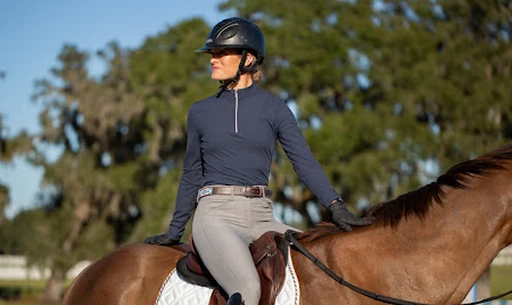
Modern Equestrian Show Shirts frequently use quarter-zippers or concealed front closures because they combine practical dressing with a clean appearance.
The zipper should operate smoothly without creating excessive stiffness through the upper chest.
Zipper length also affects the appearance of the garment. A longer opening can make dressing easier and improve ventilation before competition, while a shorter placket can create a more minimal presentation.
The top zipper stop should be positioned carefully so it does not irritate the chin or neck when fully closed.
Brands can also use covered plackets, concealed snaps or traditional button systems depending on the styling direction.
Whatever system is selected, Equestrian Show Shirts should be tested with the intended competition jacket to make sure the closure remains flat underneath the outer garment.
Shoulder, Sleeve and Armhole Design
The shoulder area deserves more development attention than it often receives.
A rider’s arms are not positioned naturally at the sides during riding. They remain forward, with repeated small adjustments through the shoulder and elbow.
The armhole should therefore provide movement without becoming excessively large.
A very tight armhole can restrict movement and create pressure, while an oversized armhole introduces unnecessary fabric underneath the jacket.
Sleeve construction should also reflect the intended season. Long-sleeve Equestrian Show Shirts can provide a traditional appearance and additional coverage, while short-sleeve versions can support warmer conditions where competition rules permit their use.
Stretch fabrics can help maintain a clean sleeve silhouette while allowing elbow movement.
Cuff Design
Long-sleeve cuffs should remain smooth underneath a jacket sleeve.
Bulky cuffs, large buttons or thick fastening systems can create uncomfortable pressure between the shirt and jacket.
Technical Equestrian Show Shirts may use slim cuffs with stretch, small closures or clean bonded-style finishing depending on the fabric and product position.
Sleeve length should also be coordinated with the show jacket. Excessively long sleeves can bunch inside the jacket, while sleeves that are too short can pull uncomfortably when the rider reaches forward.
The final sample should therefore be tested as part of the complete competition outfit.
Competition Requirements for Equestrian Show Shirts
Competition clothing rules can vary considerably between dressage, jumping, eventing, hunter classes and national federations.
Brands should avoid describing a shirt as universally “competition legal” without identifying the rule system and event category being referenced.
This is especially important for Equestrian Show Shirts sold internationally. A product acceptable under one national federation may encounter different expectations in another competition.
The safest development approach is to identify the intended market during the product brief.
| Product Question | Development Decision |
|---|---|
| Main Discipline | Dressage, jumping, eventing, hunter |
| Competition Level | Local, national, international |
| Governing Body | Relevant federation or organizer |
| Jacket Use | Required, optional or weather dependent |
| Collar Requirement | Verify current rule |
| Neckwear | Verify discipline-specific requirement |
| Shirt Color | Verify permitted presentation |
| Logo Position | Verify applicable branding rules |
Official rulebooks should always take priority over retailer descriptions, competitor products or historical assumptions.
Designing for Hot-Weather Competition
Warm-weather riding creates one of the strongest opportunities for technical Equestrian Show Shirts.
The shirt needs to maintain a formal appearance while managing heat that can build underneath the jacket.
Useful design directions include lighter stretch fabrics, discreet mesh zones, reduced seam bulk and efficient moisture transport.
The collar can also become a heat-management consideration because a tall or heavily structured collar traps warmth around the neck.
Designers should avoid solving warm-weather problems simply by reducing fabric weight to the lowest possible level. Extremely lightweight white materials may compromise opacity, durability or structure.
The strongest product balances coverage and comfort.
Branding Equestrian Show Shirts
Competition apparel generally benefits from controlled branding.
A small silicone logo, high-quality heat transfer, subtle embroidery or refined badge can communicate the brand without overpowering the formal appearance of the shirt.
Possible locations include the chest, collar, upper back or sleeve, subject to competition rules and the intended market.
The decoration method needs to work with the fabric.
Heavy embroidery can stiffen a lightweight technical knit, while an unsuitable transfer may restrict stretch or show adhesive edges.
BUSHI Sports® compares major decoration approaches in its direct embroidery versus embroidered patches guide and silicone badges versus woven patches guide.
Premium Equestrian Show Shirts usually benefit from smaller, accurately positioned branding rather than excessive decoration.
Private Label Equestrian Show Shirts
For private label buyers, Equestrian Show Shirts can be customized well beyond the logo.
Brands can develop their own collar shape, body fit, sleeve configuration, fabric combination, zipper design, ventilation pattern, color palette and label package.
Custom options can include:
- Main performance fabric
- Contrast fabric or mesh
- Short or long sleeves
- Collar height and shape
- Quarter-zip or concealed placket
- Custom panel lines
- Logo placement
- Silicone or heat-transfer branding
- Woven labels
- Size labels
- Care labels
- Hang tags
- Retail packaging
A complete equestrian collection should use consistent design language across shirts, breeches and jackets even when each product has different technical requirements.
Brands planning a wider product program can review the BUSHI Sports® Private Label Equestrian Gear Manufacturing Guide for the complete development and bulk-production process.
Developing a Tech Pack for Equestrian Show Shirts
Once the shirt design has been approved conceptually, all production requirements should be documented.
A tech pack for Equestrian Show Shirts should include front and back technical drawings, fabric references, measurement points, tolerances, collar specifications, zipper information, sleeve measurements, seam construction, logo dimensions, labels, colors and packaging.
The document should also identify areas where ventilation fabric or contrast material is used.
BUSHI Sports® explains the broader documentation process in its sportswear tech pack guide.
Clear technical information reduces interpretation during sampling and becomes particularly important when the style needs to be reordered months later.
Sample Testing Equestrian Show Shirts
A completed shirt should be evaluated beyond the fitting room.
The rider should raise the arms into riding position, reach forward, rotate the shoulders, bend through the torso and wear the shirt under the intended show jacket.
The collar should remain comfortable when fully closed. The body should stay tucked. Sleeves should not pull heavily across the elbow or shoulder. The zipper should remain flat, and ventilation zones should not create visible bulk underneath the jacket.
White Equestrian Show Shirts should also be tested for opacity under realistic lighting and after the fabric has been stretched.
The sample should then be washed according to the intended care instructions and inspected again for shrinkage, twisting, surface change, zipper behavior and logo durability.
The BUSHI Sports® sportswear sample approval checklist provides a broader framework for controlling measurements, fabrics, construction, branding, labels and final approval before bulk production.
Sample Approval Table
| Area | What to Check |
|---|---|
| Collar | Shape, comfort, closure and stability |
| Shoulder | Forward-arm movement |
| Chest | No excessive pulling |
| Back | Mobility in riding posture |
| Sleeve | Length, elbow mobility and jacket compatibility |
| Body Length | Remains tucked during movement |
| Fabric | Stretch, opacity, hand feel and drying |
| Ventilation | Position and visual integration |
| Zipper | Smooth function and comfortable top stop |
| Branding | Size, position and adhesion |
| Seams | Low bulk and clean finishing |
| Washing | Shrinkage, twisting and appearance |
An approved physical sample should become the reference used during bulk manufacturing.
Care Labels and Product Information
Technical fabrics, elastane, transfers and zippers can all respond differently to heat and laundering.
Care instructions should therefore reflect the actual product rather than being copied from another shirt.
BUSHI Sports® explains this process in its sportswear care labels guide.
For private label Equestrian Show Shirts, the final label package may need to include fiber composition, size, care instructions, country-of-origin information and other details depending on the destination market.
Brands should confirm the legal requirements that apply where the garment will be sold.
Building Equestrian Show Shirts Into a Full Collection
A show shirt rarely exists in isolation.
It normally forms part of a wider competition outfit that may include breeches, a show jacket, gloves and riding boots.
For this reason, Equestrian Show Shirts should share a visual relationship with the rest of the collection.
Logo scale, color accents, zipper finishes and design details can be coordinated without making every product identical.
For example, a brand may use the same subtle silicone logo across its breeches and shirt while repeating a small accent color inside the show jacket collar.
Brands developing breeches alongside the shirt can use the BUSHI Sports® Horse Riding Breeches Design Guide to coordinate fit, performance features and private-label development across both products.
Frequently Asked Questions About Equestrian Show Shirts
What fabric is best for Equestrian Show Shirts?
There is no single best fabric for every product. Polyester-elastane and nylon-elastane performance fabrics can both work well when they provide the required stretch, recovery, opacity, moisture behavior and surface appearance. The final selection should reflect climate, competition use, fit and target price.
Should Equestrian Show Shirts have four-way stretch?
Four-way stretch can be beneficial because it supports shoulder, arm and torso movement while maintaining a close competition fit. Recovery is equally important so the garment retains its shape after movement.
Are Equestrian Show Shirts supposed to fit tightly?
They are generally designed with a controlled, relatively streamlined fit so excess material does not bunch underneath a jacket. They should not be so tight that movement is restricted or the fabric pulls excessively across the chest and shoulders.
Why is opacity important in Equestrian Show Shirts?
White and light-colored technical fabrics can become more transparent when stretched or damp. Opacity should therefore be reviewed on the finished garment under realistic lighting and wearing conditions.
Are mesh panels suitable for competition shirts?
Discreet technical mesh can improve ventilation, particularly around the underarms or back. Its visual appearance and placement should remain appropriate for the intended competition market.
Can Equestrian Show Shirts use quarter zippers?
Quarter zippers are commonly used in modern competition-oriented designs because they provide a clean appearance and practical dressing. Exact competition requirements should still be checked for the relevant discipline and federation.
How long should an equestrian show shirt be?
The body should generally be long enough to remain securely tucked during riding movement. Exact length depends on the rider, fit, rise of the breeches and brand pattern.
Can custom logos be added to Equestrian Show Shirts?
Yes. Silicone logos, premium heat transfers, embroidery and other methods can be used depending on the fabric and competition rules. Branding should remain proportionate and should not restrict fabric stretch.
Should Equestrian Show Shirts be sampled before bulk manufacturing?
Yes. Sampling allows the buyer to review fit, riding mobility, collar comfort, opacity, ventilation, zipper function, branding and wash performance before bulk production.
Can BUSHI Sports® manufacture private label Equestrian Show Shirts?
BUSHI Sports® supports custom Equestrian Show Shirts for equestrian brands, wholesalers, retailers and riding businesses, including fabric sourcing, product development, custom fits, collars, short or long sleeves, technical panels, branding, sampling, OEM, ODM, private labels, packaging and bulk production.
Conclusion
Equestrian Show Shirts need to combine the visual discipline expected from competition apparel with the technical performance riders need during warm-up, competition and extended wear. Fabric, fit, stretch, opacity, moisture management, collar structure, sleeve mobility and ventilation all contribute to whether the garment works successfully in a riding environment.
Product development should begin with the target discipline and competition market, followed by a fabric and pattern system designed specifically for riding posture. The collar and placket should maintain a professional appearance without creating unnecessary pressure, while the shoulder and sleeves need enough mobility for the rider’s forward arm position. White and light-colored fabrics should be checked carefully for opacity, and ventilation should be integrated without compromising the refined character of the garment.
For private label brands, Equestrian Show Shirts also provide significant opportunities for differentiation through custom fit, collar geometry, technical fabric combinations, zipper details, subtle branding, labels and coordinated competition collections. These elements should be documented in a complete tech pack and verified through physical samples before entering bulk production.
BUSHI Sports® supports equestrian brands through private label equestrian gear manufacturing, including apparel development, fabrics, sampling, custom branding, OEM, ODM, quality control, packaging and international bulk production.
To discuss your sample or custom order for Equestrian Show Shirts, contact BUSHI Sports® through the contact page, send details by WhatsApp, or email info@bushisports.com.
You can also view the company location on Google Maps or connect with BUSHI Sports® on LinkedIn.