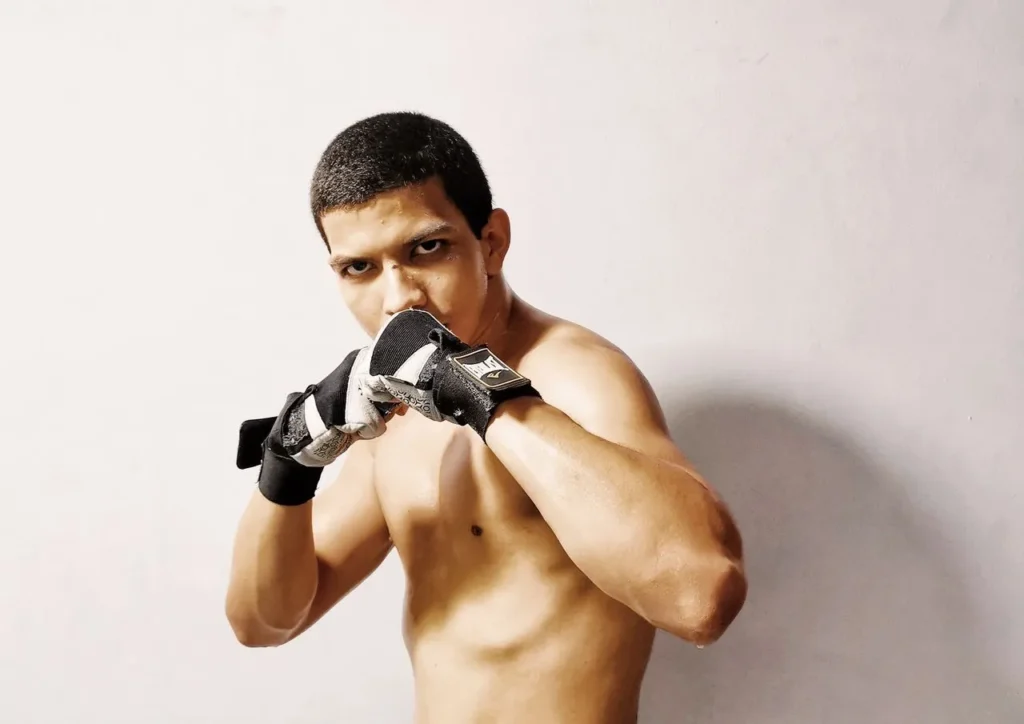
MMA gloves have to perform two jobs that naturally compete with each other. They must manage striking contact around the knuckles while leaving enough of the hand open for clinching, wrestling, takedowns, submissions, hand fighting, and grip changes.
That balance is what separates MMA gloves from boxing gloves, gym gloves, and ordinary padded handwear. A product with excessive padding may interfere with grappling and fist closure. A compact competition model may feel fast and responsive but may not suit prolonged sparring. A loose finger loop can allow the glove to rotate. A rigid thumb section can obstruct hand movement, while an exposed or poorly aligned thumb can create discomfort during striking and ground work.
Choosing an MMA gloves manufacturer is therefore not simply a matter of requesting a four-ounce product in black leather. Combat-sports brands, gyms, academies, event operators, retailers, distributors, and private label buyers need a manufacturing partner that understands the intended rule market, glove category, foam architecture, open-palm pattern, finger-loop geometry, thumb position, wrist closure, weight tolerance, materials, testing, and bulk consistency.
BUSHI Sports® provides custom wholesale MMA gloves manufacturing for combat-sports brands, gyms, academies, clubs, retailers, wholesalers, distributors, and private label businesses. Projects can include professional-style competition gloves, amateur models, sparring gloves, bag and mitt-work gloves, leather or synthetic shells, layered or molded padding, custom colors, logos, labels, packaging, samples, and scalable production.
Buyers can also develop related products through the wider custom sports gloves category and coordinate MMA gloves with rash guards, fight shorts, compression apparel, training wear, and private label packaging.
This guide uses nine production systems rather than a repeated list of generic “secrets.” Each system addresses a specific manufacturing decision that affects striking response, grappling freedom, fit, legality, durability, and commercial quality.
“A successful MMA glove does not maximize one feature. It controls the trade-off between impact padding, hand mobility, secure retention, and rule-market acceptance.”
Product Architecture: One Name, Several Different Gloves
The term MMA gloves can refer to several constructions:
- Professional competition gloves
- Amateur competition gloves
- Sparring MMA gloves
- Bag and pad-work gloves
- Hybrid training gloves
- Youth or junior training gloves
- Lace-free hook-and-loop models
- Event-supplied corner-color gloves
- Retail fitness and introductory models
These products should not share one technical specification.
| Product category | Main priority | Typical construction direction | Main development risk |
|---|---|---|---|
| Professional competition | Compact striking and grappling mobility | Low-profile knuckle padding, open palm, short secure wrist | Rule rejection, inconsistent weight, exposed pressure zones |
| Amateur competition | More visible padding and event control | Open-hand construction, larger protective profile, approved colors | Using professional geometry for amateur rules |
| Sparring | Repeated partner training | Broader and softer impact distribution, secure wrist | Excess bulk, poor grappling, premature foam breakdown |
| Bag and pad work | Repeated equipment impact | Denser foam, reinforced striking surface, durable shell | Bottoming out or reduced hand mobility |
| Hybrid training | Mixed drills | Balanced padding, flexible palm, practical closure | Compromise that performs no task well |
| Youth training | Correct proportions and simple use | Smaller hand chamber, controlled padding, easy closure | Adult pattern reduced without redesign |
System 1: Build the Specification Around the Rule Market
The first production system is regulatory classification.
MMA gloves should be developed for a clearly identified competition or training environment. There is no single specification that automatically satisfies every athletic commission, amateur federation, promotion, gym, and country.
A buyer brief should state:
- Professional, amateur, youth, sparring, bag, or fitness use
- Governing commission, federation, promotion, or gym policy
- Required nominal weight
- Permitted weight tolerance
- Approved supplier or model requirements
- Required corner colors
- Closure restrictions
- Hand-wrap allowance
- Branding limits
- Inspection and replacement rules
- Destination market
Professional Regulations Vary by Jurisdiction
The Association of Boxing Commissions and Combative Sports Unified Rules require contestants to wear appropriate gloves and regulate hand wraps, attire, and prohibited glove holding. However, individual commissions can impose their own equipment specifications and approval processes.
Washington State provides a useful official example. Its rules require professional MMA gloves to weigh at least four ounces and generally no more than six ounces without department approval. The gloves must be approved, fit the contestants, remain whole, clean, sanitary, and in good condition, and must not be twisted, manipulated, or altered. Main-event and title-fight gloves must be new under that rule set.
This example should not be presented as a worldwide rule. It shows why an MMA gloves manufacturer must identify the actual jurisdiction before finalizing weight, construction, or marketing claims.
Amateur Rules Often Use a Different Protective Profile
An official IMMAF youth equipment document has specified open-handed gloves with finger and thumb loops, hook-and-loop wrist support, red or blue colors, and a six-to-eight-ounce padded construction for that competition framework. IMMAF announced a consolidated 2025 rules book covering Youth, Junior, Senior, and Masters divisions, so buyers should verify the latest event documents rather than relying on an old specification without confirmation.
The practical lesson is simple: amateur MMA gloves should not be created by merely enlarging a professional pattern. The padding distribution, visible profile, colors, wrist system, and event approval process may all differ.
Approval Language Must Be Precise
A private label product can be:
- Designed toward a published rule
- Submitted to a commission
- Accepted for a specific event
- Listed by an authority
- Approved for a particular model and construction
These statements are not interchangeable.
A brand should not use “commission approved,” “IMMAF approved,” or similar wording unless it has documentation for the exact MMA gloves being sold. A change in foam, shell, weight, stitching, wrist closure, or factory can invalidate the basis of an earlier acceptance.
System 2: Engineer the Impact-Padding Architecture
The second system is the structure above the knuckles.
MMA gloves need enough padding to manage the intended striking load while keeping the hand compact enough for grappling. The padding system may use:
- Layered EVA foam
- PU foam
- Latex foam
- Injection-molded foam
- Pre-molded multi-density padding
- Open-cell and closed-cell combinations
- Flexible impact-dispersing inserts
- Hybrid foam systems
The choice should be based on the intended use rather than a marketing term such as “high-density protection.”
Competition Padding
Professional competition MMA gloves generally use a compact striking profile. The padding must sit correctly over the knuckles without making the hand too large for clinching, framing, pummeling, or grip fighting.
Important variables include:
- Pad width
- Pad length
- Knuckle-center position
- Thickness at the striking zone
- Taper toward the fingers
- Taper toward the wrist
- Foam density
- Recovery after impact
- Shell tension over the pad
If the pad sits too far forward, the fingers may be forced open. If it sits too far back, the main knuckle area may not align with the intended striking surface.
Sparring Padding
Sparring MMA gloves often require a broader and more forgiving surface than professional fight models. That does not mean simply adding one thick foam sheet.
A better sparring system may combine:
- A softer contact layer
- A denser support layer
- Wider knuckle coverage
- Tapered pad edges
- A stable base that resists shifting
The goal is controlled distribution, not a guarantee of injury prevention. Partner safety also depends on training intensity, coaching, athlete control, glove condition, and the techniques being used.
Bag and Pad-Work Padding
Repeated impact against heavy bags and focus equipment can compress soft foam rapidly. MMA gloves intended for this use may need denser support, stronger shell materials, reinforced seams, and more durable palm transitions.
A bag model should not automatically be described as suitable for sparring. A firm, durable striking surface may be inappropriate for partner work.
Foam Failure Modes
A development program should watch for:
- Permanent compression
- Bottoming out
- Cracking
- Delamination between layers
- Pad migration
- Uneven left-right density
- Hard internal edges
- Loss of shape after repeated use
A capable MMA gloves manufacturer records foam type, density, thickness, geometry, layer order, adhesive method, and target weight in the technical file.
System 3: Develop Open-Palm Geometry for Grappling
The third system is the open-palm structure.
This area distinguishes MMA gloves from enclosed boxing gloves. The palm must allow wrist movement, grip formation, hand fighting, and finger articulation while keeping the glove stable during striking and grappling.
Important pattern components include:
- Palm opening
- Finger loops
- Thumb loop or thumb section
- Sidewall panels
- Palm bridge
- Wrist transition
- Grip bar, when used
- Elastic or binding edges
Palm Opening Size
An opening that is too small can restrict the hand and concentrate pressure around the palm edge. An opening that is too large can allow the glove to rotate or expose unstable transitions.
The opening should be evaluated while the athlete:
- Makes a fist
- Opens the hand fully
- Posts on the mat
- Pummels for underhooks
- Grips a wrist
- Frames against a partner
- Changes between striking and grappling positions
Finger Loops
Finger loops must keep MMA gloves aligned without constricting circulation or cutting into the skin.
The pattern should control:
- Loop circumference
- Loop width
- Material stretch
- Binding softness
- Seam position
- Spacing between fingers
- Size grading
Loops that are too loose allow the knuckle pad to move. Loops that are too tight become uncomfortable when the hand swells or when wraps are used.
Grappling Freedom
The glove should permit the athlete to close the hand around an opponent’s wrist or limb without excessive fabric bunching. At the same time, the material should not create loose tabs that can catch during movement.
The ABC Unified Rules prohibit controlling an opponent by holding only the glove material. This competition rule is not a product specification, but it highlights the need for a clean, close structure without unnecessary loose material.
Palm Material
Possible palm components include:
- Natural leather
- Microfiber synthetic leather
- PU synthetic leather
- Stretch textile
- Reinforced binding
- Moisture-managing lining
The material must tolerate sweat, flexing, repeated opening, and friction against the mat and opponent.
System 4: Align the Thumb, Fingers, and Natural Fist
The fourth system is hand alignment.
MMA gloves need to support a natural fist while keeping the hand open enough for grappling. Poor geometry can create strain, pressure, or instability even when the padding material is high quality.
Fist Formation
The athlete should be able to close the fist without constantly fighting the glove. Check:
- Finger curl
- Knuckle alignment
- Pad position
- Thumb placement
- Palm tension
- Loop pressure
- Wrist angle
If the glove forces the fingers open, the athlete may grip continuously to maintain a fist. If the loops are too loose, the striking pad can shift away from the knuckles.
Thumb Construction
MMA gloves may use:
- A thumb loop
- A partially enclosed thumb
- A padded thumb section
- An open thumb with controlled attachment
The right option depends on the rule market and intended use.
The thumb should move during grappling while remaining aligned during striking. The pattern should avoid:
- Pulling at the thumb base
- Excessive separation
- Twisting
- Hard seam pressure
- A loop that cuts into the joint
- Padding that blocks opposition
Hand-Wrap Allowance
Professional MMA gloves are commonly inspected after the hands have been wrapped. The ABC Unified Rules set detailed limits for gauze and tape, while state rules may require official inspection before gloves are placed on the hands.
The product should therefore be fitted with the intended wrap system. A sample approved on an unwrapped hand may become too tight in competition use. An oversized chamber may feel unstable with a lighter training wrap.
Pre-Curved Form
A lightly pre-curved construction can reduce the effort required to form a fist. Too much curvature can make posting and open-hand grappling uncomfortable.
A proper trial should include striking pads, controlled bag work, clinch drills, takedown entries, and ground-position transitions.
System 5: Select Shell, Palm, and Lining Materials as One Package
The fifth system is material integration.
A shell cannot be evaluated separately from the foam, palm, lining, stitching, and sweat environment.
Leather Shells
Leather can offer:
- Strong tear resistance
- Flexible shaping
- Premium appearance
- Good conformity over molded or layered padding
- Long service potential when maintained correctly
Relevant specifications include:
- Leather type
- Thickness range
- Grain quality
- Finish
- Flex resistance
- Wet and dry rubbing
- Perspiration colorfastness
- Tear strength
- Lot consistency
Synthetic Shells
Microfiber and PU-based materials can support consistent thickness, color control, efficient cutting, and lower-cost collections.
Weak synthetic materials may:
- Crack at flex points
- Delaminate
- Peel after sweat exposure
- Become stiff
- Transfer color
- Tear around finger loops or wrist seams
The actual carrier fabric and coating system matter more than the generic label “synthetic leather.”
Palm and Loop Materials
Palm sections need flexibility and tear resistance. Finger loops need soft edges, stable stretch, and repeated-cycle durability.
A high-friction or rough binding can irritate the hand. A soft but weak binding can stretch permanently and allow the MMA gloves to rotate.
Lining
The lining should be checked for:
- Skin comfort
- Moisture absorption
- Drying time
- Pilling
- Color transfer
- Odor retention
- Shrinkage
- Delamination
- Pull-out
Antimicrobial and anti-odor claims should only be used when the actual treated material and supporting test evidence are available.
Material-Level Testing
Depending on the construction, useful tests can include:
- Tensile strength
- Tear strength
- Seam strength
- Flex resistance
- Abrasion
- Dry and wet rubbing
- Perspiration colorfastness
- Coating adhesion
ISO 12947-2:2016 provides a Martindale procedure for determining breakdown of suitable textile fabrics. It may support comparison of textile components, but it does not prove the impact performance or competition suitability of finished MMA gloves.
System 6: Stabilize the Wrist Without Blocking Mobility
The sixth system is wrist retention.
MMA gloves must remain secure during striking, clinching, takedowns, scrambles, and ground work. The wrist closure should stabilize the glove without preventing natural movement or interfering with wraps.
Common systems include:
- Single hook-and-loop strap
- Wide wraparound strap
- Elastic-assisted closure
- Dual-stage closure
- Competition-specific short cuff
- Extended sparring cuff
Hook-and-Loop Closures
A practical hook-and-loop system should be evaluated for:
- Strap length
- Peel strength
- Shear strength
- Edge softness
- Repeated opening cycles
- Sweat contamination
- Alignment over wraps
- Security during grappling
The exposed hook area should not remain uncovered where it can scratch an opponent. Competition and gym procedures may require taping over closure areas.
Short Competition Cuffs
A compact cuff can improve wrist mobility and reduce bulk. The trade-off is less surface area for closure and less structural material around the wrist.
Extended Training Cuffs
A longer cuff can distribute closure pressure and create a more secure feeling. Excess stiffness may restrict movement during grappling.
Wrist-Support Claims
An adjustable strap can improve glove retention and provide compression. It should not automatically be marketed as preventing sprains, stabilizing injured wrists, or replacing correct wrapping and coaching.
A responsible MMA gloves manufacturer describes the actual feature rather than making medical claims.
System 7: Create a Testing Plan for Impact, Mobility, and Durability
The seventh system is validation.
Materials may pass individual tests while the assembled MMA gloves still fail through poor geometry, stitching, foam placement, or closure design.
Weight and Pair Balance
Competition-oriented products should be weighed after full assembly.
Record:
- Left-glove weight
- Right-glove weight
- Pair difference
- Nominal model weight
- Allowed tolerance
- Size
- Batch
Printing, closures, foam variation, shell thickness, and moisture can change the final weight.
Repeated-Impact Testing
A controlled impact program may evaluate:
- Foam compression
- Recovery
- Striking-surface shape
- Pad movement
- Shell failure
- Seam failure
- Finger-loop stability
- Wrist closure
The test method should define impact energy, striker shape, sample conditioning, number of cycles, measurement points, and acceptance criteria.
Grappling-Durability Trials
MMA gloves should also be tested through movements that do not occur in boxing-glove trials:
- Wrist gripping
- Hand fighting
- Clinch pummeling
- Posting
- Takedown entries
- Ground transitions
- Controlled submission drills
Inspect for loop stretching, palm tearing, strap opening, shell twisting, and lining movement.
Chemical and Skin-Contact Review
Destination-market requirements may apply to dyes, coatings, metals, plasticizers, restricted substances, and labeling. Testing should match the actual materials and intended market.
No Universal Shortcut
ASTM lists WK63409 as a proposed work item for combative-sports gloves. ASTM’s page identifies a need for standardized assessment methodology, but the item is not a completed active glove standard.
This means brands should not claim ASTM certification through WK63409. Commission approval, federation acceptance, buyer testing, and factory quality control must be documented separately.
ISO 21420:2020 covers general protective-glove requirements such as construction, comfort, innocuousness, marking, and manufacturer information. It does not by itself prove that MMA gloves meet a specific combat-sports impact requirement.
System 8: Control Custom Branding Without Changing Performance
The eighth system is decoration management.
MMA gloves provide branding areas across:
- Knuckle shell
- Wrist strap
- Side panels
- Thumb area
- Palm bridge
- Woven labels
- Packaging
Customization methods may include:
- Screen printing
- Heat transfers
- Embroidery in suitable low-risk areas
- Debossing or embossing
- TPU or rubber patches
- Silicone marks
- Woven labels
- Custom boxes or carry bags
Branding Adds Weight and Stiffness
A large molded logo adds weight. Dense embroidery creates punctures and internal roughness. A thick transfer can reduce shell flexibility. Decoration should be included before final weight approval and testing.
Competition Identification
Events may require red and blue corner identification through glove color or tape. Amateur federations may issue approved kits rather than allowing athletes to supply their own MMA gloves.
A private label brand should create separate artwork files for:
- Retail models
- Gym training models
- Event-supplied models
- Red and blue competition versions
Artwork Placement
Graphics should not:
- Cross major flex lines
- Weaken finger-loop seams
- Cover inspection marks
- Interfere with closure
- Create hard striking-surface edges
- Hide required labels
BUSHI Sports® provides preparation guidance through why vector artwork matters and how to prepare print-ready files.
System 9: Reproduce the Approved Sample Through Bulk Quality Control
The ninth system is production control.
An approved prototype does not guarantee that bulk MMA gloves will match it. Foam density, shell thickness, loop dimensions, stitching tension, and final weight can drift unless the factory uses documented controls.
Manufacturing Sequence
1. Product Classification
The buyer and manufacturer confirm professional, amateur, sparring, bag, hybrid, fitness, or youth use.
2. Rule and Market Review
The intended jurisdiction, federation, promotion, or gym policy is documented.
3. Material Selection
Shell, foam, palm, loops, lining, binding, thread, closure, labels, and packaging are selected.
4. Pattern and Foam Development
The manufacturer creates the open-palm pattern, finger loops, thumb geometry, wrist structure, and striking pad.
5. Prototype Sample
The first sample is checked for weight, fit, fist closure, open-hand movement, padding alignment, and closure security.
6. Striking and Grappling Trials
The intended users test controlled pad work, bag work, clinch movement, takedown entries, and ground transitions.
7. Size Set
Selected sizes confirm grading, loop circumference, hand chamber, wrist range, and logo scaling.
8. Testing and Approval
Required laboratory tests, buyer tests, event submissions, or commission reviews are completed on the final construction.
9. Pre-Production Sample
The buyer approves the exact materials, dimensions, weight, color, artwork, labels, and packaging.
10. Cutting and Component Preparation
Shell, palm, loop, lining, reinforcement, cuff, and foam components are cut with controlled templates.
11. Printing and Branding
Graphics are applied before or during assembly according to the approved process.
12. Foam and Shell Assembly
Padding is positioned without gaps, folds, hard edges, or uncontrolled movement.
13. Sewing and Closure Assembly
The palm, sidewalls, loops, thumb, wrist, lining, and strap are joined with in-line inspection.
14. Turning and Shaping
The MMA gloves are formed, cleaned, and compared with the approved reference.
15. Final Weight and Functional Inspection
Inspectors check weight, pair balance, fist formation, open-hand mobility, pad position, loops, thumb, wrist closure, seams, artwork, and labels.
16. Pairing and Packing
Left and right MMA gloves are matched by size, model, color, weight, padding, and graphics before packing.
Bulk Quality-Control Table
| Inspection point | What to verify | Common failure |
| Finished weight | Target, tolerance, left-right balance | Underweight, overweight, mismatched pair |
| Knuckle padding | Position, density, shape, recovery | Thin zones, migration, hard edges |
| Fist closure | Natural curl and pad alignment | Fingers forced open or pad displaced |
| Open-palm mobility | Grip, posting, hand opening | Restriction or excessive rotation |
| Finger loops | Circumference, spacing, seam security | Cutting, looseness, tearing |
| Thumb | Position, movement, seam comfort | Pulling, twisting, excess exposure |
| Shell | Thickness, finish, tears, coating | Cracking, peeling, shade variation |
| Palm | Tear strength, opening shape, binding | Stretching, rough edges, seam failure |
| Wrist closure | Length, peel, overlap, edge finish | Opening during use or skin irritation |
| Lining | Attachment, smoothness, cleanliness | Pull-out, wrinkles, dye transfer |
| Branding | Position, adhesion, weight effect | Cracking, stiffness, rule conflict |
| Packaging | Dryness, labels, pair accuracy | Odor, compression, wrong model |
BUSHI Sports® explains wider inspection planning in how quality control works in sportswear manufacturing.
Cost Breakdown: What Changes the Quotation?
The cost of MMA gloves depends on the complete specification rather than the visible design alone.
Major cost drivers include:
- Professional, amateur, sparring, bag, or hybrid construction
- Leather or synthetic shell
- Layered or molded foam
- Number of foam densities
- Nominal weight and tolerance
- Finger-loop and thumb construction
- Palm and lining materials
- Wrist closure complexity
- Adult, women’s, and youth pattern blocks
- Printing, embossing, or molded branding
- Testing and approval requirements
- Packaging
- Order quantity
A basic synthetic fitness model with standard foam and simple branding will generally cost less than professional-style MMA gloves requiring narrow weight tolerances, selected leather, multi-density padding, custom molds, commission submission, repeated testing, and retail packaging.
The quotation should identify:
- Intended use
- Shell material
- Foam system
- Nominal weight
- Hand-size range
- Closure
- Palm construction
- Thumb and loops
- Branding
- Testing
- Packaging
- Freight basis
Terms such as “professional grade,” “maximum protection,” or “premium foam” are not detailed enough for supplier comparison.
BUSHI Sports® provides a broader explanation through its sportswear manufacturing cost breakdown.
MOQ Considerations
Minimum order quantity may be influenced by:
- Custom foam molds
- Leather color minimums
- Synthetic-material minimums
- Number of glove categories
- Number of weights and sizes
- Red and blue event versions
- Molded logos
- Labels
- Testing
- Printed packaging
A smaller launch may be possible when the buyer uses an existing pattern, available shell material, standard foam geometry, limited colors, and simple packaging.
Brands can review what MOQ means in sportswear manufacturing before requesting several weights, rule markets, fits, and colorways at a very small quantity.
Failure Analysis: Problems That Often Appear After Sampling
Professional Padding Used for Sparring
A compact fight profile may not provide the distribution expected for repeated partner training.
Amateur Gloves Built From a Scaled Professional Pattern
Adding weight without redesigning the foam footprint and palm geometry can produce bulky, unstable MMA gloves.
Finger Loops Graded by Percentage Only
Small and large hands do not scale uniformly. Loop circumference and spacing need size-specific checking.
Excessive Palm Opening
The glove can rotate or expose unstable seam transitions.
Wrist Strap Too Short
The closure may not accommodate wraps or larger wrists.
Foam Approved Before Final Branding
A molded logo, print layer, or patch can alter weight and stiffness.
Leather Replaced With a Similar-Looking Batch
Thickness, stretch, and finish changes can affect fit and final weight.
Only Striking Trials Completed
MMA gloves must also be evaluated during clinching, posting, grip fighting, and ground transitions.
Approval Claims Used Without Model Documentation
Rule-oriented design is not the same as commission or federation approval.
Packaging, Storage, and Care
MMA gloves should be dry and correctly shaped before sealed packing.
Packaging options include:
- Printed polybags
- Paper sleeves
- Branded boxes
- Mesh carry bags
- Dust bags
- Size and weight stickers
- Barcodes
- Care cards
Packaging Risks
Poor packaging can cause:
- Compressed padding
- Trapped moisture
- Odor
- Misshapen wrist straps
- Coating transfer
- Mixed weights
- Mismatched pairs
Consumer Care Guidance
- Open the wrist closure after training.
- Allow the gloves to dry naturally.
- Keep them away from direct heaters.
- Follow material-specific cleaning instructions.
- Do not leave damp MMA gloves sealed inside a sports bag.
- Avoid harsh bleach and solvents.
- Inspect padding, loops, thumb, palm, seams, and closure regularly.
- Replace the product when structural damage affects fit, retention, or padding position.
How to Evaluate an MMA Gloves Manufacturer
Rule and Product Questions
- Which rule market is the model developed for?
- Is it competition, sparring, bag, amateur, or hybrid equipment?
- Is approval already documented for this exact model?
- Which weight tolerance is used?
- Are red and blue event versions available?
Padding Questions
- Which foam types and densities are used?
- Is the padding layered or molded?
- How is knuckle alignment checked?
- How is compression recovery measured?
- Can repeated-impact testing be arranged?
Mobility Questions
- How are finger loops graded?
- How is open-hand movement tested?
- Does the sample accommodate hand wraps?
- How is thumb position evaluated?
- Are grappling trials part of development?
Material Questions
- Which leather or synthetic shell is used?
- What thickness range is controlled?
- How are tear, flex, rubbing, and abrasion checked?
- Can materials change without written approval?
- Are restricted-substance requirements documented?
Quality Questions
- Is every competition-oriented glove weighed?
- How are pairs matched?
- How is foam density controlled?
- Are internal seams and loops inspected?
- Can pre-shipment reports be supplied?
Commercial Questions
- What is the MOQ per model, color, weight, and size?
- Are mold, sample, testing, and approval costs separate?
- Can quantity be divided between red and blue?
- Is custom packaging included?
- What is the production lead time after approval?
- Which shipping term is quoted?
Why Work With BUSHI Sports®?
BUSHI Sports® is a custom sportswear and sports gloves manufacturer based in Sialkot, Pakistan. The company supports combat-sports brands, MMA gyms, academies, clubs, retailers, wholesalers, distributors, event operators, and private label buyers through OEM, ODM, sampling, customization, and bulk production.
As an MMA gloves manufacturer, BUSHI Sports® supports customization involving:
- Professional-style competition gloves
- Amateur competition directions
- Sparring MMA gloves
- Bag and pad-work models
- Hybrid training gloves
- Adult, women’s, and youth sizing
- Leather and synthetic shells
- Layered and molded foam systems
- Open-palm and finger-loop development
- Thumb engineering
- Hook-and-loop wrist closures
- Custom colors and corner identification
- Private labels and graphics
- Sample development
- Bulk production
- Quality inspection
- Custom packaging
- International order coordination
Buyers can develop MMA gloves through the wider custom sports gloves category.
Relevant BUSHI Sports® manufacturing guides include:
- Gym glove manufacturing
- Snowboard glove manufacturing
- Cycling glove manufacturing
- Golf glove manufacturing
- Field hockey glove manufacturing
- Lacrosse glove manufacturing
- American football glove manufacturing
- Cricket glove manufacturing
Each product uses different hand coverage, foam geometry, rules, grip systems, and fit requirements. Boxing, gym, and MMA gloves should not share specifications simply because they are all used in training environments.
Start Your Custom MMA Glove Project
Combat-sports brands, MMA gyms, academies, retailers, wholesalers, distributors, and private label buyers can contact BUSHI Sports® to discuss rule markets, glove categories, foam systems, shell materials, hand sizes, samples, minimum order quantities, pricing, logos, labels, packaging, production, and delivery.
- Email: info@bushisports.com
- WhatsApp: +92 348 4018 578
- Project inquiry: Contact BUSHI Sports®
Include the intended use, destination market, governing rules, preferred weight, shell material, size range, colors, artwork, estimated quantity, testing requirements, and packaging plan. A detailed brief helps the manufacturing team prepare a more accurate sample and quotation.
Frequently Asked Questions
What does an MMA gloves manufacturer do?
An MMA gloves manufacturer develops and produces professional, amateur, sparring, bag, hybrid, or fitness models according to a buyer’s requirements for weight, foam, shell, open-palm pattern, finger loops, thumb, wrist closure, sizes, colors, branding, testing, packaging, and quantity.
How are MMA gloves different from boxing gloves?
MMA gloves use an open-palm and finger-loop structure to support grappling. Boxing gloves enclose the fingers and use a larger padded structure focused primarily on punching. The foam, palm, thumb, wrist, and fit systems are therefore different.
Are all professional MMA gloves four ounces?
No universal worldwide rule makes every professional model exactly four ounces. Some jurisdictions require at least four ounces and generally limit models to around six ounces unless approved otherwise. The applicable commission or promotion must be checked.
Are amateur MMA gloves heavier?
Many amateur systems use a more protective and visibly different profile than professional competition models. An official IMMAF youth equipment document has specified six-to-eight-ounce open-hand gloves, but current event rules should always be verified before production.
Can competition MMA gloves use lace-up closures?
Closure requirements vary. Amateur systems commonly use hook-and-loop closures, and professional commissions may approve specific constructions. The buyer should not assume one closure is legal everywhere.
Why are finger loops important?
Finger loops keep the knuckle padding aligned while allowing the hand to open for grappling. Incorrect loop circumference can cause movement, pressure, tearing, or restricted circulation.
Which foam is best for MMA gloves?
There is no universal best foam. Competition, sparring, and bag work need different balances of density, thickness, recovery, weight, and flexibility. The complete layered or molded system matters more than the foam name alone.
Are sparring MMA gloves suitable for competition?
Not automatically. Sparring models may use broader padding, different weight, and different wrist construction. Competition acceptance depends on the governing authority and exact product.
Can custom logos be added?
Yes. Logos may be printed, transferred, embossed, debossed, molded, or incorporated through labels and packaging. Decoration should be included before final weight and performance approval.
Are MMA gloves covered by one international safety standard?
Competition acceptance is usually controlled by commissions, federations, promotions, and event rules. ASTM WK63409 remains a proposed work item rather than a completed active combative-sports glove standard.
How should MMA gloves be tested?
Development can include finished weight, pair balance, foam compression and recovery, repeated impact, seam strength, finger-loop pull, thumb movement, wrist-closure cycling, material abrasion, sweat conditioning, and striking and grappling trials.
Can youth MMA gloves use an adult pattern in a smaller size?
Adult geometry may provide an initial reference, but youth products need separate hand-chamber dimensions, loop spacing, thumb placement, wrist range, foam footprint, and weight planning.
What affects the MOQ?
MOQ may depend on custom molds, foam layers, leather colors, synthetic-material minimums, number of weights and sizes, red and blue versions, printing, testing, labels, and packaging.
How should MMA gloves be cleaned?
The correct method depends on the shell, lining, foam, adhesives, and branding. They should be aired after use, dried away from direct heat, and cleaned according to the tested care instructions.
When should MMA gloves be replaced?
Replace them when foam is displaced or permanently compressed, loops or seams are torn, the wrist closure opens unexpectedly, the shell is badly damaged, or the glove no longer stays aligned on the hand.
Conclusion
MMA gloves are hybrid combat-sports equipment. They must manage striking contact while preserving the open-hand mobility required for wrestling, clinching, submissions, posting, and grip fighting.
Their quality cannot be judged from nominal weight, foam thickness, or exterior appearance alone. A dependable MMA gloves manufacturer controls the rule-market specification, impact-padding geometry, open-palm pattern, finger loops, thumb position, natural fist, shell materials, wrist closure, testing, branding, and bulk production records.
Brands should define whether the product is intended for professional competition, amateur events, sparring, bag work, hybrid training, or youth use before requesting samples. These categories are not interchangeable.
BUSHI Sports® supports custom MMA gloves through product consultation, rule-oriented development, foam and shell selection, ergonomic patterning, sampling, private labeling, quality inspection, packaging, and international delivery coordination.
Discuss your next collection by emailing info@bushisports.com, messaging BUSHI Sports® on WhatsApp at +92 348 4018 578, or submitting the project through the contact page.