Field hockey gloves must protect the hand without disconnecting the player from the stick.
That requirement sounds simple, but the product-development challenge is complex. Players need enough coverage to reduce exposure to stick checks, raised balls, turf contact, collisions, and penalty-corner impacts. At the same time, the fingers must remain free to rotate the stick, change grip position, receive passes, tackle, dribble, push, sweep, and shoot.
Too much padding can make field hockey gloves heavy, hot, and restrictive. Too little coverage can leave the fingers, knuckles, thumb, or side of the hand exposed. A thick palm may improve abrasion resistance but reduce stick feedback. A close-fitting palm may improve control but wear quickly if the material and reinforcement zones are poorly selected.
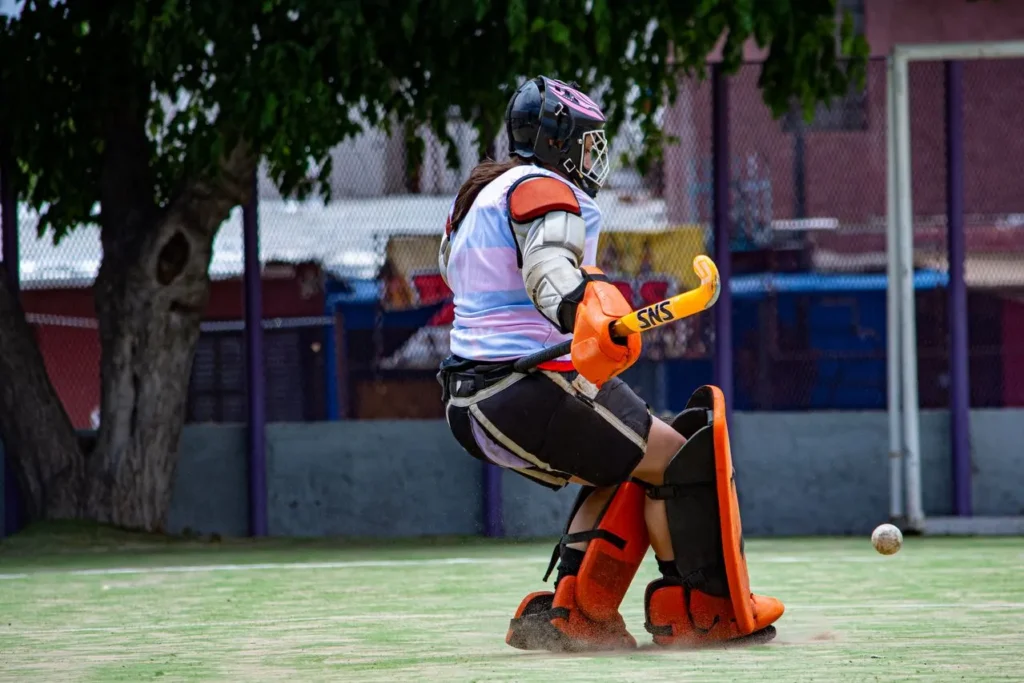
Goalkeeper hand protectors create an additional design challenge. They need substantially more impact management and coverage, but their dimensions and construction remain limited by the rules. They cannot simply become oversized blocking surfaces.
Choosing a field hockey gloves manufacturer therefore involves much more than approving colors and logos. Sports brands, clubs, academies, schools, retailers, distributors, and private label buyers need a manufacturing partner that understands lightweight padding, hand anatomy, palm grip, finger articulation, thumb protection, ventilation, testing, legal dimensions, and repeatable bulk quality.
BUSHI Sports® provides custom wholesale field hockey gloves manufacturing for sports brands, teams, clubs, academies, wholesalers, and private label businesses. Buyers can develop custom outfield hand protectors, penalty-corner gloves, goalkeeper hand protectors, adult and junior sizes, branded collections, packaging, and coordinated equipment programs.
Projects can also be combined with the wider custom sports gloves collection and custom field hockey uniforms offered by BUSHI Sports®.
This guide explains twelve design and manufacturing decisions that shape protection, stick control, weight, durability, comfort, legality, and commercial performance.
“The best lightweight glove does not remove protection. It removes unnecessary bulk while preserving coverage, mobility, and dependable material performance.”
Outfield and Goalkeeper Gloves Are Different Products
The term field hockey gloves may describe several product types:
- Full-finger outfield gloves
- Half-finger outfield gloves
- Left-hand protective gloves
- Two-hand glove sets
- Penalty-corner hand protectors
- Indoor hockey gloves
- Junior field-player gloves
- Goalkeeper left-hand blockers
- Goalkeeper right-hand stick gloves
- Goalkeeper hand-protector sets
These products should not be developed from one universal pattern.
An outfield glove usually prioritizes stick feel, mobility, low weight, and targeted protection. A goalkeeper hand protector prioritizes impact coverage and deflection while remaining within the permitted dimensions. A penalty-corner glove may be more substantial than a normal-play glove but must still fit inside the FIH measurement box for field-player hand protection.
Product Comparison
| Product type | Main purpose | Typical design direction | Main risk |
|---|---|---|---|
| Lightweight outfield glove | Normal-play hand coverage and stick control | Low-profile segmented padding, thin palm | Insufficient coverage or fast palm wear |
| Full-finger glove | Greater finger coverage | Articulated finger padding and enclosed tips | Reduced flexibility or heat |
| Half-finger glove | Direct stick feel and ventilation | Open fingertips with knuckle coverage | Exposed fingertips |
| Left-hand glove | Protection for the hand commonly positioned lower on the stick | Reinforced knuckles, fingers, and sidewall | Imbalanced fit or inadequate thumb coverage |
| Penalty-corner glove | Additional defensive protection | Wider hand coverage and denser padding | Excess size or poor stick control |
| Goalkeeper left protector | Blocking and deflecting | Broad impact surface with internal hand restraint | Illegal dimensions or excessive bulk |
| Goalkeeper right glove | Stick holding and hand protection | Reinforced fingers and thumb with shaft grip | Poor stick handling or exposed fingers |
Secret 1: Define the Playing Role Before Selecting Materials
A field hockey gloves manufacturer should begin with the player’s role, not the exterior appearance.
The buyer brief should establish:
- Outfield player or goalkeeper
- Normal play or penalty-corner defense
- Outdoor, indoor, Hockey5s, or another format
- Left hand only or a complete pair
- Full-finger or half-finger construction
- Junior, academy, club, collegiate, or elite market
- Expected climate and playing surface
- Target weight
- Required padding level
- Preferred palm thickness
- Governing competition rules
- Target retail price
- Required quantity by size and color
A defender who regularly protects penalty corners may need more coverage than a forward seeking the lightest possible glove. An indoor player may prioritize full-hand protection because play occurs in a smaller area with frequent close contact. A goalkeeper requires an entirely different impact and dimensional specification.
The correct brief prevents contradictory requests such as:
- Maximum protection with no padding
- Maximum ventilation with a fully sealed construction
- Professional durability with an extremely thin unreinforced palm
- Oversized goalkeeper coverage that exceeds legal dimensions
- One universal pattern for junior players and adults
A reliable field hockey gloves manufacturer should explain which requirements can be combined and which require separate models.
Secret 2: Build the Product Around Current FIH Size Rules
The official rules directly influence the dimensions of field hockey gloves.
The FIH Rules of Hockey permit field players to wear hand protection that does not significantly increase the natural size of the hand.
Under the 2026 rules, field-player hand protection used during normal play or while defending penalty corners must fit comfortably, without being compressed, inside an open-ended measurement box with internal dimensions of:
- 290 mm long
- 180 mm wide
- 110 mm high
This measurement affects:
- Knuckle height
- Finger-padding thickness
- Sidewall width
- Thumb protection
- Cuff structure
- Penalty-corner glove development
- Junior-to-adult grading
A glove should not be forced into the measurement box. The rule requires it to fit comfortably without compression.
Goalkeeper Hand-Protector Limits
The 2026 rules specify that each goalkeeper hand protector may have a maximum:
- Width of 228 mm
- Length of 365 mm
The protector is measured when laid flat with the palm facing upward.
Goalkeeper hand protectors must not contain an addition designed to retain the stick when the stick is not being held in the hand.
The rules also prohibit protective equipment that significantly increases the natural size of a goalkeeper’s body or protected area.
The current maximum length is especially important. FIH increased it from 355 mm to 365 mm to resolve a conflict with the minimum dimensions required for a size-large glove under BS EN 13546:2002+A1:2007.
That change allows manufacturers to develop a large goalkeeper hand protector that can satisfy both the FIH dimensional limit and the relevant European protective-equipment standard.
A field hockey gloves manufacturer should maintain:
- Finished-product measurement records
- Size-specific templates
- An FIH hand-protection box
- Goalkeeper width and length gauges
- Approved reference samples
- Production tolerances
A design that is legal in the prototype size may become illegal after grading, foam expansion, molding, or inconsistent assembly.
Secret 3: Map the Real Impact Zones
Protection should be placed according to exposure, not according to a decorative pattern.
Important outfield protection zones include:
- Knuckles
- Finger backs
- Fingertips
- Thumb
- Thumb-index area
- Outside edge of the hand
- Lower hand
- Wrist transition
The hand changes shape while controlling the stick. For that reason, coverage should be checked in several positions:
- Open hand
- Closed grip
- Reverse-stick grip
- Tackling position
- Dribbling position
- Push-pass position
- Slap or sweep position
- Penalty-corner defensive stance
A glove that appears fully covered while lying flat may expose gaps when the player closes the hand.
Knuckle Coverage
Knuckles require enough padding to manage direct contact without preventing finger flexion. One solid block can feel protective but may restrict movement.
Possible solutions include:
- Floating knuckle panels
- Segmented foam
- Molded flexible shells
- Overlapping padding
- Flex grooves
- Articulated protective plates
Finger Coverage
The finger backs may be divided into two or more protective segments. Segment length should follow the joints.
Poor segmentation can create:
- Open gaps during flexion
- Padding migration
- Finger stiffness
- Pressure against the stick
- Twisted fingertips
- Uneven protection across sizes
Thumb Protection
The thumb needs protection without losing rotation. A rigid thumb guard can interfere with grip changes, while a soft structure may provide limited impact management.
The field hockey gloves manufacturer should define:
- Thumb angle
- Segment count
- Side coverage
- Base reinforcement
- Palm connection
- Insert shape
- Internal width
- Seam position
Secret 4: Use Lightweight Multi-Layer Padding
Lightweight protection does not mean using only thin soft foam.
A more efficient construction may combine several materials:
- Abrasion-resistant outer layer
- Flexible impact-distributing insert
- High-density foam
- Softer comfort foam
- Moisture-managing lining
Each layer performs a different function.
| Layer | Possible purpose |
| Outer textile or synthetic shell | Abrasion resistance and material containment |
| Molded plastic or flexible insert | Spreads concentrated contact |
| High-density foam | Resists complete compression |
| Medium-density foam | Manages energy and supports shape |
| Soft inner foam | Improves comfort |
| Lining | Reduces skin friction and manages moisture |
A thick low-density foam can compress completely under concentrated contact. A thinner multi-layer system may provide better structural response while reducing bulk.
The field hockey gloves manufacturer should record:
- Foam type
- Foam density
- Thickness
- Compression behavior
- Recovery
- Insert material
- Insert hardness
- Layer order
- Bonding method
- Weight by size
Weight Distribution Matters
The total glove weight is important, but balance also matters. Excessive material near the fingertips can make the glove feel heavier than the same weight concentrated closer to the hand.
Lightweight field hockey gloves should avoid unnecessary:
- Decorative overlays
- Thick internal seams
- Oversized cuffs
- Heavy molded badges
- Duplicate padding
- Large hook-and-loop closures
- Excessive palm reinforcement
Every removed component should be reviewed to confirm that protection, durability, or retention has not been compromised.
“A lightweight glove should feel faster because its materials are efficient—not because important protection has been deleted.”
Secret 5: Design the Left and Right Hands Separately
Outfield field hockey gloves are often asymmetric.
Many players use more substantial protection on the left hand because of its position on the stick and its exposure during low defensive play. The right hand may use a lighter glove or remain ungloved, depending on preference and competition requirements.
Goalkeeper hand protectors are even more asymmetric.
Outfield Left-Hand Design
A left-hand model may include:
- Reinforced knuckles
- Finger-back protection
- Sidewall coverage
- Thumb protection
- Thin stick-contact palm
- Flexible wrist opening
- Low-profile cuff
Outfield Right-Hand Design
A right-hand glove may prioritize:
- Grip changes
- Shaft movement
- Palm flexibility
- Lower padding volume
- Ventilation
- Finger sensitivity
Goalkeeper Left-Hand Protector
The left hand is commonly used as a broader blocking and deflecting surface. The protector may use:
- Wide impact face
- High-density foam
- Internal hand pocket
- Finger restraint
- Wrist strap
- Curved blocking profile
- Reinforced edge
Goalkeeper Right-Hand Protector
The right-hand protector must allow the goalkeeper to hold and control the stick.
Its construction may include:
- Protected fingers
- Reinforced thumb
- Shaft-compatible palm
- Internal grip channel
- Wrist retention
- Impact-resistant backhand
It must not use an attachment that retains the stick when the goalkeeper is no longer holding it.
A field hockey gloves manufacturer should create separate technical drawings, patterns, and inspection standards for each hand.
Secret 6: Engineer the Palm for Stick Feel and Durability
The palm creates the connection between the player and the stick.
Important palm properties include:
- Friction
- Thickness
- Flexibility
- Stretch
- Abrasion resistance
- Tear strength
- Perspiration resistance
- Drying speed
- Seam strength
- Surface consistency
Common palm materials include:
- Synthetic suede
- Microfiber
- PU synthetic leather
- Polyester grip fabrics
- Nylon composites
- Natural leather in selected products
- Silicone-printed textiles
- Reinforced multilayer fabrics
Thin Palm Construction
A thin palm improves direct feedback and stick rotation. However, it can wear quickly around the thumb, index finger, lower palm, and shaft-contact areas.
Reinforcement Zones
Reinforcement may be added at:
- Thumb-index junction
- Index finger
- Lower palm
- Heel
- Side edge
- Main stick-contact line
The reinforcement should follow the hand’s movement and should not create a hard ridge.
Silicone and Printed Grip
Grip printing may increase surface friction while keeping weight low.
The application should be tested for:
- Adhesion
- Cracking
- Peeling
- Sweat resistance
- Wet performance
- Abrasion
- Transfer to stick tape or grip
- Effect on flexibility
Palm Seam Placement
Poor seam placement can create pressure points and early wear. Seams should be kept away from major shaft-contact zones where practical.
A field hockey gloves manufacturer should conduct stick trials using different handle diameters, grip tapes, and hand positions.
Secret 7: Maintain Finger Mobility Through Segmentation
Finger mobility depends on more than soft materials.
It is influenced by:
- Segment length
- Segment width
- Gap size
- Overlap
- Foam density
- Insert shape
- Palm stretch
- Finger-stall width
- Seam allowance
- Lining bulk
Full-Finger Construction
Full-finger field hockey gloves provide more complete coverage but need careful fingertip engineering. Excess material at the tip can reduce control.
The fingertip should remain aligned when the player:
- Opens the hand
- Closes around the stick
- Rotates the stick
- Changes hand spacing
- Performs reverse-stick movements
Half-Finger Construction
Half-finger designs offer ventilation and direct contact but expose the fingertips.
The cut edge should be:
- Smooth
- Securely bound
- Free from restrictive elastic
- Positioned away from the finger joint
- Resistant to fraying
Overlapping Protective Segments
Overlap can maintain protection as the finger bends. Too much overlap can create bulk and resistance.
Hinged Structures
Flexible fabric hinges can connect protective blocks. Their position should align with the finger joints.
The field hockey gloves manufacturer should complete repeated flex tests and inspect for:
- Foam migration
- Stitch failure
- Open impact gaps
- Twisted fingers
- Lining bunching
- Palm wrinkles
- Insert cracking
Secret 8: Develop Goalkeeper Hand Protectors as Protective Equipment
Goalkeeper field hockey gloves are not simply oversized outfield gloves.
They form part of a broader protective equipment system that may include:
- Helmet
- Chest and shoulder protection
- Arm protection
- Hand protectors
- Padded shorts
- Leg guards
- Kickers
- Pelvic or groin protection
The BSI listing for BS EN 13546:2002+A1:2007 describes requirements and test methods covering field-hockey goalkeeper hand, arm, torso, leg, foot, and genital protectors, together with field-player shin protectors.
The standard addresses areas including:
- Ergonomics
- Performance
- Innocuousness
- Sizing
- Coverage
- Marking
- Information supplied by the manufacturer
A product should not claim compliance simply because it resembles another goalkeeper protector. The exact model and construction need appropriate testing and documentation.
Goalkeeper Impact Face
The blocking surface should manage impact without creating an illegal enlarged profile.
Development variables include:
- Outer shell
- Foam density
- Insert type
- Surface curvature
- Edge shape
- Hand position
- Internal restraint
- Wrist stability
- Ball rebound behavior
Internal Hand Pocket
The goalkeeper’s hand must remain stable inside the protector. A loose pocket can allow the protector to rotate during impact.
The internal construction should avoid:
- Sharp edges
- Hard fasteners
- Excessive seam bulk
- Finger compression
- Sweat accumulation
- Wrist slippage
Rebound and Deflection
A goalkeeper may use the hand protector to stop or deflect the ball. The response should be evaluated for:
- Surface hardness
- Impact absorption
- Rebound direction
- Edge behavior
- Structural recovery
- Repeated-impact durability
Goalkeeper field hockey gloves should be tested as protective equipment, not only evaluated through appearance and hand feel.
Secret 9: Add Ventilation Without Weakening Coverage
Field hockey gloves are worn during repeated high-intensity movement and can retain substantial heat.
Ventilation may be created through:
- Mesh finger gussets
- Perforated palms
- Spacer mesh
- Open-knit backhand zones
- Air channels between protective blocks
- Moisture-managing lining
- Perforated cuffs
- Uncoated low-risk zones
Mesh Placement
Mesh can improve airflow but should not replace protection in exposed areas.
Suitable locations may include:
- Finger sides
- Lower backhand
- Cuff
- Palm areas away from main stick contact
- Channels between knuckle sections
Moisture Management
The lining should be evaluated for:
- Skin comfort
- Sweat absorption
- Drying speed
- Odor retention
- Color transfer
- Pilling
- Shrinkage
- Delamination
Antimicrobial or anti-odor claims require evidence for the actual treated material. They should not be added as general marketing language.
Drying Trials
Field hockey gloves should be tested through repeated cycles of:
- Wear
- Moisture exposure
- Natural drying
- Reuse
- Inspection
Slow drying can contribute to odor, lining failure, adhesive deterioration, and user dissatisfaction.
Secret 10: Create Dedicated Junior and Adult Size Systems
External glove length is not enough to define fit.
The pattern should control:
- Hand length
- Palm width
- Finger length
- Finger circumference
- Thumb length
- Thumb angle
- Wrist circumference
- Cuff opening
- Intended ease
- Padding dimensions
- Internal lining volume
Junior Field Hockey Gloves
Junior products should not be adult gloves reduced evenly in every direction.
Young players generally need:
- Shorter finger channels
- Narrower palms
- Smaller protective blocks
- Lower weight
- Softer articulation
- Easier hand entry
- Smaller wrist openings
- Shorter closures
An oversized junior glove can shift around the hand and reduce stick control. A glove that is too tight may compress the fingers and create protection gaps.
Size-Set Development
A proper size set should include a smaller, middle, and larger size.
Inspect:
- Fingertip position
- Palm wrinkles
- Thumb alignment
- Wrist retention
- Segment gaps
- Knuckle placement
- Logo scale
- Glove weight
- FIH box compliance
- Left-right consistency
The field hockey gloves manufacturer should use real hand measurements and stick trials, not only age labels.
Secret 11: Test Protection, Grip, Fit, and Durability
No single test defines a good field hockey glove.
A complete development program may include laboratory checks, factory testing, rule measurements, and player trials.
Impact Testing
For protective constructions, testing may evaluate:
- Peak transmitted force
- Energy absorption
- Foam compression
- Insert cracking
- Repeated-impact performance
- Coverage
- Restraint
- Structural recovery
Goalkeeper models intended for relevant markets may require evaluation under BS EN 13546:2002+A1:2007 and applicable PPE requirements.
Palm Abrasion
Palm materials should be compared after controlled rubbing to identify:
- Thinning
- Holes
- Surface polishing
- Pilling
- Grip loss
- Coating failure
- Delamination
Seam and Component Strength
Useful checks include:
- Seam tensile strength
- Stitch security
- Thumb attachment
- Cuff pull resistance
- Hook-and-loop cycling
- Palm tear resistance
- Padding attachment
- Grip-print adhesion
Environmental Conditioning
Samples may be evaluated after:
- Heat
- Cold
- Moisture
- Perspiration
- Wet playing conditions
- Artificial-turf contamination
- Cleaning
- Repeated drying
Player Trials
Outfield players should test:
- Dribbling
- Tackling
- Passing
- Receiving
- Reverse-stick movement
- Shooting
- Penalty-corner defense
- Hand repositioning
Goalkeepers should test:
- Ready position
- Blocking
- Deflection
- Diving
- Stick control
- Clearing
- Repeated impact
- Wrist stability
The field hockey gloves manufacturer should document whether feedback concerns personal preference, sizing, or a measurable product defect.
“Protection claims should follow testing. No field hockey glove can guarantee that hand injuries will never occur.”
Secret 12: Preserve the Approved Specification During Production
Field hockey gloves contain many small components. A visually similar substitution can change protection, grip, weight, fit, or legality.
The production file should include:
- Bill of materials
- Padding map
- Foam densities and thicknesses
- Insert shapes
- Palm specification
- Pattern set by size
- Finger segmentation
- Thumb construction
- Cuff design
- Stitch requirements
- Artwork placement
- Color standards
- FIH measurement requirements
- Testing requirements
- Approved pre-production sample
- Packaging standard
- Product tolerances
Manufacturing Process
1. Product Brief
The buyer defines glove type, playing role, protection target, weight, materials, sizes, colors, rules, branding, quantity, packaging, and price level.
2. Material Selection
The field hockey gloves manufacturer proposes palm materials, outer fabrics, foams, inserts, mesh, lining, elastic, closures, labels, and packaging.
3. Pattern Development
Patterns are created for palm, backhand, fingers, thumb, gussets, cuff, padding, and reinforcement.
4. Prototype Construction
The first sample is used to evaluate fit, mobility, protection placement, weight, and manufacturability.
5. Stick and Player Trials
The intended users test grip, rotation, finger mobility, thumb position, ventilation, and coverage.
6. Rule Measurement
Outfield protection is checked in the FIH measurement box. Goalkeeper products are checked against permitted width and length.
7. Size Set
Selected sizes confirm grading, logo scaling, weight, padding position, and legal dimensions.
8. Testing
Material, construction, impact, abrasion, and relevant compliance testing are completed.
9. Pre-Production Sample
The buyer approves the final materials, size, colors, artwork, labels, and packaging.
10. Cutting
Palm, shell, lining, foam, mesh, and reinforcement pieces are cut using controlled templates.
11. Printing and Applications
Logos, graphics, silicone grip, transfers, molded details, and labels are applied.
12. Padding Assembly
Foams and inserts are positioned according to the approved protection map.
13. Sewing and Joining
Palm, backhand, fingers, thumb, cuff, and closures are assembled with in-line inspection.
14. Turning and Finishing
The glove is shaped, cleaned, checked internally, and compared with the approved reference.
15. Pairing and Functional Inspection
Left and right gloves are paired by style, size, color, palm, protection, and artwork.
16. Packing
The products are labeled, protected from crushing and moisture, assorted, and prepared for delivery.
Quality-Control Table
| Inspection area | What to check | Common failure |
| Padding | Position, density, thickness, alignment | Open gaps or inconsistent protection |
| Inserts | Shape, edges, attachment | Migration, cracking, hard pressure points |
| Fingers | Length, mobility, seam direction | Twisting, loose tips, restricted movement |
| Thumb | Angle, protection, grip movement | Poor stick control or exposed joint |
| Palm | Thickness, grip, reinforcement, seams | Holes, slipping, ridges, delamination |
| Backhand | Flexibility, coverage, ventilation | Rigid movement or weak impact zones |
| Cuff | Retention, comfort, mobility | Loose fit or restricted wrist |
| Outfield dimensions | Comfortable fit within FIH box | Excess width, height, or length |
| Goalkeeper dimensions | Maximum width and length | Oversized protector |
| Stick retention | No prohibited goalkeeper attachment | Illegal strap or retaining addition |
| Pairing | Size, hand, color, material | Mismatched products |
| Branding | Position, stretch, durability | Cracking or off-center graphics |
| Labels | Size, care, claims, traceability | Missing or unsupported information |
| Packaging | Shape and moisture protection | Crushed padding or trapped moisture |
BUSHI Sports® explains wider inspection principles in how quality control works in sportswear manufacturing.
Branding Lightweight Field Hockey Gloves
Customization options include:
- Printed backhand graphics
- Heat transfers
- Sublimated textile panels
- Silicone logos
- TPU applications
- Molded branding
- Woven labels
- Wrist-strap logos
- Custom palm prints
- Team colors
- Player names or numbers
- Branded packaging
Avoid Heavy Decorative Components
A large molded badge may increase weight and restrict movement. Lightweight branding should follow the structure of the glove.
Keep Graphics Away From Flex Points
Rigid artwork should not bridge:
- Finger joints
- Thumb hinges
- Floating knuckle panels
- Cuff hinges
- Palm stretch areas
Use Size-Specific Artwork
A graphic approved on an adult large may become crowded on a junior glove.
BUSHI Sports® provides relevant artwork guidance in why vector artwork matters and how to prepare print-ready files.
Cost Breakdown
The price of field hockey gloves depends on the complete construction.
Major cost drivers include:
- Outfield or goalkeeper design
- Full-finger or half-finger pattern
- Palm material
- Foam type and density
- Molded or rigid inserts
- Number of protective segments
- Thumb complexity
- Backhand fabric
- Ventilation materials
- Cuff and closure
- Adult and junior sizes
- Left-hand-only or paired construction
- Branding method
- Testing requirements
- Packaging
- Order quantity
A basic left-hand junior glove made with commercial synthetic materials and simple foam will generally cost less than an elite goalkeeper protector using multi-density foam, molded inserts, reinforced edges, custom internal restraints, compliance testing, and retail packaging.
The quotation should identify:
- Palm material
- Padding system
- Inserts
- Outer fabric
- Closure
- Size range
- Artwork
- Sampling
- Testing
- Packaging
- Shipping basis
Terms such as “professional protection” or “premium lightweight foam” are not sufficient for comparing suppliers.
BUSHI Sports® provides a wider explanation in its sportswear manufacturing cost breakdown.
MOQ Considerations
MOQ may be affected by:
- Custom molded components
- Foam-cutting setup
- Palm-material minimums
- Custom colors
- Size range
- Goalkeeper and outfield variants
- Printing setup
- Labels
- Packaging
- Testing
A smaller launch may be possible when the buyer uses an established pattern, available palm material, standard inserts, limited colors, and simple packaging.
Brands can review what MOQ means in sportswear manufacturing before requesting a completely new platform at a very small quantity.
How to Evaluate a Field Hockey Gloves Manufacturer
Protection Questions
- Which foam densities are used?
- Are molded inserts included?
- How are impact zones mapped?
- How are protective gaps controlled?
- Can goalkeeper testing under BS EN 13546 be arranged?
- Which claims are supported by evidence?
Palm Questions
- What palm material is used?
- What is its thickness?
- How is abrasion evaluated?
- How does it perform when wet or sweaty?
- Are high-wear zones reinforced?
- Does grip printing transfer to the stick?
Rule Questions
- Does outfield protection fit comfortably inside the FIH box?
- Are goalkeeper protectors below the maximum dimensions?
- Does the goalkeeper model avoid prohibited stick-retaining additions?
- Are production samples measured by size?
- Which rule edition is being followed?
Fit Questions
- Are youth and adult patterns separate?
- How are finger length and palm width graded?
- Is the thumb pattern tested on the stick?
- Can size sets be produced?
- How is cuff fit controlled?
Manufacturing Questions
- How are foams and inserts verified?
- Can materials change without written approval?
- How are gloves paired?
- Are inspection records available?
- How is traceability maintained?
Commercial Questions
- What is the MOQ?
- Can quantity be divided by size?
- Are sample and testing costs separate?
- Is custom packaging included?
- What is the lead time after approval?
- Which shipping term is quoted?
A reliable field hockey gloves manufacturer should explain the balance between protection, weight, mobility, durability, and cost.
Common Product-Development Mistakes
Using One Pattern for Every Glove Type
Outfield, penalty-corner, indoor, and goalkeeper products need different construction.
Selecting Padding by Thickness Alone
Density, inserts, coverage, recovery, and segmentation are equally important.
Making a Lightweight Glove by Removing Coverage
Weight should be reduced through efficient engineering, not by exposing the hand.
Ignoring the FIH Measurement Box
A field-player protector must fit comfortably inside the required box without compression.
Oversizing Goalkeeper Hand Protectors
Goalkeeper products remain subject to maximum width and length.
Adding a Stick-Retention Feature
A goalkeeper protector must not retain the stick when it is not being held.
Using an Unreinforced Thin Palm
Stick feel may improve initially while product life becomes unacceptable.
Scaling Adult Patterns Directly Into Junior Sizes
Junior players need separate internal proportions and lower weight.
Adding Rigid Artwork Across Finger Joints
The decoration may crack and restrict movement.
Making Unsupported Certification Claims
A material description does not prove that the final product meets a standard.
Why Work With BUSHI Sports®?
BUSHI Sports® is a custom sportswear and sports gloves manufacturer based in Sialkot, Pakistan. The company supports sports brands, teams, clubs, academies, wholesalers, retailers, and distributors through OEM, ODM, private label, and bulk manufacturing.
As a field hockey gloves manufacturer, BUSHI Sports® supports customization involving:
- Lightweight outfield glove concepts
- Full-finger and half-finger designs
- Left-hand protection
- Penalty-corner hand protectors
- Goalkeeper hand protectors
- Adult and junior sizing
- Palm materials
- Multi-density padding
- Molded protective inserts
- Thumb engineering
- Backhand fabrics
- Ventilation panels
- Cuffs and closures
- Colors and team graphics
- Private labels
- Sample development
- Bulk production
- Quality inspection
- Custom packaging
- International order coordination
Buyers can develop field hockey gloves through the wider custom sports gloves category and combine them with custom field hockey uniforms.
Relevant BUSHI Sports® glove-development resources include:
- Lacrosse glove protection manufacturing
- American football glove grip technology
- Cricket glove safety design
- Goalkeeper glove grip technology
- Baseball glove manufacturing
Each sport presents different impact patterns, grip requirements, materials, dimensions, and rules. Specifications should not be copied directly between products.
Learn more through the BUSHI Sports® About Us page or submit product requirements through the contact page.
For field hockey gloves manufacturing inquiries:
- Message BUSHI Sports® on WhatsApp
- Email info@bushisports.com
- Call +92 348 4018 578
- View the BUSHI Sports® location on Google Maps
- Follow BUSHI Sports® on LinkedIn
- Follow BUSHI Sports® on Instagram
- Follow BUSHI Sports® on Facebook
- Follow BUSHI Sports® on X
- Follow BUSHI Sports® on Threads
- View product inspiration on Pinterest
- Watch company content on YouTube
Frequently Asked Questions
What does a field hockey gloves manufacturer do?
A field hockey gloves manufacturer develops and produces outfield or goalkeeper hand protection according to a buyer’s requirements for padding, palm material, sizing, thumb construction, cuff, weight, colors, logos, labels, packaging, quantity, and destination market.
Are field hockey gloves compulsory?
The general FIH rules permit field players to wear hand protection but do not require every field player to wear it. Goalkeepers may wear specialized hand protectors as part of their protective equipment. Local leagues may apply additional requirements.
How large can outfield field hockey gloves be?
Under the 2026 FIH rules, field-player hand protection must fit comfortably inside a box measuring 290 mm long, 180 mm wide, and 110 mm high without being compressed.
What are the maximum goalkeeper hand-protector dimensions?
The current FIH maximum is 228 mm wide and 365 mm long when the protector is laid flat with the palm facing upward.
Why did FIH increase the goalkeeper glove length limit?
The maximum length was increased from 355 mm to 365 mm to resolve a conflict with the minimum size-large requirement under BS EN 13546:2002+A1:2007.
Can a goalkeeper glove hold the stick automatically?
No. FIH rules prohibit additions designed to retain the stick when it is not being held in the goalkeeper’s hand.
Which hand do outfield players commonly protect?
Many players use more substantial protection on the left hand because of its position and exposure during stick handling and low defensive play. Preferences vary by player and position.
Are full-finger or half-finger gloves better?
Full-finger field hockey gloves provide more complete coverage. Half-finger gloves can improve ventilation and direct feel but leave the fingertips exposed. The correct choice depends on playing role and personal preference.
What palm material is best?
There is no universal best palm. Microfiber and synthetic suede can provide a lightweight feel, while reinforced composites may offer greater durability. The material should be evaluated for grip, abrasion, sweat behavior, flexibility, and cost.
Can junior players use adult gloves in smaller sizes?
Junior products should use dedicated finger lengths, palm widths, thumb dimensions, padding scale, wrist openings, and lighter construction.
What is BS EN 13546:2002+A1:2007?
It is a protective-equipment standard covering requirements and test methods for field-hockey goalkeeper hand, arm, torso, leg, foot, and genital protectors, together with field-player shin protectors.
Can custom team logos be added?
Yes. Logos can be printed, transferred, molded, or incorporated through labels and textile panels. Artwork should remain flexible and should not compromise protection, ventilation, or legal dimensions.
What affects MOQ?
MOQ may depend on custom molds, palm materials, padding components, goalkeeper variants, sizes, colors, graphics, labels, testing, and packaging.
How should field hockey gloves be tested?
Development can include impact testing, foam compression, palm abrasion, seam strength, grip trials, moisture conditioning, size fitting, FIH dimension checks, and position-specific field testing.
Can field hockey gloves prevent every hand injury?
No. They can provide protective coverage and impact-management materials, but results still depend on fit, product condition, impact location, ball or stick speed, and game circumstances.
Conclusion
Field hockey gloves are lightweight protective products built around a demanding balance. The player needs coverage against stick, ball, surface, and contact exposure while continuing to feel and control the stick.
The final performance depends on impact-zone mapping, multi-layer padding, thumb construction, palm grip, finger articulation, ventilation, cuff design, sizing, testing, legal dimensions, and repeatable production.
A dependable field hockey gloves manufacturer should begin by identifying the playing role, glove type, age group, competition format, and destination market. The manufacturer should then convert those requirements into a documented construction that can be sampled, measured, tested, inspected, and reproduced.
Brands should not select field hockey gloves through appearance, padding thickness, or price alone. Physical samples, player trials, palm specifications, rule checks, goalkeeper measurements, material testing, and a detailed quality plan provide a stronger basis for bulk production.
BUSHI Sports® supports custom field hockey gloves through product consultation, material selection, pattern development, lightweight padding, goalkeeper protection, sampling, private labeling, quality inspection, packaging, and international order coordination.
Explore the custom wholesale field hockey gloves manufacturer page or contact BUSHI Sports® to discuss outfield gloves, goalkeeper hand protectors, palms, padding, sizing, colors, logos, quantities, packaging, and delivery requirements.