
Polyester vs polyester spandex is one of the most important fabric decisions in custom sportswear. Both options use polyester as the main fibre, but they create different stretch, fit, recovery, moisture behaviour, printing results, durability, cost, and production risk.
A 100% polyester knit can still provide mechanical stretch through its loop structure, textured yarn, and finishing. Polyester-spandex adds an elastic fibre—also called elastane—to create stronger extension and recovery. That is why the blend is widely used for leggings, sports bras, compression tops, fitted gym wear, and cycling shorts.
The choice is not simply “non-stretch versus stretch.” Polyester vs polyester spandex must be compared through the exact GSM, knit structure, elastane percentage, stretch direction, recovery, opacity, finishing, intended fit, branding method, and wash performance.
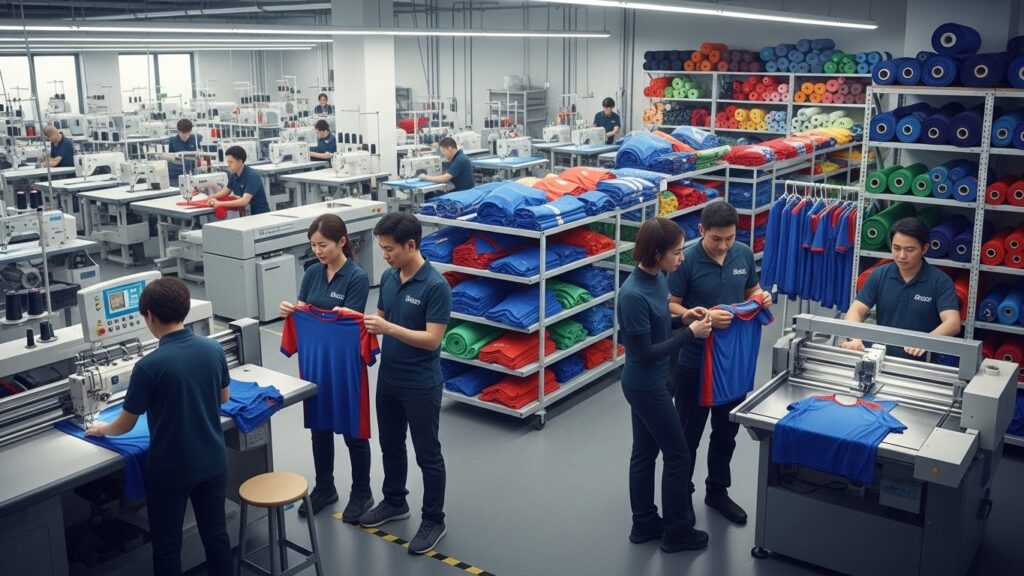
BUSHI Sports® provides custom wholesale activewear manufacturing for sports brands, gyms, teams, academies, retailers, wholesalers, distributors, and private label buyers. Projects can include running tops, gym shirts, leggings, sports bras, compression wear, shorts, tracksuits, labels, packaging, samples, and bulk production.
This guide explains seven decisions that help buyers choose between 100% polyester and polyester-spandex for sportswear.
“The best fabric composition is the one that maintains its intended fit and performance after movement, sweat, washing, printing, and bulk production.”
Quick Answer
The short polyester vs polyester spandex answer depends on the garment fit and printing method.
For lightweight jerseys, running shirts, team training tops, tracksuits, and fully sublimated sportswear, 100% polyester is often the more practical option. It can provide low weight, rapid drying, stable printing, easier colour matching, and competitive bulk pricing.
For leggings, sports bras, fitted shorts, compression tops, yoga wear, and close-body activewear, polyester-spandex is usually the better starting point because elastane supports greater extension and recovery.
This polyester vs polyester spandex comparison still depends on the exact fabric. A compact 100% polyester interlock may feel more stable than a lightweight blend, while a well-engineered polyester-spandex jersey may dry quickly and perform well in warm conditions.
Polyester vs Polyester Spandex Comparison Table
| Requirement | 100% polyester | Polyester-spandex |
|---|---|---|
| Stretch | Mechanical stretch depends on construction | Greater stretch from elastane |
| Recovery | Suitable for stable or regular fits | Usually stronger for fitted products |
| Fit direction | Regular, relaxed, athletic, or lightly fitted | Fitted, sculpted, compression, or high-mobility |
| Drying | Often fast because polyester absorbs little moisture | Can dry well, but dense blends may hold more water |
| Sublimation | Highly suitable | Suitable when heat settings are approved |
| Opacity | Usually easier to control | Must be checked at intended extension |
| Processing | Generally straightforward | Requires tighter heat and width control |
| Cost | Usually lower | Usually higher |
| Common uses | Jerseys, running tops, shorts, tracksuits | Leggings, sports bras, compression wear |
Decision 1: Define the Product in Polyester vs Polyester Spandex
The first polyester vs polyester spandex decision is the garment category. A football jersey, running shirt, gym legging, sports bra, compression top, and warm-up jacket do not need the same stretch or fit.
Before requesting fabric samples, define:
- Product and sport
- Men’s, women’s, youth, or unisex block
- Regular, fitted, or compression fit
- Two-way or four-way stretch
- Climate and activity intensity
- Opacity and abrasion needs
- Printing or branding method
- Washing frequency
- Target price and quantity
A team jersey may need stable measurements and a smooth sublimation surface more than high stretch. A workout legging needs extension around the hip, knee, and calf while recovering after movement.
Polyester vs polyester spandex should also be compared within similar constructions. Comparing a 130 GSM polyester mesh with a 260 GSM polyester-spandex interlock mainly reveals differences in weight and knit structure.
The BUSHI Sports® guide on polyester mesh vs interlock fabric explains how construction affects airflow, opacity, stability, and printing.
What Does Spandex Mean?
United States textile rules define spandex as a manufactured fibre containing at least 85% segmented polyurethane in its fibre-forming substance. Elastane is the equivalent generic term widely used in other markets.
Commercial blends may include examples such as 95/5, 90/10, or 88/12 polyester and spandex. More elastane does not automatically mean better quality. Yarn placement, fabric modulus, knit structure, and finishing determine how the stretch feels and recovers.
Decision 2: Stretch and Recovery in Polyester vs Polyester Spandex
Stretch is the clearest difference in polyester vs polyester spandex. A 100% polyester knit can extend through loop movement and textured yarn, but it normally cannot match the controlled elasticity of a well-engineered polyester-spandex blend.
Polyester-spandex is useful when a garment must fit closely, move through deep flexion, recover after extension, stabilize a waistband, or create controlled compression.
ISO 20932-1:2018 provides methods for measuring fabric elasticity and related properties. Buyers should request results in both directions because a fabric may stretch strongly across its width but only slightly along its length.
Stretch Percentage Is Not Enough
A supplier may report 80% stretch, but that figure does not explain:
- The load used
- Recovery after release
- Permanent growth
- Performance after washing
- Behaviour after heat application
- Opacity at full extension
Polyester vs polyester spandex should therefore include recovery and growth data, not only maximum extension.
When 100% Polyester Is Enough
Mechanical stretch may be sufficient for soccer jerseys, loose running shirts, basketball tops, training T-shirts, tracksuit jackets, relaxed shorts, and fanwear.
When Spandex Is Necessary
Polyester-spandex is usually more suitable for compression shirts, workout leggings, cycling shorts, sports bras, fitted gym tops, yoga wear, singlets, and tight base layers.
The pattern must be developed for the approved fabric. A compression block created for one blend cannot be transferred safely to a weaker or more powerful material without a fit trial.
Decision 3: Moisture and Heat in Polyester vs Polyester Spandex
Polyester is hydrophobic and generally absorbs little moisture into the fibre. This can support fast drying when the fabric spreads sweat and receives enough airflow.
Adding elastane changes the fabric system, but composition alone does not predict drying. Polyester-spandex fabrics are often heavier and denser because they are designed for fitted products. Their additional mass may dry more slowly than a lightweight 100% polyester jersey.
Polyester vs polyester spandex moisture performance depends on GSM, thickness, knit density, yarn shape, finish, air permeability, fit, elastane percentage, climate, and layering.
AATCC TM195 evaluates liquid moisture management, while ISO 11092:2026 measures thermal and water-vapour resistance.
Hot-Weather Products
For loose hot-weather tops, 100% polyester mesh or lightweight interlock is often the practical first option. For fitted products, polyester-spandex may still be necessary, but heat can be managed through lower GSM, ventilated structures, mapped mesh, and limited layering.
The BUSHI Sports® guide on sportswear for extreme heat explains why airflow, moisture spreading, fit, colour, and sun exposure must be considered together.
Comfort and Hand Feel
Polyester-spandex can feel smooth and supportive because it follows the body. A poor-quality blend can feel rubbery, hot, shiny, or restrictive. A 100% polyester microfilament fabric may feel softer than a coarse blend.
Approve comfort through physical swatches and finished samples rather than relying on composition labels.
Decision 4: Durability in Polyester vs Polyester Spandex
Durability in polyester vs polyester spandex includes resistance to abrasion, pilling, seam damage, dimensional change, and loss of stretch.
A 100% polyester jersey can provide strong dimensional stability when the yarn and knit are controlled. It does not rely on elastane to maintain a regular fit.
Polyester-spandex can deliver excellent shape retention, but excessive heat, unsuitable pressing, harsh chemicals, and poor laundering can weaken elastic performance. A damaged blend may bag at the knees, seat, elbows, waistband, or underband.
Test:
- Stretch, recovery, and permanent growth
- Pilling and abrasion
- Bursting and seam strength
- Dimensional change
- Surface shine
- Colourfastness
- Performance after repeated washing
Abrasion and Surface Finish
Leggings, cycling shorts, fitted gym shorts, and compression products experience heavy rubbing. Structure and finish can matter more than a small composition difference.
A brushed polyester-spandex legging may feel soft but pill faster than a smooth compact blend. A stable 100% polyester fabric can be durable but may not provide enough extension for deep movement.
Sewing Requirements
Polyester vs polyester spandex also affects sewing. Stretch garments may need stretch-compatible needles, flexible seams, differential feed, controlled stitch density, and hems that extend without breaking.
Decision 5: Printing in Polyester vs Polyester Spandex
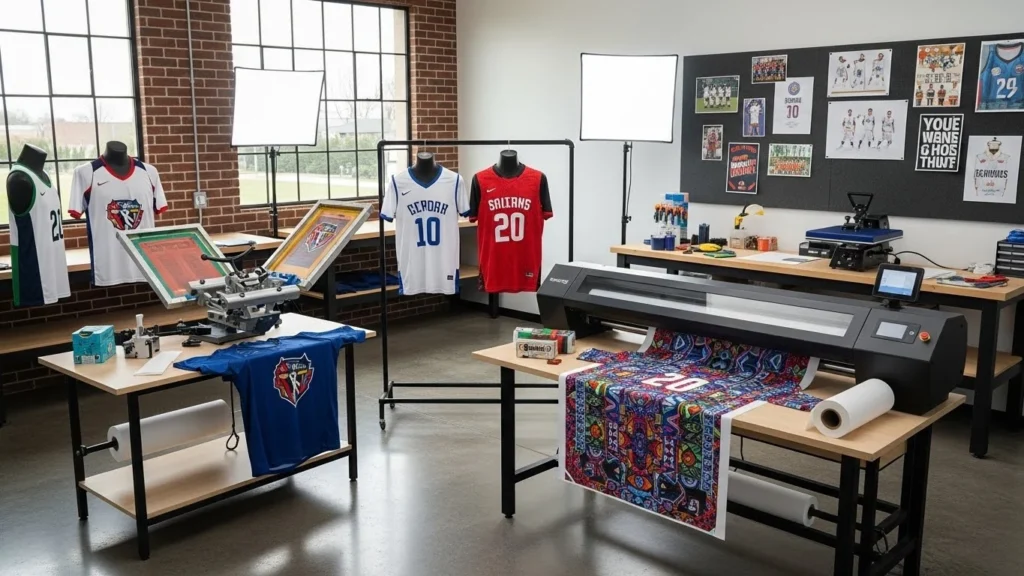
Sublimation is one of the strongest reasons to choose 100% polyester. Disperse dyes used in sublimation have a strong affinity for polyester, allowing all-over graphics to integrate with the textile surface.
This makes 100% polyester suitable for custom jerseys, running tops, training shirts, printed shorts, tracksuits, and event apparel.
Polyester-spandex can also be sublimated when the material and process are approved. Elastane introduces additional controls involving heat, pressure, width, recovery, and surface appearance.
Heat and Pressure Control
The factory should approve:
- Transfer temperature and time
- Pressure
- Fabric relaxation
- Width change
- Shade after pressing
- Stretch after printing
- Recovery after washing
Polyester vs polyester spandex printing should be compared on the actual production fabric rather than a digital mockup.
Colour Under Stretch
A polyester-spandex fabric may look lighter when stretched because the knit opens. This matters for dark leggings, compression shorts, and fitted tops.
Check colour unstretched, at intended extension, under bright light, after washing, and across sizes.
Branding Applications
Both compositions can support heat transfers, silicone logos, TPU badges, and other branding methods when the adhesive and application settings match the fabric.
BUSHI Sports® explains file preparation in why vector artwork is important for sportswear printing.
Decision 6: Cost and MOQ in Polyester vs Polyester Spandex
Cost is an important polyester vs polyester spandex difference. Stock 100% polyester fabrics are widely available and often support lower prices or smaller minimum orders.
Polyester-spandex may cost more because of elastane yarn, more complex knitting, higher fabric weight, controlled finishing, width variation, recovery testing, more demanding sewing, and a higher rejection risk when stretch is inconsistent.
Main Cost Drivers
- GSM and thickness
- Yarn and elastane quality
- Elastane percentage
- Knit structure
- Performance finishes
- Sublimation or solid dyeing
- Custom colours
- Testing
- Pattern complexity
- Quantity and packaging
A simple sublimated training shirt will normally cost less than a four-way-stretch legging with flatlock seams, pockets, and premium packaging.
MOQ Planning
White stock polyester can often be customized through sublimation, supporting smaller colour runs. Polyester-spandex is frequently solid dyed, so minimums may apply per fabric and colour.
BUSHI Sports® provides further guidance in its sportswear manufacturing cost breakdown and MOQ guide.
Decision 7: Select Polyester vs Polyester Spandex by Product
The final polyester vs polyester spandex decision should be based on the specific garment.
| Product | Practical starting point | Main reason |
| Soccer or team jersey | 100% polyester | Sublimation, low weight, stable graphics |
| Running T-shirt | 100% polyester | Drying, airflow, and low bulk |
| Basketball jersey | 100% polyester or low-spandex blend | Ventilation and stable shape |
| Training shorts | Either | Depends on fit and movement |
| Compression shirt | Polyester-spandex | Extension and recovery |
| Workout leggings | Polyester-spandex | Opacity, fit, and mobility |
| Sports bra | Polyester-spandex | Support and close-body fit |
| Cycling jersey | 100% polyester or low-spandex blend | Printing and controlled fit |
| Cycling shorts | Polyester-spandex | Compression and movement |
| Tracksuit | 100% polyester or low-spandex fabric | Stability, durability, and price |
| Yoga wear | Polyester-spandex | Four-way movement |
| Fanwear | 100% polyester | Graphics and broader sizing |
Practical Verdict
For regular-fit sportswear, large team orders, full sublimation, and price-sensitive products, 100% polyester is normally the safer commercial choice.
For fitted, sculpted, or compression products, polyester-spandex is normally the stronger performance choice.
A collection can use both. Running shirts and tracksuits may use 100% polyester, while leggings and sports bras use polyester-spandex.
Polyester vs Polyester Spandex Testing Checklist
| Property | Test direction | Why it matters |
| Stretch and recovery | ISO 20932-1 or suitable method | Confirms extension and permanent growth |
| Moisture management | AATCC TM195 | Compares wetting, spreading, and transport |
| Air permeability | ASTM D737 | Supports ventilation comparison |
| Thermal and vapour resistance | ISO 11092:2026 | Compares heat and vapour behaviour |
| Bursting strength | ISO 13938-2 or equivalent | Evaluates multidirectional strength |
| Dimensional change | Approved wash procedure | Checks shrinkage and growth |
| Pilling and abrasion | Recognized test methods | Protects appearance |
| Colourfastness | Washing, perspiration, and rubbing | Protects colour quality |
| Opacity | Dry, wet, and stretched review | Prevents transparency complaints |
| Sublimation trial | Physical print and wash test | Confirms shade and heat stability |
Questions to Ask a Manufacturer
Use these polyester vs polyester spandex questions before approving fabric or requesting a quotation.
- Is the 100% polyester mechanically stretchable?
- What is the exact elastane percentage?
- What are the stretch and recovery results in both directions?
- Does the fabric become transparent at intended extension?
- Is the polyester-spandex approved for sublimation?
- How does it perform after repeated washing?
- What GSM and knit structure are supplied?
- Is the same fabric used for the PP sample and bulk order?
- What MOQ applies per colour?
- Can the fabric code or elastane yarn change without written approval?
The sportswear sample approval checklist explains how these details should be frozen before bulk cutting.
Common Buying Mistakes
Choosing Only by Fibre Percentage
Two 90/10 fabrics can have different stretch, opacity, recovery, and surface quality.
Assuming 100% Polyester Has No Stretch
Knitted polyester can provide useful mechanical stretch without elastane.
Assuming More Spandex Is Always Better
Higher elastane can increase power and cost, but may also create excessive compression or more difficult processing.
Ignoring Heat During Sublimation
A polyester-spandex sample should be checked after printing because heat can influence dimensions and recovery.
Skipping Opacity Tests
Fitted garments must be assessed under realistic extension.
Using One Fabric Across the Collection
Jerseys, leggings, sports bras, and tracksuits have different requirements.
Why Work With BUSHI Sports®?
BUSHI Sports® supports activewear and teamwear buyers with:
- 100% polyester and polyester-spandex comparison
- Running and gym shirts
- Team training apparel
- Leggings, sports bras, and compression wear
- Shorts and tracksuits
- Sublimation and branding
- Men’s, women’s, youth, and unisex patterns
- Size sets and PP samples
- Labels, packaging, and inspection
A complete polyester vs polyester spandex brief should identify the product, fit, weight, stretch, opacity, climate, colours, printing, quantity, target price, testing, and delivery date.
Frequently Asked Questions
What is the main difference in polyester vs polyester spandex?
The main difference is elasticity. A 100% polyester fabric relies on knit construction for mechanical stretch, while polyester-spandex includes elastane for greater extension and recovery.
Is 100% polyester good for sportswear?
Yes. It is widely used for jerseys, running shirts, training tops, shorts, and tracksuits because it can be lightweight, quick-drying, durable, and suitable for sublimation.
Is polyester-spandex better for leggings?
Usually, yes. The blend supports close fit, movement, recovery, and compression. It still needs opacity, abrasion, and wash testing.
Can 100% polyester stretch?
Yes. Knitted polyester can provide mechanical stretch through loop structure and textured yarn, although it normally offers less controlled elasticity than a spandex blend.
Can polyester-spandex be sublimated?
Some blends can be sublimated successfully. The exact fabric must be tested for shade, width change, surface shine, stretch, and recovery after heat application.
Which option costs less?
100% polyester is generally more economical and widely available. Polyester-spandex often costs more because of elastane, knitting complexity, testing, and processing controls.
Which is better for compression wear?
Polyester-spandex is usually better because elastane provides the extension and recovery required for negative ease and controlled compression.
Conclusion
A final polyester vs polyester spandex decision should be selected according to product, fit, printing, climate, durability, cost, and care requirements.
A 100% polyester construction is usually practical for lightweight jerseys, running tops, training shirts, tracksuits, fanwear, and fully sublimated sportswear. It supports stable graphics, quick drying, easier sourcing, and competitive bulk production.
Polyester-spandex is usually the stronger choice for leggings, sports bras, compression apparel, cycling shorts, yoga wear, and fitted products requiring greater extension and recovery.
Fibre percentage alone cannot define quality. Buyers should compare exact fabrics through stretch testing, moisture testing, opacity checks, wash trials, print samples, fit testing, and pre-production approval.
BUSHI Sports® supports polyester vs polyester spandex development through fabric comparison, patterns, samples, sublimation, branding, labels, packaging, testing coordination, quality inspection, and international bulk manufacturing.
To discuss a custom sportswear project, email info@bushisports.com, message BUSHI Sports® on WhatsApp at +92 348 4018 578, or submit requirements through the contact page.