Saddle Pad Construction Guide: Fabrics, Padding, Quilting and Shape
Saddle Pad Construction Guide explains how outer fabrics, cushioning layers, underside linings, quilting, binding and shape work together in a finished equestrian product. A saddle pad is not simply a decorative textile placed beneath a saddle. Its pattern, material thickness, seam placement and attachment details must suit the intended saddle type, discipline, cleaning routine and target customer.
For equestrian brands, tack shops, clubs and private-label buyers, these choices also affect price, sampling, size grading, branding and repeat-order consistency. This Saddle Pad Construction Guide provides a focused framework for developing dressage, jumping and all-purpose saddle pads with Bushi Sports®.
Table of Contents
- How saddle pad layers work together
- Outer fabric options
- Padding and cushioning systems
- Underside and lining materials
- Quilting patterns and construction
- Saddle pad shapes
- Binding, piping and straps
- Branding and private-label options
- Sampling and quality control
- Care, compliance and FAQs
Why This Saddle Pad Construction Guide Matters
A successful saddle pad balances shape retention, controlled cushioning, moisture handling, cleaning and visual consistency. No single fabric or foam guarantees those results. The outer, padding, lining, thread and binding must be approved as one construction.
The pad must also be evaluated with the saddle for which it is intended. Added thickness does not automatically improve saddle fit, and a pad should not be marketed as a solution for an unsuitable saddle. Where fit, pressure or discomfort is a concern, the horse should be assessed by an appropriately qualified saddle fitter or equine professional.
Bushi Sports® develops custom wholesale saddle pads with options for shape, thickness, quilting, lining, binding, piping, straps, logos, labels and packaging. The broader Horse Gear Materials and Construction Guide explains how these material decisions connect with complete equestrian collections.
Saddle Pad Construction Guide to Layer Systems
Most quilted saddle pads contain several functional layers. The exact specification varies, but a typical structure may include:
- An outer face fabric that establishes appearance and surface durability
- One or more cushioning or stabilizing layers
- An underside material selected for contact, moisture and cleaning requirements
- Quilting thread that holds the layers together
- Binding around the perimeter
- Girth loops, billet straps or other attachment details
Each added layer changes thickness, flexibility, drying time and sewing behavior. A soft outer combined with high-loft batting may look full but become unstable after washing. Dense foam may hold its shape but make the pad too rigid.
The Saddle Pad Construction Guide therefore recommends approving the complete layered panel before cutting the first finished sample.
Outer Fabrics for Saddle Pads
The outer fabric influences color, quilting definition, abrasion behavior and branding compatibility. Buyers should record composition, structure, weight, finish, width and approved color reference rather than specifying only “polyester” or “cotton.”
Polyester and Polyester Blends
Woven polyester is widely used because it can offer color consistency, dimensional stability and compatibility with quilting, piping and embroidery. Microfiber-like surfaces can create a refined appearance, while technical woven constructions may improve durability or drying behavior.
Recycled polyester can be considered where the required appearance and performance are verified. Buyers can compare sourcing considerations in the Bushi Sports® guide to recycled polyester versus virgin polyester.
Cotton and Poly-Cotton
Cotton and poly-cotton outer fabrics provide a familiar textile appearance and can produce clear quilting. Cotton content may increase absorbency, but it can also affect shrinkage, drying time and colorfastness.
Pre-production testing should use the planned care method rather than assuming every cotton-rich construction will remain dimensionally stable.
Velvet-Look and Specialty Surfaces
Velvet-look, suede-effect and lightly brushed fabrics can support premium collections. Nap direction must be controlled during cutting because panels can appear to have different shades when rotated.
These surfaces should also be reviewed for marking, pilling, dust collection and compatibility with embroidery, badges or other branding.
| Outer fabric | Main advantages | Points to verify |
|---|---|---|
| Woven polyester | Consistency, durability and color range | Abrasion, heat response and surface finish |
| Poly-cotton | Balanced hand feel and stability | Shrinkage, drying and colorfastness |
| Cotton | Natural textile appearance and absorbency | Dimensional change and drying time |
| Microfiber or suede-effect fabric | Smooth premium appearance | Pilling, marking and nap direction |
| Recycled polyester | Verified recycled-content option | Traceability, performance and claim documentation |
Saddle Pad Construction Guide to Padding
Padding should be specified by material, thickness, density and recovery. Thickness alone is not a useful indicator of performance because two foams or battings with the same measurement may compress very differently.
Foam Layers
Open-cell foam can provide softness and flexibility but may absorb more moisture. Closed-cell foam generally absorbs less water and can add structure, although excessive density may make a pad stiff.
Perforated or contoured foam may be considered when the full design is tested rather than assumed to be more breathable.
Felt
Felt can provide stable cushioning and a traditional material story. Fibre type, density, thickness and edge behavior should be documented.
Felt may respond differently to moisture and cleaning than foam, so care instructions must match the complete layered construction.
Synthetic Batting
Polyester batting provides loft and can create a fuller quilted appearance. Quilting spacing must control migration and bunching.
Buyers should examine recovery after compression and washing because unsuitable fill can flatten, separate or shift.
Layered Padding Systems
Combining thin foam with batting can balance stability and loft. However, additional layers increase sewing bulk and may affect drying time.
This Saddle Pad Construction Guide recommends testing trial panels for compression, recovery, quilting definition and dimensional change before the pattern is finalized.
| Padding option | Main purpose | Development checks |
|---|---|---|
| Open-cell foam | Flexible cushioning | Moisture absorption and compression recovery |
| Closed-cell foam | Structure and lower water uptake | Stiffness, heat and edge transitions |
| Felt | Stable cushioning | Density, moisture response and dimensional stability |
| Synthetic batting | Loft and quilting definition | Migration, flattening and wash performance |
| Layered foam and batting | Combined structure and loft | Bulk, drying time and seam compatibility |
Underside and Lining Materials
The underside sits closest to the horse, making surface texture, seam placement and cleanliness important. A material described as breathable does not guarantee that the complete saddle pad will manage heat or moisture effectively. Padding, quilting density and saddle coverage also influence the result.
Common underside options include:
- Brushed cotton or poly-cotton for a familiar contact surface
- Polyester mesh for lower weight and airflow potential
- Moisture-managing knit structures for faster spreading and drying
- Fleece or faux-shearling panels for selected designs
- Spacer mesh where dimensional airflow and structure are required
Mesh hole size, yarn stiffness and snag resistance should be reviewed. Fleece pile should not be so bulky that it traps excessive debris or creates unstable edges.
This Saddle Pad Construction Guide also recommends checking lining colorfastness against light-colored horses and after exposure to moisture, sweat and washing.
Textile certification may support a brand’s material-safety program. OEKO-TEX® STANDARD 100 covers textiles tested for harmful substances, but any certification claim must correspond to valid documentation for the relevant component or finished article.
Saddle Pad Construction Guide to Quilting Patterns
Quilting joins the outer, padding and lining while helping control movement between layers. It also becomes one of the most visible design elements.
Diamond Quilting
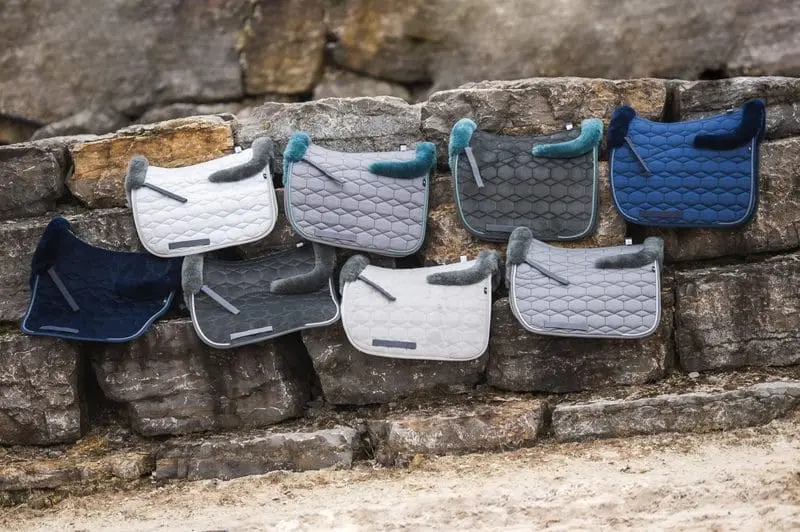
Diamond quilting is versatile and visually familiar. Small diamonds can stabilize fill and create a structured surface, while larger diamonds produce a softer, more open appearance.
Very dense stitching may compress the padding more heavily. Pattern scale should therefore be approved with the actual padding layers.
Square and Box Quilting
Square quilting offers clean geometry and easy alignment with logos or labels. Panel dimensions should be planned so the pattern remains balanced around curved edges and the spine.
Boxes that are too large may allow the fill to move, while extremely small boxes can reduce loft.
Channel Quilting
Vertical, horizontal or curved channels can create a modern look. Long channels require stable feeding during sewing because misalignment is more visible than in smaller repeated patterns.
Channel direction should also complement the finished pad shape rather than appearing disconnected from its outline.
Custom Quilting
Wave, hexagon, logo-inspired and other custom patterns can differentiate a private-label collection. Complex designs may increase stitching time and create more compressed areas, so the pattern should be sampled at its actual production scale.
For an overview of stitch selection and seam behavior, buyers can consult the Bushi Sports® guide to sportswear stitching types. Saddle pad quilting still requires product-specific machinery, thread and construction trials.
Shape, Spine and Discipline-Specific Patterns
The Saddle Pad Construction Guide separates shape from decoration because the pattern controls how the pad sits beneath the saddle. A dressage pad, jumping pad and all-purpose pad should not simply share one outline with different branding.
| Saddle pad shape | Typical profile | Main construction priorities |
|---|---|---|
| Dressage | Straighter, longer drop | Vertical balance, billet placement and controlled lower edge |
| Jumping | More forward-cut front | Shoulder area, front contour and compact rear profile |
| All-purpose | Moderate forward shape | Versatility, balanced coverage and stable attachment |
| Half pad | Reduced outline near saddle panels | Contouring, edge transitions and material compatibility |
| Western-style pad | Larger or more rectangular format | Layer stability, edge strength and appropriate density |
The spine line should follow the intended silhouette and provide appropriate shaping around the wither area. A flat pattern may bridge, pull or shift when placed on a three-dimensional back.
Darts, shaped seams or contoured cutting can help create form, but they must be positioned and finished carefully. Bulky seams should not be placed in sensitive contact areas.
Size grading should preserve the relationship between length, drop, spine curve and strap placement. Simply enlarging every measurement by the same percentage may distort the pad.
Physical samples should be evaluated with the target saddle styles rather than approved from flat measurements alone.
Binding, Piping and Attachment Straps
Binding protects the layered edge and defines the finished outline. It should curve without wrinkling, stretching or creating a hard joint. The binding width, fold, material and seam allowance must suit the pad’s total thickness.
Piping adds color and structure but should remain proportional to the finished edge. Multiple piping rows can produce a premium look, although they also increase bulk and require accurate sewing around curves.
Girth loops and billet straps help stabilize the pad. Their length, position, width and closure should match the intended saddle system.
Stress areas may need bar tacks or reinforcement patches, but excessive stitching can perforate narrow straps. The Saddle Pad Construction Guide recommends cycle-testing hook-and-loop closures and checking that exposed hook surfaces cannot contact the horse.
Branding and Private-Label Options
Branding should be planned after the material and quilting pattern are established. Large embroidery can stiffen a panel, while dense backing may create a noticeable ridge.
Logo placement should avoid high-pressure, high-friction and heavily curved areas. Branding dimensions must be recorded in the technical pack instead of being approved only by visual proportion.
Available options may include:
- Direct embroidery on stable outer panels
- Woven labels or patches
- Silicone and rubber badges
- Heat-transfer logos on compatible materials
- Sublimated outer panels where suitable
- Branded binding, piping and straps
- Printed care labels, hang tags and retail packaging
The Bushi Sports® comparison of silicone badges versus woven patches can help brands evaluate dimensional and textile logo options.
For broader information about OEM, ODM and collection development, visit the private-label equestrian gear manufacturing guide.
Saddle Pad Sampling and Quality Control
The first sample should confirm shape, layer compatibility and construction feasibility. A pre-production sample should then represent the final materials, quilting, dimensions, branding, straps and packaging.
The Saddle Pad Construction Guide recommends checking:
- Finished length, drop and spine dimensions
- Left-right symmetry and pattern alignment
- Quilting consistency and skipped stitches
- Padding distribution and recovery
- Binding width, smoothness and join position
- Strap placement, reinforcement and closure operation
- Logo size, placement and backing
- Color matching across fabric, binding and piping
- Dimensional change after the approved cleaning process
- Pairing with the intended saddle shape and size
The Bushi Sports® sample approval checklist provides a practical starting point. Record every correction in the technical pack so the final sample becomes a measurable production standard.
Care, Claims and Responsible Sourcing
Care instructions must reflect the complete construction. A washable outer fabric may be combined with foam, specialty trim or adhesive that requires a lower temperature or controlled drying method.
Closures should be secured before washing when specified, and the pad should be fully dry before storage. Product labels should clearly distinguish between machine-washable, hand-wash and surface-cleaning requirements.
Avoid unsupported claims such as pressure relieving, therapeutic, antibacterial or guaranteed non-slip. These statements require evidence relevant to the finished product.
A saddle pad should not be presented as a substitute for suitable saddle fit or professional assessment.
For recycled materials, Textile Exchange explains that the Global Recycled Standard verifies and tracks recycled raw materials through the supply chain. Brands should confirm certification scope and transaction documentation before making recycled-content claims.
Competition-focused collections should also be checked against current discipline and event requirements. The FEI Jumping Tack and Equipment Requirements demonstrate how detailed equestrian equipment rules can be.
Saddle Pad Construction Guide FAQs
1. What is the best outer fabric for a saddle pad?
There is no universal best fabric. Woven polyester offers consistency and durability, cotton provides a familiar textile feel, and specialty surfaces support premium styling. The final choice depends on use, price, cleaning and required appearance.
2. How thick should saddle pad padding be?
Thickness should be developed with the material density, saddle type and intended use. A thicker pad is not automatically better and should not be used to correct unsuitable saddle fit.
3. Which quilting pattern is most durable?
Durability depends on thread, stitch balance, layer stability and quilting spacing rather than pattern shape alone. Diamond and square patterns are common because they provide regular stabilization and clear visual inspection.
4. What is the difference between dressage and jumping pads?
Dressage pads usually have a straighter, longer drop. Jumping pads normally have a more forward-cut profile. Strap placement, spine shape and overall coverage should correspond with the intended saddle.
5. Can Bushi Sports® produce custom quilting patterns?
Yes. Custom patterns can be developed subject to design complexity, machinery, materials, sampling and order requirements. The quilting should be approved at full scale before bulk production.
6. Can buyers approve materials before production?
Yes. Buyers can review fabric swatches, color standards, padding, lining, binding, piping, straps and branding before approving the complete pre-production sample.
7. What branding methods work on saddle pads?
Options may include embroidery, woven patches, silicone badges, heat transfers, sublimated panels and branded trims. The best method depends on the outer fabric, quilting, care process and logo position.
8. What details are needed for a custom quotation?
Provide the pad style, saddle type, dimensions, fabrics, padding, lining, quilting, colors, binding, straps, branding, quantity, packaging and destination market.
Conclusion
A dependable saddle pad combines an appropriate outer, controlled padding, a suitable underside, accurate quilting and a shape developed for the intended saddle. Binding, straps, branding and care requirements must support that system rather than being treated as separate decoration.
This Saddle Pad Construction Guide gives B2B buyers a structured method for comparing specifications, reviewing samples and protecting repeat-order consistency. Bushi Sports® supports equestrian brands, retailers, distributors, clubs and private-label buyers with material sourcing, product development, sampling, customization, quality control, packaging and bulk production.
To discuss a custom saddle pad sample or wholesale order, contact Bushi Sports® through the contact page, send your requirements by WhatsApp, or email info@bushisports.com. You can also view the company location on Google Maps.
Follow Bushi Sports® on LinkedIn, Instagram, Facebook, X, Threads, Pinterest, TikTok, YouTube and Medium.